Shangri-Ha Cactus Ranch
Tylecodon wallichii (Last one!)
Tylecodon wallichii (Last one!)
Couldn't load pickup availability
Tylecodon wallichii
Wallich’s Tylecodon
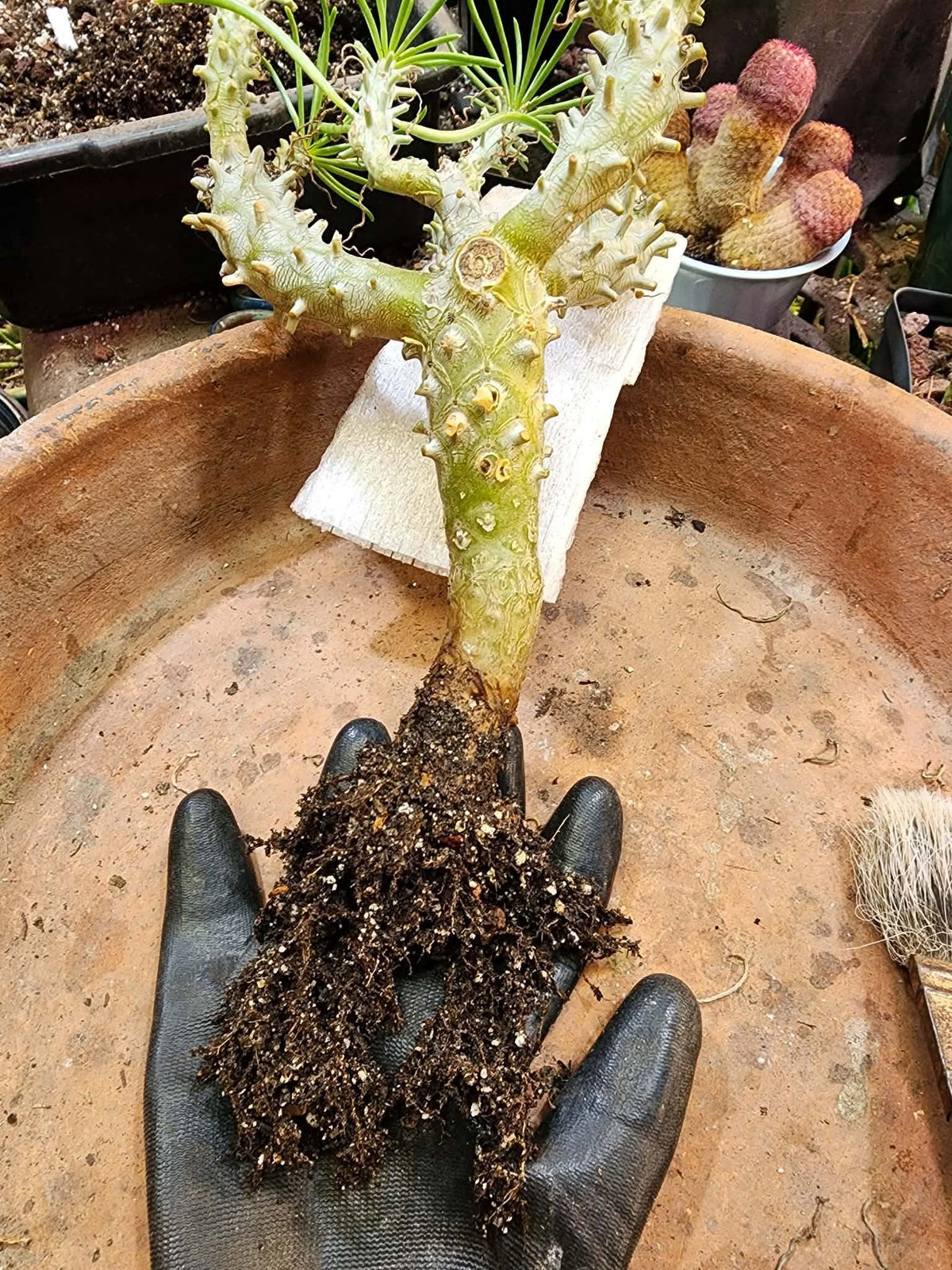
You will receive this exact specimen.
Measures approximately 13" tall above the soil line × 9" wide.
Showcased here in Handmade Pottery – Desert Basket Form No. 23 (sold separately).
Roots as shown.
Will be shipped bare root.
🌵
Tylecodon wallichii is a distinctive caudiciform succulent native to the arid and semi-arid regions of southern Africa, occurring primarily in South Africa and Namibia. A member of the Crassulaceae, it develops thickened, water-storing stems and branches adapted to surviving long periods of heat and drought.
Like many Tylecodon, this species follows a winter-growing, summer-dormant cycle. With the arrival of cooler weather, new leaves emerge from the ends of the branches and remain through the active growing season. As temperatures rise and conditions become drier, the foliage is shed, revealing the sculptural framework beneath.
This exact specimen has developed the wonderful character that makes mature Tylecodon wallichii so appealing. At approximately 13 inches tall and 9 inches wide, it is already an established, architectural plant with a substantial woody structure and an irregular branching habit. Rather than the uniform symmetry of many succulents, T. wallichii develops slowly into something resembling a miniature tree shaped by an unforgiving landscape.
Its seasonal transformation is part of the attraction. In active growth it is a leafy succulent; during dormancy, the exposed stems and branching structure become the show.
Care Instructions
☀️ Light: Provide very bright light to full sun. Strong light encourages compact growth and maintains the characteristic sturdy form. Plants moving from protected conditions should be acclimated gradually to intense direct sun.
💧 Water: Tylecodon wallichii is primarily a winter grower. Water during the cool active-growing season, allowing the soil to dry substantially between waterings. As the plant begins shedding its leaves and entering summer dormancy, reduce watering dramatically. Keep nearly dry during hot dormant conditions.
🪨 Soil: Requires an exceptionally fast-draining succulent mix with a high proportion of mineral material. Pumice, lava rock, coarse grit and similar inorganic components are ideal for maintaining excellent drainage and root aeration.
🌡️ Temperature: Best grown with mild to warm days and cooler conditions during its winter growth period. Protect from hard frost and prolonged freezing temperatures.
💨 Humidity: Prefers dry conditions and excellent air circulation. Avoid prolonged combinations of cool temperatures, high humidity and wet soil.
🌱 Growth Habit: A slow-growing, branching succulent that gradually develops a thickened woody framework. Leaves appear during the cooler growing season and are normally shed as the plant enters its warm-season dormancy.
⚠️ Special Note: Do not interpret summer leaf loss as a plant in distress. Seasonal dormancy is a normal part of the life cycle of Tylecodon wallichii. The greatest cultivation risk is continuing to water heavily after the plant has entered dormancy.
Why It Stands Out
- Established specimen approximately 13" tall × 9" wide
- Beautifully developed, architectural branching
- Fascinating winter-growing, summer-dormant life cycle
- Dramatically different appearance between growing and dormant seasons
- Slow-growing species that becomes increasingly sculptural with age
- Excellent example of southern Africa’s drought-adapted succulent flora
- Established rooted specimen
- You will receive this exact plant
Collector Notes
There is something wonderfully counterintuitive about Tylecodon wallichii.
When much of the succulent collection is waking up for summer, this plant is preparing to shut down. And when cooler weather arrives and many warm-season plants begin slowing, T. wallichii comes back to life.
That reversal is an adaptation to its native environment. Growth is timed to take advantage of the cooler portion of the year, while the plant retreats into dormancy during the hotter, drier summer period. The leaves are temporary equipment: useful when conditions favor growth, expendable when conserving moisture becomes more important.
What remains when those leaves disappear is perhaps the most interesting part of the plant.
Over many growing seasons, the persistent stems thicken, branch and weather. The plant gradually exchanges the appearance of a conventional leafy succulent for something much more architectural — a miniature woody structure whose age is written into every fork and irregularity.
This is why established Tylecodon specimens have a presence that young plants simply cannot imitate. Time is part of the plant. The branching cannot be hurried, and the character cannot be manufactured in a single growing season.
At approximately 13 inches tall and 9 inches wide, this specimen is already displaying that transition beautifully. It has enough established structure to read as a mature architectural plant while retaining the ability to change dramatically with each seasonal cycle.
And that may be the best thing about growing Tylecodon wallichii: the plant you put on the bench in January is not quite the same plant you will be looking at in July.