Skip to product information
1 of 7

Shangri-Ha Cactus Ranch

Tephrocactus Geometricus – Stacker Cactus - 3 Cladodes

Tephrocactus Geometricus – Stacker Cactus - 3 Cladodes

Regular price $85.00 USD
Regular price $85.00 USD Sale price $85.00 USD
Sale Sold out
Shipping calculated at checkout.

Tephrocactus geometricus — Stacker Cactus

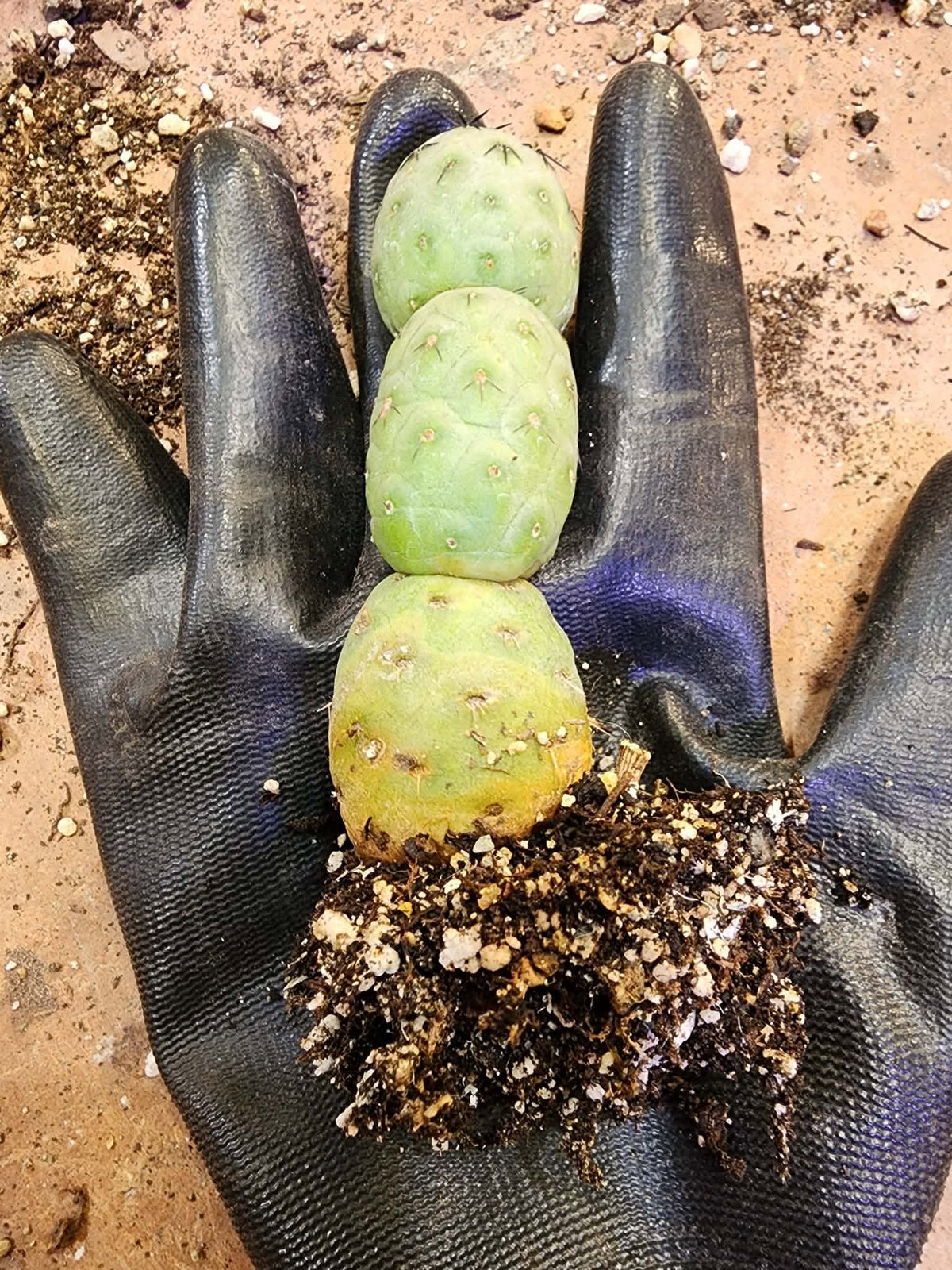
You will receive the exact specimen shown here.
Measures approximately 3.5" tall.
Showcased here in Handmade Pottery — After the Rain Planter No. 224 (sold separately).
Roots as shown.
Will be shipped bare root.

🌵

Tephrocactus geometricus is one of the most extraordinary small cacti of the high deserts of Argentina, instantly recognizable for its nearly spherical stem segments stacked one upon another in improbable geometric formations. The smooth blue-green bodies, sparse dark spines, and almost mathematical growth habit make mature specimens look less like conventional cacti than collections of stones delicately balanced by hand.

This exact specimen has developed a particularly wonderful three-segment vertical stack, reaching approximately 3.5" tall. Each rounded segment has its own shape, coloration, and sparse arrangement of areoles, creating the wonderfully precarious architecture that makes this species so sought after by collectors.

Care Instructions

☀️ Light
Provide very bright light with several hours of direct sun. Strong light encourages compact, rounded segments and the characteristic blue-green coloration. Acclimate gradually to intense sun after shipping or periods under filtered conditions.

💧 Water
Water thoroughly during active growth, then allow the soil to dry completely before watering again. Tephrocactus geometricus is exceptionally well adapted to arid conditions and should never remain wet for prolonged periods. Keep substantially drier during cold weather and dormancy.

🪨 Soil
Requires an extremely fast-draining, predominantly mineral cactus mix. Pumice, lava rock, coarse grit, decomposed granite, and similar inorganic materials are excellent choices. Excellent root aeration is particularly important.

🌡️ Temperature
Tolerates considerable temperature variation when kept dry but should be protected from prolonged hard freezes, particularly in cultivation. Cool, dry winter conditions can be beneficial, while cold combined with wet soil should be avoided.

🌬️ Humidity
Prefers dry air and excellent ventilation. In more humid climates, particularly careful watering and a highly mineral substrate help prevent prolonged moisture around the roots.

📈 Growth Habit
Produces individual rounded stem segments that arise successively and may eventually form remarkable chains or clusters. New segments often emerge from the upper portion of an existing body, creating the characteristic stacked appearance for which the plant is prized.

✍️ Special Note
The joints between segments are naturally narrow and relatively fragile. Individual segments of Tephrocactus can detach as part of the plant's natural growth and propagation strategy, so handle the specimen carefully when unpacking, repotting, or moving it.

Coloration can also shift with light, temperature, hydration, and seasonal growth. The blue-green to gray-green tones seen in well-grown plants are part of the species' natural character.

Old areoles, minor corking, natural surface marks, and evidence of previous growing seasons are normal features of collector specimens. Please review all photographs carefully, as you will receive the exact plant shown.

Why It Stands Out

  • Wonderful three-segment vertical stack
  • Approximately 3.5" tall
  • Extraordinary geometric growth habit
  • Beautiful blue-green stem coloration
  • Nearly spherical individual segments
  • Sparse, contrasting dark spines
  • Naturally sculptural architecture
  • Highly sought-after Argentine collector cactus
  • Each segment develops its own individual geometry
  • Remarkable form in an exceptionally compact plant
  • The exact specimen shown here

Collector Notes

There are cacti that grow into columns, cacti that creep across the ground, cacti that disappear almost entirely beneath it—and then there is Tephrocactus geometricus, which seems to have decided that the sensible thing to do is stack itself into a tower of balls.

The species is native to the extremely arid landscapes of northwestern Argentina, where conditions can be punishing: intense solar radiation, dramatic temperature changes, rocky mineral soils, and remarkably little dependable rainfall.

Its architecture makes considerably more sense there than it first appears to in cultivation.

Rather than producing one continuous stem, T. geometricus divides its growth into distinct, swollen segments. Each becomes a compact reservoir capable of storing water when moisture is available and enduring long intervals when it is not.

New segments emerge from older ones.

One sphere becomes two.

Two can become three.

Eventually an old plant may become an extraordinary congregation of rounded bodies—sometimes forming a chain, sometimes a sprawling cluster, and occasionally producing the beautifully improbable vertical stacks that collectors prize.

The connection between those segments is deliberately less permanent than it appears.

In habitat, detached joints can become a means of vegetative propagation. A segment separated from the parent plant may eventually root when conditions permit, turning what looks like an accident into another strategy for survival.

That helps explain the peculiar delicacy of a plant otherwise built to survive an extremely harsh landscape.

The bodies themselves are equally remarkable.

They can develop a muted blue-green to grayish surface, interrupted by widely spaced areoles and relatively sparse spination. Instead of surrounding itself with the dense defensive armor associated with many desert cacti, T. geometricus leaves much of its remarkable geometry exposed.

Older specimens can also flower spectacularly, producing surprisingly large blooms in proportion to the size of the individual segments. The effect is almost absurd: a plant constructed from small desert spheres suddenly producing a flower that seems far too extravagant for the architecture supporting it.

But perhaps the most compelling feature is simply the passage of time made visible.

Each additional segment represents another successful period of growth. A stacked specimen is therefore not merely taller—it has accumulated a sequence of distinct bodies, each produced at a different point in the plant's history.

This specimen has reached three.

And because the individual segments are not perfectly identical, the stack doesn't feel manufactured. One leans slightly differently from another. One carries a different distribution of areoles. The proportions shift as the eye travels upward.

That imperfection is what makes the geometry so good.

At only approximately 3.5" tall, this little plant manages to possess the architecture of something much larger: three rounded bodies balanced one above another, looking simultaneously engineered and precarious.

A tiny tower built slowly in one of the driest landscapes in South America—and a particularly beautiful example of why Tephrocactus geometricus has become one of the most recognizable small collector cacti in cultivation.

View full details