Shangri-Ha Cactus Ranch
Opuntia Cochenillifera ‘Sunburst’ Variegata
Opuntia Cochenillifera ‘Sunburst’ Variegata
Couldn't load pickup availability
Opuntia cochenillifera ‘Sunburst’ Variegata — Variegated Prickly Pear
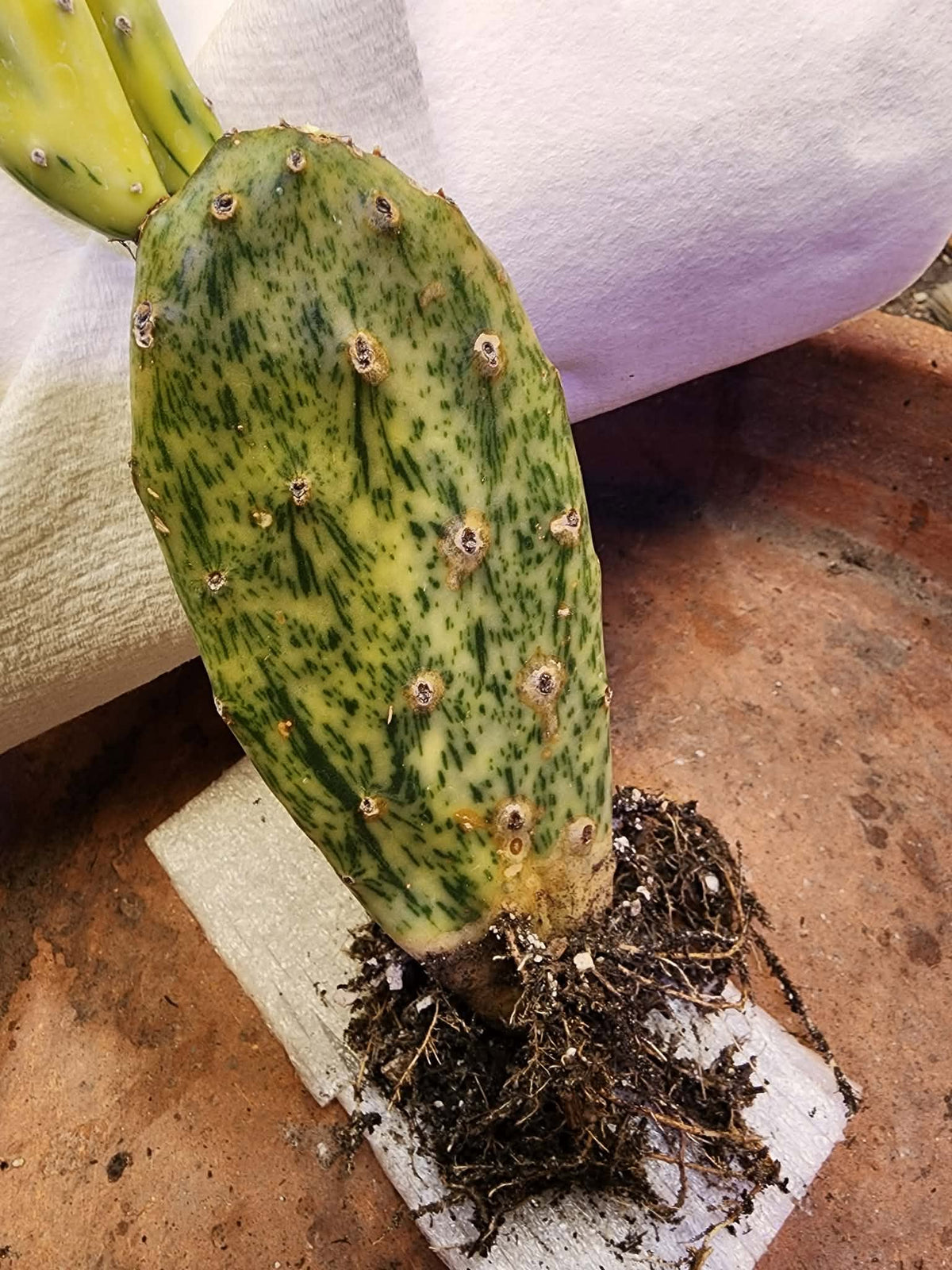
You will receive this exact specimen.
Measures 10.5" tall above the soil line.
Showcased here in Handmade Pottery — Moss Fragment Vessel No. 143 (sold separately).
Roots as shown.
Will be shipped bare root.
🌵
Opuntia cochenillifera ‘Sunburst’ Variegata is a spectacular variegated selection distinguished by broad, flattened pads splashed and streaked with cream, yellow, pale green, and deeper green. Unlike the uniform coloration of the typical species, every new pad has the potential to develop its own arrangement of variegation, making mature plants increasingly complex as they branch and build their characteristic prickly pear silhouette.
This exact specimen stands approximately 10.5" tall above the soil line and has already developed the strong architectural character that makes ‘Sunburst’ so effective as a collector plant. Its irregular variegation creates a striking contrast between areas rich in chlorophyll and luminous sections of cream and yellow, while the stacked pads give the plant a distinctly sculptural, almost abstract appearance.
Care Instructions
☀️ Light
Provide very bright light to full sun for strong, compact growth and good variegation. Because pale variegated tissue contains less protective pigment, acclimate gradually to intense direct sun, particularly after shipping or a period under filtered light. Excellent light is important for maintaining vigorous growth and strong coloration.
💧 Water
Water thoroughly during active warm-season growth, then allow the soil to dry completely before watering again. Reduce watering substantially during cooler months. Established Opuntia are highly drought tolerant and are far more vulnerable to prolonged wet soil than to brief periods of dryness.
🪨 Soil
Use an exceptionally fast-draining cactus mix with generous mineral content. Pumice, lava, coarse grit, and similar inorganic materials help maintain the aeration and drainage necessary for healthy roots. Avoid dense, moisture-retentive soil.
🌡️ Temperature
Thrives in warmth and active summer conditions. Protect from hard frost and prolonged cold, especially when container grown. Variegated growth may be more sensitive to environmental extremes than fully green growth.
🌬️ Humidity
Prefers relatively dry conditions with excellent air circulation. Avoid prolonged cool humidity or stagnant moisture around the pads and root zone.
📈 Growth Habit
Develops through successive flattened pads, gradually branching into a shrubby or tree-like form under favorable conditions. New pads emerge from areoles along established growth and can vary dramatically in their distribution of green and variegated tissue.
✍️ Special Note
Variegation is naturally variable. Individual pads may contain dramatically different proportions and patterns of green, cream, and yellow, and future growth cannot be expected to reproduce the markings of any particular existing pad exactly. This unpredictability is an important part of the appeal of established ‘Sunburst’ specimens.
As with any mature collector cactus, natural surface marks, scars, corking, changes in coloration, and evidence of previous growing seasons are part of the specimen's history rather than imperfections. Please review all photographs carefully, as you will receive the exact plant shown.
Why It Stands Out
- Exact collector specimen shown
- Impressive 10.5" height above the soil line
- Highly variegated ‘Sunburst’ selection
- Striking cream, yellow, and green coloration
- Each pad displays its own individual pattern
- Strong stacked-pad architecture
- Beautiful contrast between chlorophyll-rich and pale tissue
- Established branching growth
- Excellent sculptural silhouette
- Variegation becomes increasingly complex as the plant develops
- Strong established root system
- The exact specimen shown here
Collector Notes
Opuntia cochenillifera belongs to one of the most instantly recognizable groups of cacti: the prickly pears. Rather than producing cylindrical or globular stems, Opuntia develops flattened stem segments known as cladodes, or pads. Each pad functions as both stem and photosynthetic surface, and successive pads create the branching architecture of the mature plant.
The species has a long and particularly interesting botanical and cultural history. Native to tropical regions of the Americas and widely cultivated beyond its original range, O. cochenillifera has historically been associated with the cultivation of cochineal insects, whose bodies were harvested to produce the extraordinarily important crimson dye known as cochineal.
‘Sunburst’ transforms the familiar green architecture of the species through variegation.
Instead of a continuous field of chlorophyll, the pads are broken into irregular territories of green, yellow, cream, and intermediate shades. Sometimes the colors appear as broad sectors; elsewhere they form streaks, marbling, islands, or irregular transitions across the surface.
Because each new pad develops independently, the composition never truly repeats itself.
That makes a mature variegated Opuntia especially interesting. A single plant can carry pads from several generations of growth, each recording a different expression of the same underlying variegation. One pad may be predominantly green with a flash of yellow, while the next may reverse the balance almost completely.
The green portions are also more than decorative contrast. They contain the chlorophyll responsible for most of the plant's photosynthesis, while heavily cream or yellow areas possess substantially less. A beautifully balanced specimen therefore becomes an interplay between the plant's ornamental mutation and the green tissue that supports continued vigorous growth.
At 10.5" tall above the soil line, this specimen has progressed beyond the simplicity of a single rooted pad and begun to display the branching, layered character for which mature prickly pears are known. The overlapping planes create changing silhouettes depending upon the viewing angle, while the variegation prevents any two sections from reading alike.
Bright, architectural, unpredictable, and unmistakably Opuntia, this ‘Sunburst’ demonstrates why variegated prickly pears become increasingly compelling with age: every new pad adds another variation to a pattern the plant never repeats exactly.