Shangri-Ha Cactus Ranch
Myrtillocactus geometrizans ‘Fred’ Variegata — Crested & Monstrose | Collector Specimen
Myrtillocactus geometrizans ‘Fred’ Variegata — Crested & Monstrose | Collector Specimen
Couldn't load pickup availability
Myrtillocactus geometrizans ‘Fred’ Variegata — Crested & Monstrose
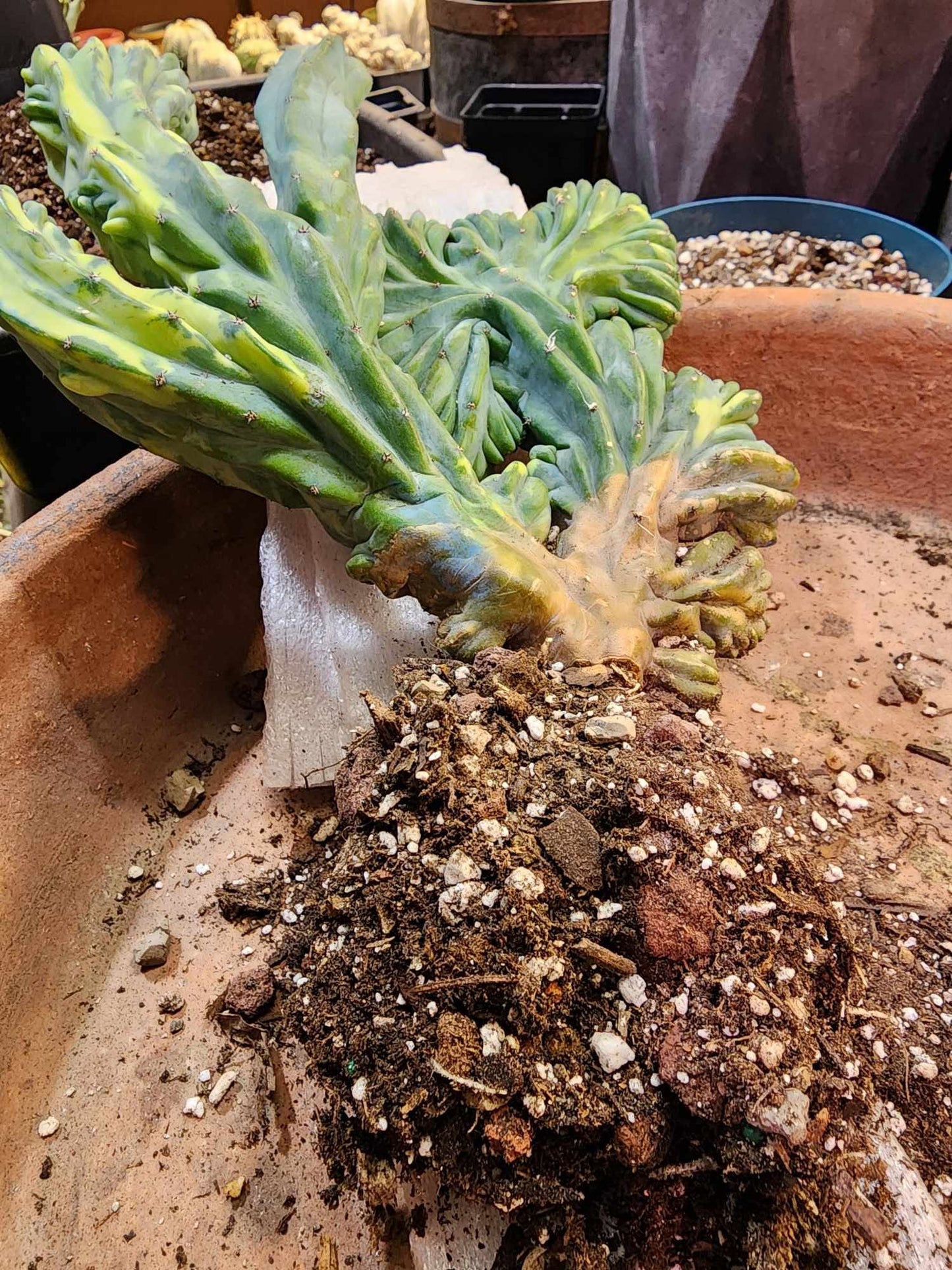
You will receive this exact, large specimen!
Measures 8" wide x 7.5" tall.
Roots as shown.
Showcased here in Handmade Pottery – Aqueduct Relic Bowl No. 174 (sold separately).
Will be shipped bare root.
🌵
Myrtillocactus geometrizans ‘Fred’ is one of the most wonderfully bizarre mutations of the familiar Blue Myrtle Cactus, prized by collectors for growth that abandons the normal architecture of the species almost entirely. This exceptional variegated specimen displays both crested and monstrose growth, producing broad, intricately folded fans alongside elongated, irregular sculptural stems. The result is an extraordinary mass of ridges, folds, twists, and unpredictable growing points, all washed in the beautiful blue-green coloration characteristic of Myrtillocactus geometrizans and streaked with vivid yellow to chartreuse variegation. At an impressive 8" wide x 7.5" tall, this is already a substantial and highly individual collector specimen—one whose combination of fasciation, monstrose growth, variegation, and mature sculptural form makes it especially unusual.
Care Instructions
☀️ Light
Very bright light to partial or full sun. Strong light helps maintain compact growth, blue-green coloration, and pronounced variegation. Because the yellow portions contain reduced chlorophyll and can be more susceptible to sunburn, acclimate gradually to intense direct sunlight.
💧 Water
Water thoroughly during active growth, then allow the soil to dry completely before watering again. Reduce watering substantially during cooler months and keep quite dry in winter. Crested and monstrose growth can create folds and recessed areas where moisture may linger, so avoid allowing water to remain trapped within the plant.
🪨 Soil
Requires a very fast-draining cactus mix with substantial mineral content and excellent aeration around the roots. Avoid dense or moisture-retentive soils.
🌡️ Temperature
Protect from frost and prolonged cold. This Mexican cactus performs best in warm conditions during active growth and should be kept considerably drier when temperatures are cool.
🌬️ Humidity
Prefers relatively dry conditions with excellent air circulation. Good airflow is especially important around the densely folded crested portions of the plant.
📈 Growth Habit
Highly unpredictable. Unlike normal Myrtillocactus geometrizans, ‘Fred’ produces distorted monstrose growth rather than conventional columnar stems. This specimen additionally exhibits pronounced fasciation, creating broad crested sections alongside irregular monstrose branches. New growth may continue in either form—or shift between them—as the plant develops, making every mature specimen completely individual.
✍️ Special Note
This specimen combines three particularly desirable characteristics: variegation, monstrose growth, and cresting. Because these mutations disrupt normal growth patterns, individual sections may develop at different rates and future growth cannot be predicted precisely. Variegation may also vary from one growing point to another. These changes are part of the character of the plant and are precisely what make mature ‘Fred’ specimens so fascinating to grow.
Why It Stands Out
- Exceptional 8" wide x 7.5" tall collector specimen
- Both crested and monstrose growth
- Beautiful blue-green epidermis
- Dramatic yellow and chartreuse variegation
- Multiple irregular growing points
- Broad, intricately folded crested sections
- Sculptural elongated monstrose growth
- Every ‘Fred’ develops completely differently
- A particularly unusual form of an already extraordinary cultivar
Collector Notes
The ordinary Myrtillocactus geometrizans is a large, branching columnar cactus native to Mexico, but ‘Fred’ bears remarkably little resemblance to the conventional form of the species. Its mutation disrupts normal stem development, replacing orderly ribs and columns with unpredictable folds, knobs, ridges, and distorted growing points. Crested growth introduces another layer of mutation: rather than maintaining a single conventional growing point, the apex becomes elongated through fasciation, producing the extraordinary fanlike structures visible throughout this specimen.
What makes this particular plant especially compelling is the coexistence of those different growth expressions. Dense crested fans sweep and fold through the center while elongated monstrose stems emerge around them, and the entire structure is animated by irregular streaks and patches of yellow-green variegation against the naturally glaucous blue-green body. There is no predetermined mature shape for a plant like this. Each new growing point can alter the composition, producing a specimen that becomes increasingly individual with age. At 8" wide x 7.5" tall, this ‘Fred’ has already developed into a remarkable living sculpture—and its next move is entirely its own.