Shangri-Ha Cactus Ranch
Myrtillocactus geometrizans cv. 'Strictum' f. cristata - Crested Specimen - Last one!
Myrtillocactus geometrizans cv. 'Strictum' f. cristata - Crested Specimen - Last one!
Couldn't load pickup availability
Myrtillocactus geometrizans cv. ‘Strictum’ f. cristata — Crested Specimen
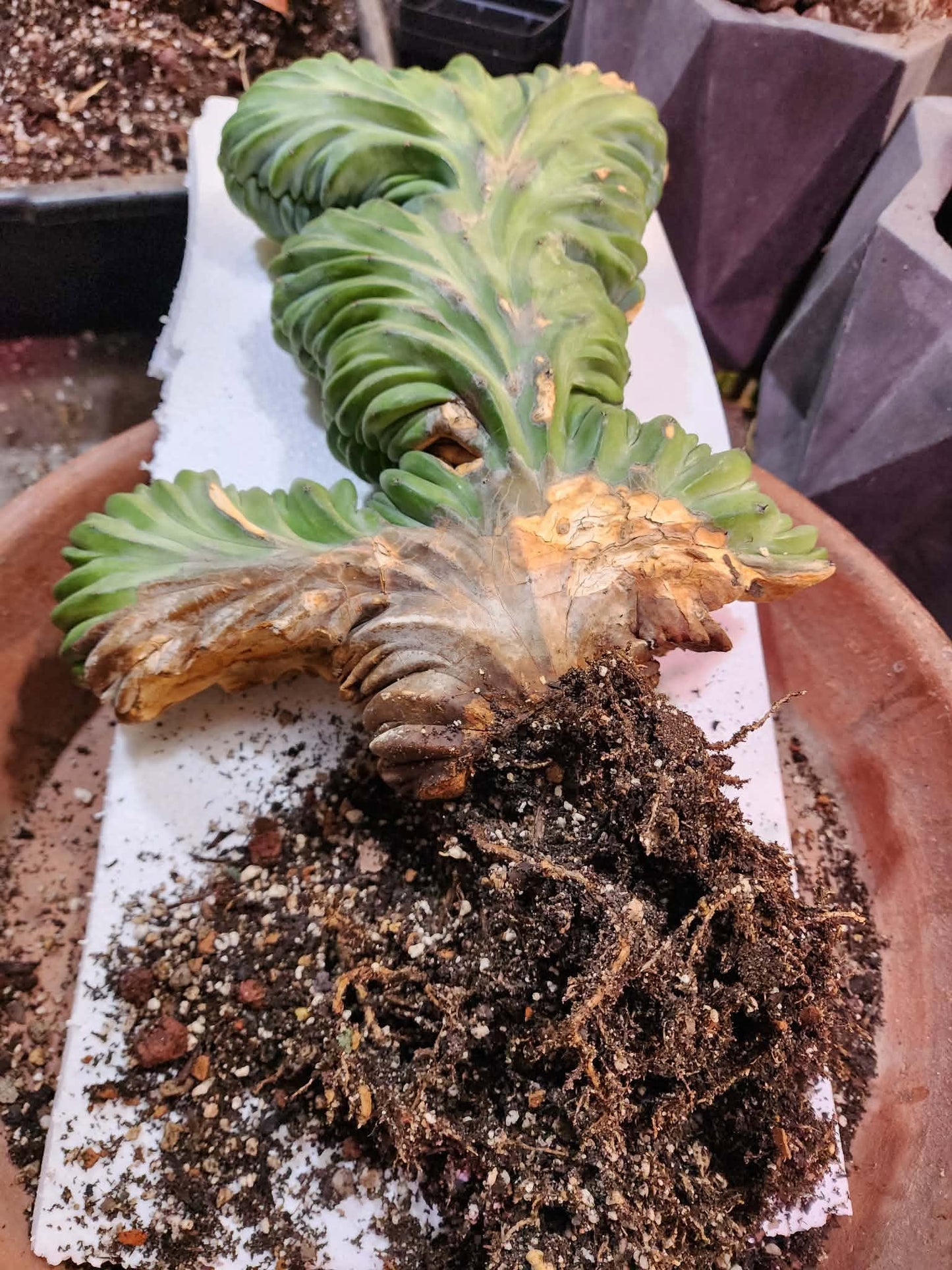
You will receive this exact specimen.
Measures 9.5" wide × 12" tall above the soil line.
This is a LARGE and substantial specimen and will be a little expensive to ship.
Showcased here in Handmade Pottery - Canyon Grid Vessel No. 47 (sold separately).
Roots as shown.
Will be shipped bare root.
🌵
Myrtillocactus geometrizans cv. ‘Strictum’ f. cristata is a striking crested form of the Mexican columnar cactus commonly known as Blue Myrtle Cactus. Rather than maintaining the conventional upright growing point of the species, cristate growth causes the apical meristem to elongate laterally, producing expanding ridges, folds, fans, and densely packed sculptural growth. In ‘Strictum’, that already unusual development is expressed through a particularly compact, strongly organized structure.
This is a substantial established specimen measuring approximately 7.5" wide × 12" tall above the soil line. Its crest has developed into a complex vertical mass of tightly arranged folds, with individual growing ridges rising, dividing, and pressing against one another. The result is an exceptionally architectural plant whose form changes dramatically depending upon the viewing angle.
Care Instructions
☀️ Light
Very bright light to full sun. Strong light helps maintain compact growth, good coloration, and well-defined crest development. Acclimate gradually to intense direct sunlight after shipping, particularly if the plant has previously been grown under filtered light.
💧 Water
Water thoroughly during active warm-season growth, then allow the soil to dry completely before watering again. Reduce watering substantially during cooler months. Crested specimens should never remain in persistently damp soil, particularly when temperatures are low.
🪨 Soil
Requires an exceptionally fast-draining cactus mix with substantial mineral content. Pumice, lava, coarse grit, and similar inorganic materials provide excellent drainage and root aeration. Avoid dense, organic, or moisture-retentive mixes.
🌡️ Temperature
Prefers warm, dry growing conditions. Protect from hard frost and prolonged cold, especially when container grown. During winter dormancy or periods of cool weather, keep the root system considerably drier.
🌬️ Humidity
Best grown in relatively dry conditions with excellent air circulation. Dense crested growth can create small protected areas between folds where moisture lingers, making good airflow especially useful.
📈 Growth Habit
Unlike normal Myrtillocactus geometrizans, which develops upright columnar stems and eventually branches into a large candelabra-like plant, forma cristata produces an elongated growing point. The resulting crest expands through irregular fans, ridges, folds, and occasional branching or reversion. No two mature crested specimens develop exactly alike.
✍️ Special Note
The botanical term cristata refers to crested growth, an unusual developmental condition in which the normally concentrated growing point becomes elongated. Instead of producing a single cylindrical stem, the plant continues growth along an extended line, creating the characteristic fans, waves, folds, and convoluted ridges seen in this specimen.
Crested plants naturally change form as they grow. Sections may thicken, divide, overlap, produce new crested branches, or occasionally develop normal columnar shoots. These changes are part of the living architecture of a cristate cactus rather than defects. Please review all photographs carefully, as you will receive the exact plant shown.
Why It Stands Out
- Large, established crested specimen
- Impressive 12" height above the soil line
- Broad 7.5" sculptural crest
- Unusual cv. ‘Strictum’ form
- Dense, strongly vertical crest development
- Multiple folded and dividing growing ridges
- Beautiful blue-green Myrtillocactus coloration
- Dramatic architectural silhouette
- Mature crest structure developed over years of growth
- Every viewing angle reveals a different formation
- Established root system
- The exact specimen shown here
Collector Notes
Myrtillocactus geometrizans is native to Mexico and is one of the country's characteristic large columnar cacti. In habitat, the species can develop into a substantial tree-like plant composed of numerous blue-green branches, eventually forming the distinctive candelabra architecture for which mature specimens are known.
The genus name Myrtillocactus refers to the resemblance of its small edible fruits to those of Myrtillus—the European bilberry or whortleberry—while geometrizans alludes to the remarkably regular geometric construction of the stems. That geometry is particularly evident in normal plants, where the ribs, areoles, and branching columns create a highly ordered structure.
Cresting radically alters that geometry.
A conventional Myrtillocactus geometrizans stem grows from a relatively compact apical meristem at its tip. In forma cristata, that growing region becomes elongated into a line. As growth continues simultaneously along that expanded meristem, the plant can no longer maintain an ordinary cylindrical column. The growing edge instead begins to curve, buckle, divide, and fold around itself.
Over time, those simple folds can become extraordinarily complicated.
Older crested specimens may develop entire landscapes of growth—parallel ridges beside tightly compressed valleys, broad fans that divide into smaller crests, and vertical sections that twist away from the original plane. New growth continually modifies what came before it, so the architecture of a mature crest becomes a physical record of years of development.
The cultivar designation ‘Strictum’ is associated with a more compact, strongly upright expression, and when combined with cristate growth it can produce an especially architectural plant. Rather than forming one broad, relatively flat fan, specimens may build upward through a dense congregation of narrow crested ridges.
That character is particularly evident in this 12" tall specimen.
From its relatively narrow base, the plant rises into an increasingly complex crown of vertical folds. Individual ridges compete for space as they ascend, producing a remarkably dense arrangement of blue-green tissue, repeating areoles, shadows, channels, and irregular growing edges.
And because a crest is never truly finished, its present shape is only one stage in the plant's development. Future growth may extend existing ridges, divide them, create entirely new folds, or redirect portions of the crest in unexpected ways.
That unpredictability is much of the appeal of collecting cristate cacti: the genetics establish the possibility, but time creates the sculpture.
At 12" tall and 9.5" wide, this established Myrtillocactus geometrizans cv. ‘Strictum’ f. cristata has already moved well beyond the small crested starts commonly encountered in cultivation. Dense, mature, beautifully blue-green, and extraordinarily dimensional, it is a living piece of cactus architecture—and the exact specimen shown here.