Shangri-Ha Cactus Ranch
Monadenium schubei ‘Tanzania Red’
Monadenium schubei ‘Tanzania Red’
Couldn't load pickup availability
Monadenium schubei ‘Tanzania Red’ — Rare Dark-Foliaged African Succulent
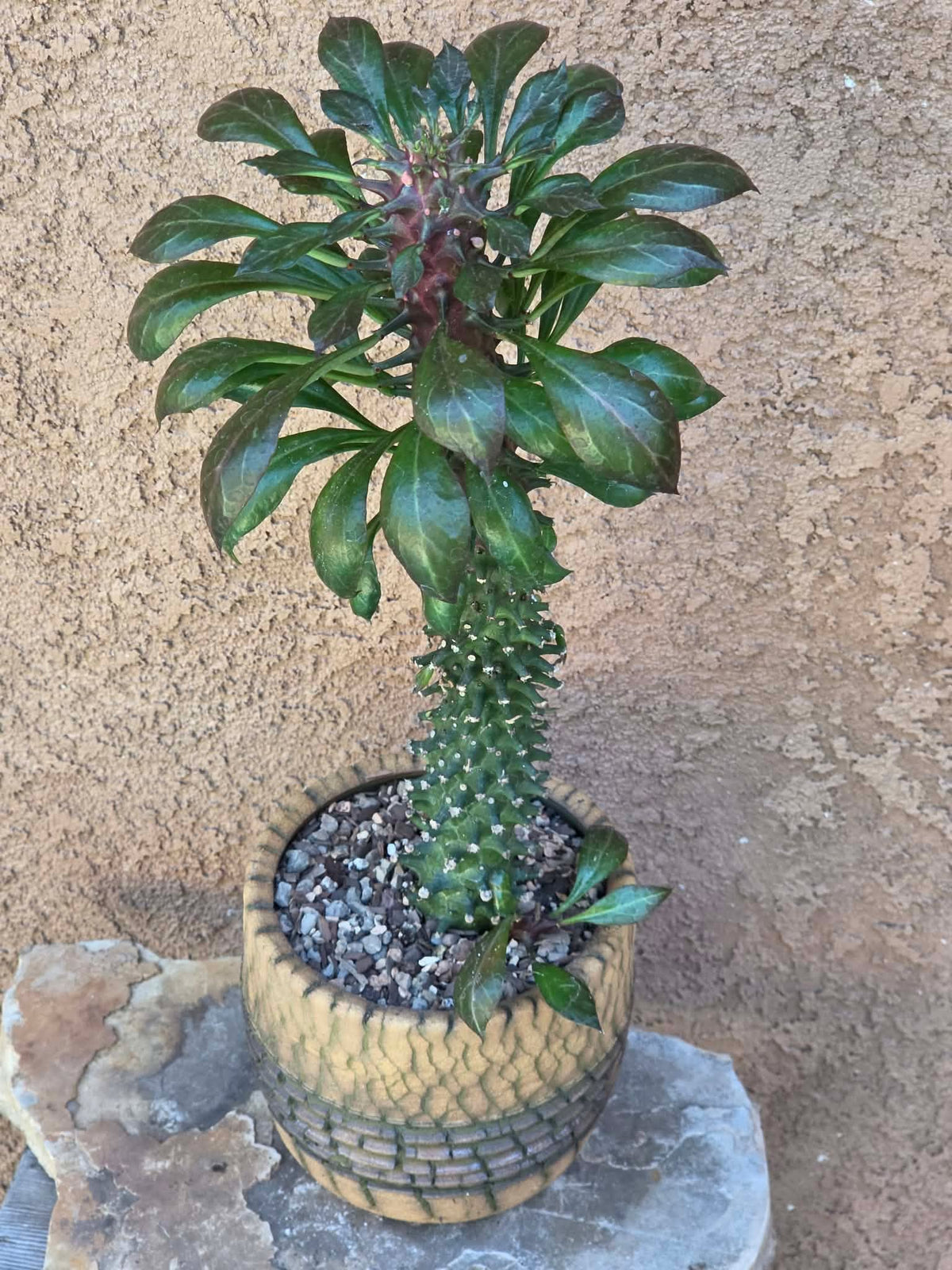
You will receive this exact specimen.
Measures approximately 15" tall above the soil line.
Features a tall, heavily tuberculate succulent stem crowned with striking dark burgundy-purple foliage and reddish new growth.
Roots as shown.
Showcased here in one-of-a-kind Handmade Pottery — Sage Ridge Planter No. 84 (sold separately).
Will be shipped bare root.
🌵
Monadenium schubei ‘Tanzania Red’ is an extraordinary horticultural selection of an unusual East African succulent, distinguished by its heavily textured upright stem and dramatic, dark-colored foliage. Traditionally classified within the genus Monadenium, these plants are now generally included within the broader genus Euphorbia, reflecting modern botanical understanding of their evolutionary relationships. The plant combines two strikingly different structural elements: a tall, fleshy, tuberculate stem armed with short projections and a terminal crown of relatively broad leaves that may develop rich burgundy, purple, and reddish coloration. This unusual combination gives the species a distinctive appearance, quite unlike the more familiar columnar or globular succulents commonly encountered in cultivation.
This exact specimen is particularly impressive for its 15-inch height, strongly defined vertical stem, and richly colored terminal foliage. The upright green stem is densely covered with elongated, tooth-like tubercles arranged in irregular vertical patterns, creating a rugged, almost prehistoric surface texture. Toward the upper portion, the stem becomes darker and more purplish, providing a beautiful transition into the crown of leaves. The foliage displays an extraordinary combination of deep green, burgundy, and nearly black-purple tones, with fresh reddish growth concentrated near the apex. Several leaves extend outward in an irregular, radiating arrangement, giving the plant a striking architectural silhouette. Its dramatic contrast between the spiny lower structure and dark, leafy crown makes this a particularly compelling individual specimen.
Care Instructions
☀️ Light
Provide abundant bright light with gentle direct morning sunlight or strong filtered sun. Good illumination encourages compact growth and helps maintain the rich burgundy and purple coloration associated with the ‘Tanzania Red’ selection. Protect from sudden exposure to intense afternoon sunlight, particularly during extreme heat, as the leaves may be susceptible to scorching. Gradually acclimate the plant to brighter conditions after shipping or relocation.
💧 Water
Water thoroughly during active warm-season growth, allowing the growing medium to dry substantially between waterings. The presence of leaves and active new growth generally indicates increased moisture requirements, although the succulent stem provides some water storage. Reduce watering significantly when temperatures cool or the plant begins shedding foliage. During dormancy, maintain predominantly dry conditions, providing only occasional moisture when necessary to prevent excessive dehydration. Avoid prolonged saturation around the roots and lower stem.
🪨 Soil
Requires a highly porous, fast-draining succulent medium with excellent root aeration. A mineral-rich mixture containing pumice, lava rock, coarse grit, or similar inorganic components is recommended, with a modest proportion of organic material to support healthy root development. The medium should drain rapidly while retaining enough moisture for active seasonal growth. Avoid dense, compacted, or persistently wet soils.
🌡️ Temperature
Prefers warm growing conditions and protection from frost. As a conservative cultivation precaution, maintain temperatures above approximately 55°F (13°C), especially when the growing medium contains moisture. Avoid prolonged exposure to cold, damp conditions and sudden temperature extremes. Warm days and moderate nighttime temperatures encourage healthy foliage development and active stem growth.
🌬️ Humidity
Average household humidity is generally suitable when accompanied by good air circulation. The leafy crown may appreciate moderate atmospheric humidity during active growth, but avoid stagnant, excessively humid conditions, particularly during cooler weather. Good airflow around the foliage and stem helps reduce the risk of fungal problems and moisture-related deterioration.
📈 Growth Habit
An upright, succulent-stemmed plant that develops a distinctive cylindrical to somewhat angular body densely covered with elongated tubercles and short spine-like projections. Leaves are concentrated primarily toward the actively growing upper portions, creating a pronounced contrast between the rugged stem and comparatively delicate foliage. The ‘Tanzania Red’ selection is valued for its dark burgundy-purple leaf coloration and reddish new growth. With maturity, the plant may become taller and develop additional structural complexity, while seasonal foliage changes can substantially alter its appearance.
✍️ Special Note
The rich foliage coloration of ‘Tanzania Red’ may vary with light intensity, temperature, seasonal activity, and growing conditions. New leaves may emerge with reddish or purple tones and change as they mature. Seasonal leaf loss is possible and does not necessarily indicate declining health. The prominent tubercles and short projections along the stem are natural features of the plant's growth habit. As with other members of the Euphorbia group, damaged tissue may release irritating, potentially toxic milky latex. Wear gloves when handling damaged portions and avoid contact with skin and eyes. Protect the leafy crown during shipping and repotting, as the leaves may be more delicate than the succulent stem.
Why It Stands Out
- Unusual Monadenium schubei ‘Tanzania Red’ — distinctive East African succulent selection
- Impressive upright specimen measuring approximately 15" tall above the soil line
- Extraordinary crown of deep burgundy-purple and nearly black foliage
- Fresh reddish new growth concentrated near the apex
- Strong contrast between the dark leafy crown and bright green succulent stem
- Dense, elongated tubercles creating a rugged, heavily textured stem surface
- Interesting progression from green lower growth to darker purple upper tissue
- Beautifully irregular, radiating arrangement of terminal leaves
- Distinctive architectural silhouette combining spiny succulent structure and broad foliage
- Fascinating example of the unusual growth forms traditionally classified within Monadenium
- Seasonal foliage changes that contribute to the plant's evolving appearance
- Showcased in one-of-a-kind Handmade Pottery — Sage Ridge Planter No. 84 (sold separately)
- Exceptional addition to a specialized collection of African Euphorbias and unusual dark-foliaged succulents
Collector Notes
Monadenium schubei belongs to a fascinating group of succulent plants historically recognized within the genus Monadenium, a collection of predominantly African species characterized by unusual stem structures, specialized inflorescences, and diverse growth habits. Modern botanical treatments generally place these plants within the broader genus Euphorbia, reflecting their close evolutionary relationships with other members of the Euphorbiaceae family. Despite these taxonomic changes, the name Monadenium remains widely used among succulent collectors and specialist nurseries, particularly for plants whose distinctive architecture and foliage separate them visually from more conventional Euphorbia species.
The species is associated with tropical East Africa, including Tanzania, a region whose varied landscapes support an extraordinary diversity of succulent and drought-adapted plants. East African habitats range from open grasslands and rocky slopes to seasonally dry woodland and more sheltered environments, creating numerous ecological opportunities for specialized plant growth forms. Succulent Euphorbias and their relatives have evolved a remarkable assortment of adaptations to these conditions, including fleshy stems, reduced or seasonal foliage, protective projections, and unusual reproductive structures. The combination of a water-storing stem and a comparatively leafy crown is one of the particularly interesting expressions of this diversity.
One of the most distinctive characteristics of Monadenium schubei is its heavily tuberculate stem. Rather than developing smooth cylindrical surfaces or broad, continuous ribs, the plant produces numerous elongated projections that extend outward from the fleshy body. These tubercles create a rugged, sharply articulated surface, with small spine-like structures and leaf-related features appearing at intervals along the stem. Their arrangement gives the plant an almost armored appearance, particularly where the projections are closely spaced. This structural organization is an important part of the species' ornamental character and distinguishes it from many more familiar succulent Euphorbias.
The stem also serves an essential physiological function. Its fleshy tissues provide water storage, allowing the plant to endure periods when moisture availability is reduced. The relatively compact, upright form minimizes the extensive branching and broad leaf area associated with many non-succulent shrubs, while the seasonal crown of leaves provides additional photosynthetic capacity during favorable growing conditions. This combination of succulent storage tissue and temporary foliage represents an effective strategy for plants inhabiting environments where rainfall and temperature may vary considerably throughout the year.
The ‘Tanzania Red’ selection introduces an especially dramatic ornamental characteristic: richly colored foliage in shades of burgundy, purple, and nearly black. While many succulent plants are cultivated primarily for stem shape, spination, or unusual growth patterns, this selection offers the additional appeal of strongly contrasting leaf coloration. The darkest leaves can appear almost black under certain lighting conditions, while younger growth may display brighter reddish or purple tones. These colors create a striking visual contrast against the green succulent stem and contribute to the plant's distinctive appearance.
This exact specimen is particularly beautiful for the relationship between its tall, textured stem and dramatic terminal crown. Measuring approximately 15" tall above the soil line, the plant has developed a strong vertical presence, with the lower portion densely covered in prominent tubercles. The projections are especially visible along the middle of the stem, where their repeating shapes create an intricate pattern of light and shadow. As the stem approaches the upper growth, its coloration becomes darker, gradually transitioning into the richly colored leafy crown.
The foliage itself forms an irregular arrangement of outward-reaching leaves, with some extending almost horizontally while others angle upward or downward. Their elongated, somewhat pointed shapes create a lively silhouette that contrasts with the rigid vertical organization of the stem. Several leaves display deep green upper surfaces with pronounced burgundy or purple coloration, while others appear nearly black in the photograph. The newest growth near the apex introduces brighter reddish tones, creating an attractive progression of color and maturity within a relatively compact crown.
The seasonal nature of the foliage adds another dimension to the plant's character. Depending on growing conditions, temperature, and moisture availability, the leafy crown may become fuller during active growth or diminish as the plant enters dormancy. During periods of reduced activity, the rugged succulent stem becomes more visually prominent, revealing the intricate arrangement of tubercles and spine-like projections. When new growth resumes, fresh foliage can introduce renewed color and movement to the upper portion. This changing relationship between stem and leaves makes the plant particularly rewarding to observe throughout its seasonal cycle.
Like other members of the Euphorbia group, plants traditionally classified as Monadenium possess specialized reproductive structures known as cyathia. These are distinctive inflorescences composed of highly reduced flowers arranged within a specialized cup-like structure. The reproductive morphology of Monadenium species was historically important in distinguishing them from other Euphorbias, although modern taxonomic studies have demonstrated their close evolutionary relationships. While flowers are not a prominent feature of this photograph, the genus's unusual reproductive biology contributes considerably to its botanical interest.
The specimen's presentation in one-of-a-kind Handmade Pottery — Sage Ridge Planter No. 84 creates a particularly beautiful contrast between plant and vessel. The planter features an extraordinary combination of turquoise, celadon green, and earthy olive tones, with raised, irregular glaze formations that resemble mineral deposits or weathered stone. These textured surfaces complement the rugged tubercles of the succulent stem while providing a striking color contrast to the dark burgundy-purple foliage. The vessel's broad upper rim and gently tapered form also balance the plant's tall, slender silhouette, creating a cohesive sculptural composition.
For collectors of unusual African succulents, this exact Monadenium schubei ‘Tanzania Red’ offers a remarkable combination of impressive vertical growth, heavily textured stem architecture, dramatic dark foliage, and vivid reddish new growth. Its 15-inch height gives it substantial presence, while the contrast between the rugged lower stem and leafy upper crown creates an unusually expressive silhouette. The rich coloration, distinctive tubercles, and individual arrangement of leaves make this a particularly compelling specimen for a specialized collection of Euphorbias, Monadeniums, and other extraordinary succulent plants.