Shangri-Ha Cactus Ranch
Melocactus bahiensis sap. amethystinus – Turk’s Cap Cactus
Melocactus bahiensis sap. amethystinus – Turk’s Cap Cactus
Couldn't load pickup availability
Melocactus bahiensis ssp. amethystinus — Turk’s Cap Cactus
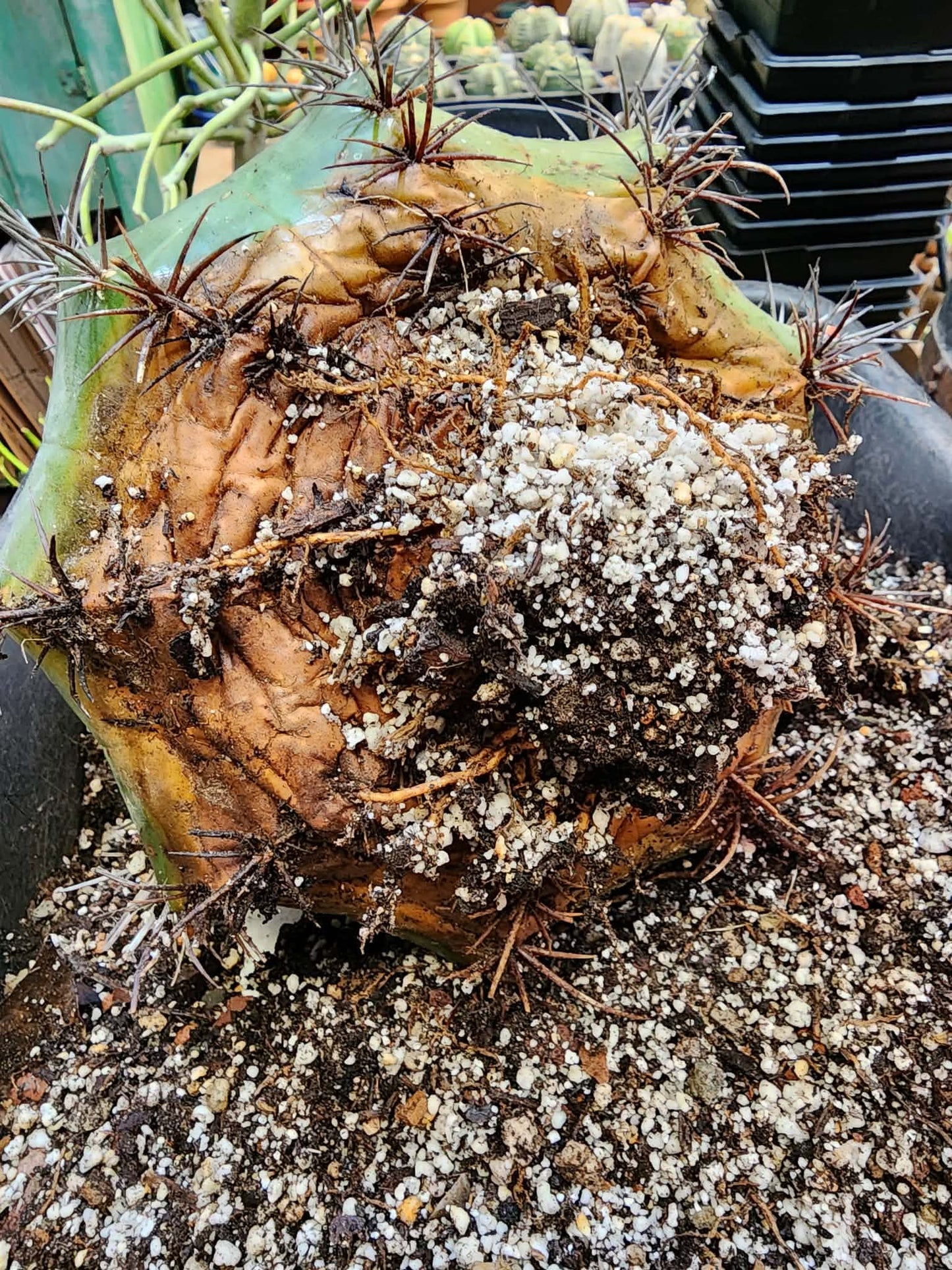
You will receive this exact specimen.
Measures 8.5" wide × 7" tall.
Showcased here in Handmade Pottery — Woven Earth Bowl No. 44 (sold separately).
Roots as shown.
Will be shipped bare root.
🌵
Melocactus bahiensis ssp. amethystinus is a remarkable Brazilian cactus belonging to one of the most distinctive genera in the entire cactus family. Young plants grow as handsome ribbed globes, but maturity brings an extraordinary transformation: the ordinary vegetative body eventually stops producing new ribs at its apex and begins constructing an entirely different structure—the dense, woolly cephalium from which all future flowers and fruits will emerge.
This is a large, beautifully developed specimen measuring approximately 8.5" wide × 7" tall, with a broad blue-green body, strongly defined ribs, and mature established architecture. Its substantial size gives it tremendous presence even before considering the unusual life cycle for which Melocactus is famous.
Care Instructions
☀️ Light
Very bright light with several hours of direct sun is ideal. Strong light encourages compact growth, pronounced ribs, and good spine development. In extremely hot climates, some protection from the most intense afternoon sun can be beneficial. Acclimate gradually after shipping.
💧 Water
Water thoroughly during active warm-season growth, then allow the soil to dry substantially before watering again. Melocactus should not remain continuously wet, but established plants generally appreciate somewhat more consistent warm-season moisture than extremely xeric desert cacti. Reduce watering considerably during cooler weather without allowing the root system to remain cold and saturated.
🪨 Soil
Requires an exceptionally fast-draining cactus mix with substantial mineral content. Pumice, lava, coarse grit, and similar inorganic materials provide excellent drainage and aeration. Good root-zone conditions are particularly important for mature Melocactus, which can resent root disturbance.
🌡️ Temperature
Prefers warmth and should be protected from frost. Melocactus originates in tropical and subtropical environments and is generally less tolerant of prolonged cold than many familiar North American desert cacti. Keep warm and substantially drier during winter.
🌬️ Humidity
Tolerates moderate humidity when combined with warmth, excellent drainage, and good air circulation. Avoid the combination of cold temperatures and prolonged moisture.
📈 Growth Habit
Begins life as a conventional globose to short-columnar cactus, gradually increasing in diameter and rib development. Once the plant reaches reproductive maturity, ordinary growth at the apex changes dramatically and the plant begins producing a cephalium—a specialized flowering structure composed of densely packed wool and bristles. From that point forward, flowers and fruits are produced from the cephalium rather than directly from the ordinary green stem.
✍️ Special Note
The defining characteristic of Melocactus is the cephalium, and its appearance represents one of the most extraordinary developmental transitions found among cacti.
Once cephalium production begins, the green vegetative body essentially stops increasing in height in the conventional way. The cephalium itself then continues growing upward over successive seasons, becoming a permanent record that the cactus has reached reproductive maturity.
Because mature Melocactus can be sensitive to disturbance of their established root systems, handle carefully when potting after arrival and provide excellent drainage while the roots reestablish.
Please review all photographs carefully, as you will receive the exact plant shown.
Why It Stands Out
- Large 8.5" wide specimen
- Beautiful mature-sized body
- Distinctive amethystinus subspecies
- Strong, deeply defined ribs
- Handsome blue-green coloration
- Bold radial spine pattern
- Fascinating developmental biology
- Eventually produces the extraordinary Melocactus cephalium
- Brazilian native
- Substantial established root system
- Excellent specimen for the serious cactus collection
- The exact plant shown here
Collector Notes
Few cactus genera have a life story quite like Melocactus.
The genus occurs naturally through parts of the Caribbean, Mexico, Central America, and South America, with Brazil representing an especially important center of diversity. Melocactus bahiensis is Brazilian, and the subspecies amethystinus is associated with the remarkable dry and rocky landscapes of eastern Brazil.
The name Melocactus has surprisingly old roots. Early European botanists used names derived from melon cactus, an obvious reference to the rounded, ribbed body of the plants. Their familiar English name—Turk’s Cap Cactus—came later and refers to the conspicuous cephalium of mature specimens, which early observers thought resembled a traditional Turkish fez.
But the cephalium is much more interesting than the nickname suggests.
For the first portion of its life, a Melocactus behaves much like many other globular cacti. Its growing point continually produces new stem tissue, ribs, areoles, and spines as the body gradually becomes larger.
Then, upon reaching reproductive maturity, something extraordinary happens.
The growing point changes its entire developmental program.
Instead of continuing to construct ordinary green photosynthetic stem tissue, it begins producing a tightly compressed structure of wool, bristles, reduced internodes, and reproductive tissue. This is the cephalium.
Once that transition occurs, there is no going back.
The plant has effectively crossed a botanical threshold from juvenile vegetative growth into its mature reproductive phase. Tiny flowers emerge from within the cephalium, followed by elongated, often brightly colored fruits that are gradually pushed outward through the wool.
And while the green body beneath it changes comparatively little afterward, the cephalium can continue elongating year after year.
In very old Melocactus, the result can be astonishing: a relatively compact green cactus supporting a tall cylindrical crown representing years—or even decades—of reproductive growth.
That makes a large pre-cephalium specimen fascinating in its own right.
At approximately 8.5" across, this Melocactus bahiensis ssp. amethystinus has already developed the broad body, substantial ribs, and mature presence that make the genus so impressive. Yet the plant's most dramatic biological event still lies ahead: the moment when ordinary cactus growth gives way to an entirely different architecture.
Most cacti simply become larger versions of themselves.
Melocactus does something stranger: it grows up—and then changes the rules.