Shangri-Ha Cactus Ranch
Jatropha berlandieri - Buddha Belly
Jatropha berlandieri - Buddha Belly
Couldn't load pickup availability
Jatropha berlandieri — Buddha Belly
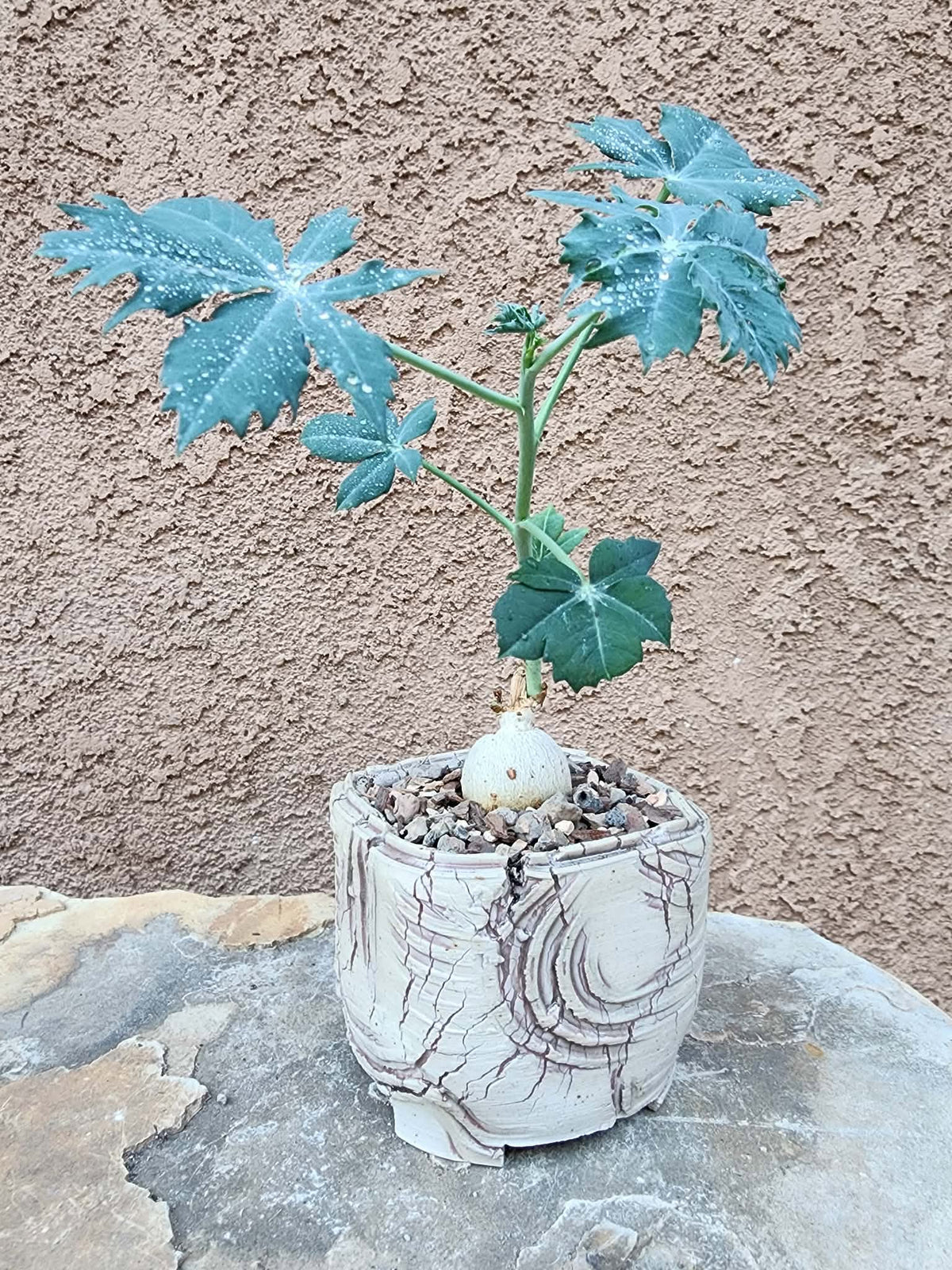
You will receive the exact specimen shown here.
Measures approximately 6" tall × 5" wide.
Showcased here in Handmade Pottery — Fault Line Vessel No. 161 (sold separately).
Roots as shown.
Will be shipped bare root.
🌵
Jatropha berlandieri, commonly known as Buddha Belly, is a wonderfully unusual caudiciform plant native to the southwestern United States and northeastern Mexico. Its defining feature is the swollen, water-storing base that gives rise to its familiar common name, topped seasonally by slender stems, deeply divided foliage, and delicate flowers.
This exact specimen is particularly appealing for its substantial 5" wide caudex, creating a broad, wonderfully irregular sculptural base at only approximately 6" tall. The naturally weathered surface, old growth points, and asymmetrical contours give the plant the character of a miniature landscape—one that becomes increasingly pronounced as the caudex matures.
Care Instructions
☀️ Light
Provide very bright light to several hours of direct sun during active growth. Strong light encourages compact development and healthy seasonal growth. Acclimate gradually to intense direct sun after shipping or dormancy.
💧 Water
Water thoroughly while the plant is actively growing, then allow the soil to dry substantially before watering again. As foliage yellows and the plant enters dormancy, reduce watering dramatically. A dormant, leafless caudex should be kept considerably drier than an actively growing plant.
🪨 Soil
Requires a very fast-draining mix with substantial mineral content. Pumice, lava rock, coarse grit, and similar inorganic materials provide excellent drainage and aeration around the thickened root and caudex.
🌡️ Temperature
Prefers warm conditions during active growth. Protect from hard frost and prolonged cold, particularly when wet. A warm growing season helps encourage strong foliage and flowering.
🌬️ Humidity
Tolerates ordinary humidity when accompanied by good airflow and excellent drainage. Avoid prolonged combinations of cool temperatures, stagnant air, and wet soil.
📈 Growth Habit
Develops a large, irregular underground or partially exposed caudex from which seasonal stems emerge. During active growth these stems carry distinctive divided leaves and flowers; during dormancy the above-ground growth may disappear almost completely, leaving the sculptural caudex behind.
✍️ Special Note
Seasonal dormancy is normal. Jatropha berlandieri may lose its leaves and retreat dramatically during its resting period. A leafless plant is not necessarily dead or unhealthy. Watering should follow the plant's active growth cycle rather than a fixed year-round schedule.
Members of the genus Jatropha contain compounds that can be toxic if ingested, and the sap may cause irritation. Handle damaged tissue carefully and keep the plant away from children and pets who may ingest it.
Natural scars, old stem attachments, corking, irregular surfaces, and evidence of previous growing seasons are part of the character of an established caudiciform specimen rather than imperfections. Please review all photographs carefully, as you will receive the exact plant shown.
Why It Stands Out
- Impressive 5" wide caudex
- Compact specimen approximately 6" tall
- Wonderfully irregular sculptural form
- Mature, weathered caudex character
- Seasonal transformation between growth and dormancy
- Distinctive divided foliage during active growth
- Excellent plant for caudiciform collectors
- Native to North America
- Every mature caudex develops an individual shape
- Established root system
- The exact specimen shown here
Collector Notes
Jatropha berlandieri occupies a fascinating place among caudiciform plants because its extraordinary swollen body isn't merely ornamental. It is an adaptation to an environment in which favorable growing conditions can arrive intensely and then disappear.
Native to Texas and northeastern Mexico, the species experiences periods when heat and available moisture permit rapid growth, followed by conditions during which maintaining a full canopy of leaves would become an expensive proposition.
Its solution is to retreat.
The plant stores resources in an enlarged subterranean structure, producing stems and foliage when conditions permit and withdrawing into its swollen base when they do not.
That is the real Buddha belly.
In cultivation, growers often expose more of this enlarged structure because of its extraordinary sculptural appearance. What might ordinarily remain partly concealed beneath the soil becomes the visual centerpiece of the plant: broad, knotted, irregular, and increasingly individual with age.
Unlike a conventional woody trunk, the caudex does not necessarily develop according to a tidy architectural plan.
It bulges.
It narrows.
Old growing points disappear while new ones emerge elsewhere.
Scars accumulate.
The result is a plant whose history becomes increasingly visible on its surface.
During active growth, the transformation can be dramatic. Slender stems emerge from this seemingly ancient body and produce fresh green leaves divided into narrow lobes. Flowers may then appear above the foliage, creating an extraordinary contrast between delicate seasonal growth and the heavy, permanent storage structure beneath it.
Then, as the growing season ends, much of that activity can vanish again.
This cycle is one of the great pleasures of growing caudiciform plants. Dormancy isn't an interruption in the life of the plant. Dormancy is part of its strategy.
The caudex allows Jatropha berlandieri to wait.
When conditions become favorable again, stored resources support another season of stems, leaves, flowers, and reproduction without requiring the plant to rebuild itself entirely from seed.
At approximately 5" across, the caudex on this specimen has already developed the broad, irregular proportions that make older examples so compelling. Its asymmetry isn't something to correct; it is precisely what gives the plant its individuality.
And unlike many of the famous caudiciforms collected from Africa and Madagascar, this strange little plant belongs to the flora of North America.
That makes its appearance all the more surprising.
A swollen body that looks ancient, seasonal stems that can seemingly appear from nowhere, delicate foliage that eventually disappears again—the entire plant is built around the ability to respond to opportunity and then wait patiently for its return.
At only 6" tall × 5" wide, this specimen compresses that remarkable survival strategy into something almost bonsai-like: a tiny, living landscape whose form records seasons most of us never witnessed.