Skip to product information
1 of 8

Shangri-Ha Cactus Ranch

Gymnocalycium Mihanovichii f. cristata variegata - Last one!

Gymnocalycium Mihanovichii f. cristata variegata - Last one!

Regular price $110.00 USD
Regular price $110.00 USD Sale price $110.00 USD
Sale Sold out
Shipping calculated at checkout.

Gymnocalycium mihanovichii f. cristata variegata
Variegated Crested Gymnocalycium

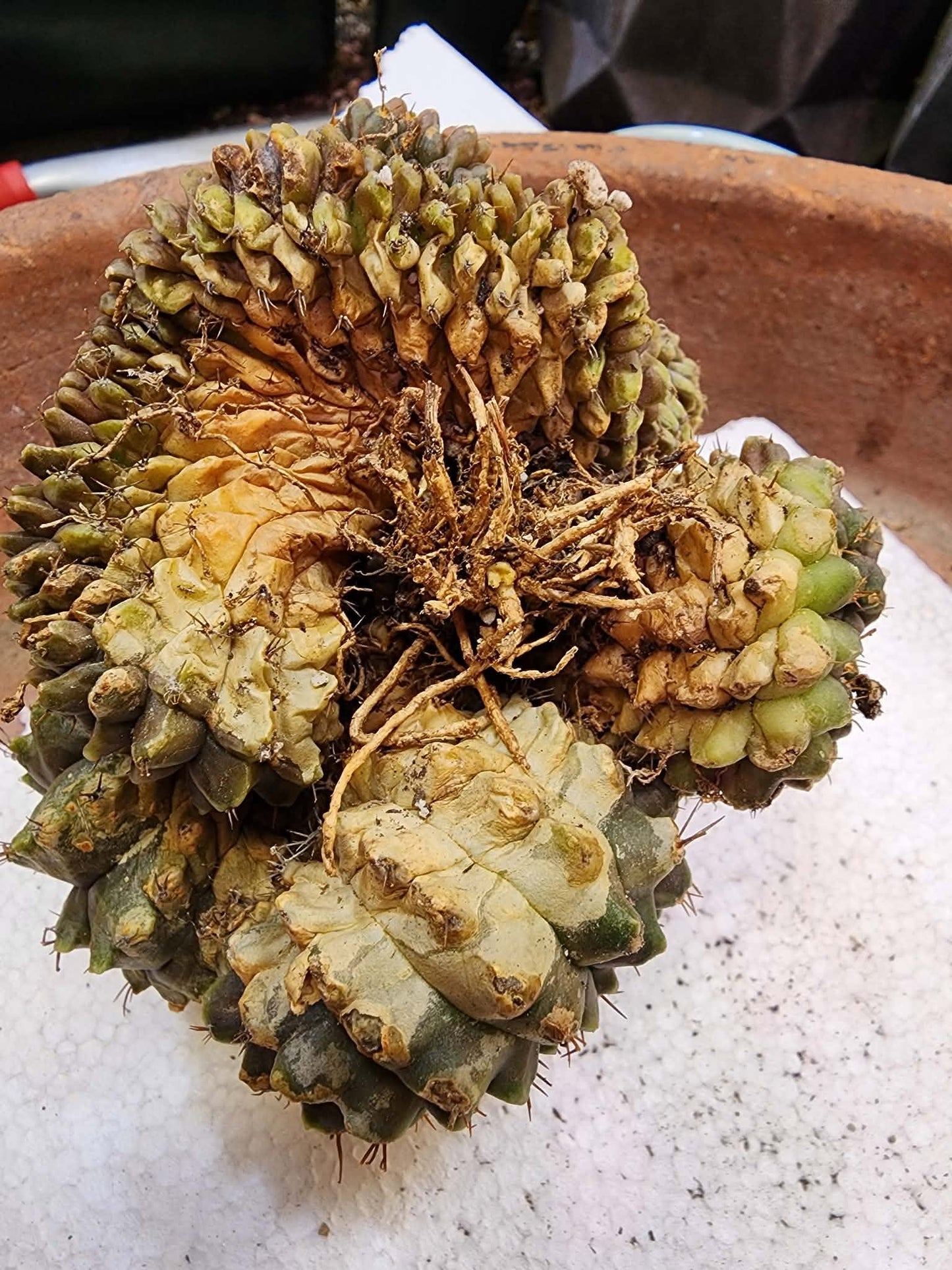
You will receive this exact specimen.
Measures approximately 5" wide × 4" tall above the soil line.
Can develop remarkably vibrant coloration when grown in strong light and full sun.
Showcased here in Handmade Pottery – Lava Scar Vessel No. 176 (sold separately).
Roots as shown.
Will be shipped bare root.

🌵

Gymnocalycium mihanovichii f. cristata variegata is an extraordinary crested and variegated form of the South American species Gymnocalycium mihanovichii. Rather than developing the familiar compact, rounded body of the typical species, the cristate growth point elongates and folds upon itself, producing undulating fans, ridges, and densely compressed geometric forms. Variegation adds another layer of unpredictability, with chlorophyll distributed unevenly through the tissue and allowing individual sections to develop shades of green, olive, yellow, bronze, pink, purple, and red depending upon genetics, season, and light exposure.

This exact specimen is particularly impressive for its large, multi-crested structure. Numerous folded growth points crowd together into an exceptionally complex 5" × 4" mass, with some sections forming broad convoluted fans while others rise into tightly compressed crests. Its current palette ranges from deep blue-green and olive to yellow-green, bronze, and muted purple, with subtle reddish tones already visible throughout. Under stronger sun, the variegated tissue can become considerably more colorful, making this a specimen whose appearance can evolve dramatically through the growing season.

Care Instructions

☀️ Light
Bright light to partial or full sun. Strong light can intensify the yellow, bronze, red, pink, and purple coloration characteristic of variegated G. mihanovichii, while also encouraging compact growth. Acclimate gradually to intense direct sun, particularly after shipping, as variegated tissue can scorch more readily than fully green growth.

💧 Water
Water thoroughly during active growth, allowing the soil to dry well between waterings. Reduce watering significantly during cooler periods and winter dormancy. Crested specimens contain numerous folds and recesses, so avoid allowing water to remain trapped within the crown for prolonged periods.

🪨 Soil
Requires a very fast-draining, mineral-rich cactus mix with excellent aeration. A generous proportion of pumice, lava rock, coarse grit, or similar inorganic material is recommended to prevent prolonged moisture around the roots.

🌡️ Temperature
Prefers warm conditions during active growth. Protect from freezing temperatures and prolonged cold, particularly when the soil is damp. Dry plants can tolerate cooler conditions considerably better than wet ones.

🌬️ Humidity
Prefers relatively dry conditions with good air circulation. Dense crested growth can retain moisture between folds, making ventilation particularly important.

📈 Growth Habit
A crested mutation in which the normal single growing point becomes elongated, producing fan-shaped and convoluted growth rather than a conventional globular cactus body. As the crest continues to divide and fold, mature specimens can develop extraordinarily intricate masses of overlapping ridges and growing points, with no two plants developing exactly alike.

✍️ Special Note
Variegated tissue contains reduced chlorophyll and can react more strongly to environmental changes than ordinary green growth. Color intensity may shift considerably with light, temperature, and season. Introduce strong sun gradually rather than moving the plant abruptly from protected conditions into intense exposure.

Why It Stands Out

  • Rare crested AND variegated form
  • Large, established specimen
  • Approximately 5" wide × 4" tall
  • Extraordinary multi-crested architecture
  • Numerous densely folded growing points
  • Complex blue-green, olive, yellow, bronze, and purple coloration
  • Can develop much more vibrant color in strong sun
  • Every section of the crest develops differently
  • Highly sculptural mature form
  • Exceptional specimen for an advanced cactus collection

Collector Notes

Gymnocalycium mihanovichii is native to South America, principally Paraguay and adjoining portions of the region, where the species occurs naturally as a comparatively small, flattened-globose cactus. It became internationally famous through brightly colored chlorophyll-deficient cultivars commonly sold as grafted “Moon Cactus,” but the species encompasses a much broader and considerably more interesting range of forms than those familiar commercial plants suggest.

Cristation results from an alteration of the plant's normal growing point. Instead of maintaining a single compact apical meristem, growth proceeds along an elongated line. The cactus consequently expands into fans and ridges, which can repeatedly fold, divide, and crowd against one another. Over time, a mature crest can become dramatically more complicated than the original mutation, creating an almost geological landscape of repeating ribs and compressed growth.

Variegation introduces a second independent source of variation. Different portions of the plant contain different concentrations of chlorophyll, producing an irregular mosaic of green and chlorophyll-reduced tissue. Environmental conditions then influence how those tissues appear. Strong light and temperature changes can encourage protective pigmentation, allowing yellow and green areas to take on remarkable bronze, red, pink, or purple tones. This is why the same specimen can look strikingly different at various points in the year.

Plants combining both cristation and variegation are particularly collectible because two highly variable growth phenomena are occurring simultaneously. Every new section of crest can develop a different shape and a different balance of pigmentation, so the plant effectively continues redesigning itself as it grows.

This exact specimen is a particularly dramatic example. At approximately 5" wide × 4" tall, it has already developed a substantial network of individual crests, from broad blue-green folded sections to tightly compressed yellow-green and bronze growth. The darker central folds and purple-toned areas add remarkable depth to the structure, while its ability to develop significantly stronger coloration under bright conditions gives the plant an additional dimension of seasonal change. Already mature, complex, and utterly individual, it is the kind of specimen whose architecture should become only more extraordinary with age.

View full details