Shangri-Ha Cactus Ranch
Euphorbia zoutpansbergensis - 3 Feet Tall!
Euphorbia zoutpansbergensis - 3 Feet Tall!
Couldn't load pickup availability
Euphorbia zoutpansbergensis — Extraordinary Large South African Collector Specimen
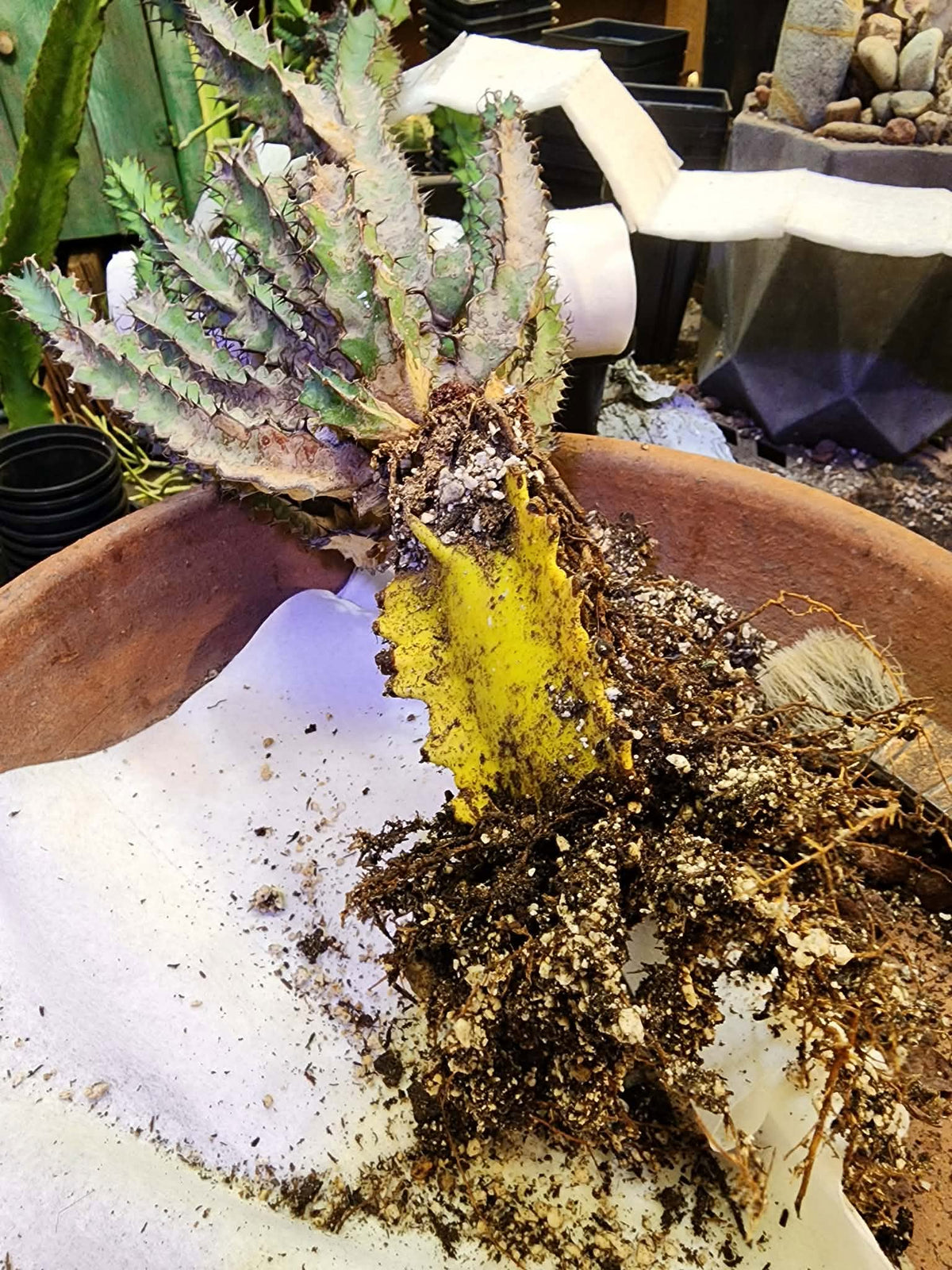
You will receive the exact BIG specimen shown here.
Measures 32" tall above the soil line × 10" wide.
We also have a few smaller ones available if this is too big for your space.
Roots as shown.
Showcased here in one-of-a-kind Handmade Pottery — Sand Ledger 93 (sold separately).
Will be shipped bare root.
🌵
Euphorbia zoutpansbergensis is a remarkable South African succulent species whose imposing architecture and dramatic branching habit make it one of the more compelling members of the enormous and extraordinarily diverse genus Euphorbia.
Unlike the compact, rounded succulents often associated with collectible Euphorbias, this species develops into a substantial, tree-like plant, producing angular, spiny branches that gradually create an intricate, sculptural crown.
It is a plant with considerable presence.
The species is native to South Africa's Limpopo Province, particularly the Soutpansberg and Blouberg mountain regions, where it grows among rocky slopes, cliffs, and sheltered ravines at elevations of approximately 1,100–1,500 meters.
These landscapes are characterized by rugged terrain, mineral-rich rock formations, seasonal rainfall, and extended periods when plants must endure limited available moisture.
Euphorbia zoutpansbergensis is exceptionally well adapted to these conditions.
Its succulent stems store water, while its formidable spines provide protection in an environment where surviving prolonged dry periods is essential.
The species can eventually develop into a substantial shrub or small tree, sometimes reaching several meters in height in its natural habitat.
Its branches are typically angular, with prominent ribs and paired spines arranged along the edges. As the plant matures, its branching becomes increasingly elaborate, producing a distinctive silhouette that can resemble a miniature African tree.
The overall effect is architectural, dramatic, and unmistakably sculptural.
And then there is this specimen.
Standing an extraordinary 32 inches tall above the soil line and measuring approximately 10 inches wide, this is a particularly impressive example of a species already celebrated for its commanding form.
At nearly three feet tall, this specimen has moved well beyond the scale of an ordinary tabletop succulent.
It is a statement plant.
Its considerable height creates a striking vertical presence, while its relatively narrow width allows it to occupy space with an elegance that is unusual for such a substantial succulent.
For collectors accustomed to smaller specimens, a plant of this scale offers an entirely different experience.
The proportions become more dramatic.
The structure becomes more apparent.
And the plant begins to function almost as a piece of living sculpture.
Large specimens of Euphorbia zoutpansbergensis are especially appealing because the species' natural architecture becomes increasingly expressive as it develops. What begins as a relatively simple succulent gradually takes on the character of a miniature tree, with an individuality that cannot be replicated by mass-produced decorative plants.
This specimen is showcased in Handmade Pottery — Sand Ledger 93, a one-of-a-kind vessel selected to complement its substantial vertical form.
The pottery is available separately.
And if 32 inches is more plant than your space can accommodate, we also have a few smaller specimens available.
Care Instructions
☀️ Light
Provide very bright light, preferably with several hours of direct sunlight once the plant has been properly acclimated. Euphorbia zoutpansbergensis naturally inhabits exposed and lightly wooded environments and appreciates strong illumination.
Outdoor cultivation in full sun to light afternoon shade is suitable in appropriate climates. Indoors, position near a very bright window or provide supplemental grow lighting.
Acclimate gradually to intense sunlight, particularly after shipping or extended indoor cultivation, to avoid sunburn.
💧 Water
Water thoroughly during active growth, allowing the substrate to dry substantially before watering again. Although this species is exceptionally drought tolerant once established, it benefits from appropriate watering during warm growing periods.
Reduce watering considerably during cool weather and winter dormancy.
Avoid prolonged moisture retention around the roots, particularly when temperatures are low. As with many succulent Euphorbias, excessive moisture combined with inadequate drainage can lead to root and stem rot.
Large specimens should be watered according to their growing conditions, container size, and substrate rather than a fixed calendar schedule.
🪨 Soil
Use a highly porous, exceptionally well-draining succulent mix.
Pumice, lava rock, coarse grit, and other mineral components help provide the aeration necessary for healthy root development.
A modest organic component may be included, but avoid heavy, moisture-retentive potting soils.
Because this specimen is 32 inches tall, container stability is especially important. Choose a sufficiently substantial pot with excellent drainage and enough weight to support the plant securely.
The root system should be accommodated without excessive crowding or unnecessary disturbance.
🌡️ Temperature
Prefers warm growing conditions and good airflow.
Although mature plants may tolerate brief periods of cool weather when kept dry, valuable cultivated specimens should be protected from frost and prolonged cold.
Maintain warmer conditions during active growth and avoid exposing the plant to cold, wet soil.
For collectors in climates with chilly winters, a bright, sheltered location is recommended during the colder months.
🌬️ Humidity
Prefers relatively dry conditions and excellent ventilation.
The species is naturally adapted to environments where air movement and rapid drainage help prevent prolonged moisture accumulation.
In humid climates, provide particularly good airflow and exercise caution with watering.
📈 Growth Habit
Euphorbia zoutpansbergensis develops as a spiny, branching succulent shrub or small tree.
Its stems are characteristically angular, commonly displaying five to seven ribs, with paired spines along the ridges.
As plants mature, branches spread and ascend, gradually producing a dense, architectural crown.
Under favorable conditions, the species can grow relatively vigorously compared with many slower-growing collectible succulents.
The ultimate size and branching habit depend on age, growing conditions, available root space, and cultivation practices.
This specimen already measures an impressive 32 inches above the soil line, making it particularly suitable for collectors seeking a substantial, established-looking plant.
✍️ Special Note
All Euphorbias contain a milky latex sap that can be irritating or toxic.
Avoid contact with the eyes, skin, and mouth. The sap can cause significant irritation, particularly if it enters the eyes.
Wear protective gloves and eye protection when handling, pruning, or repotting this species.
Keep the plant away from children and pets who may come into contact with its spines or sap.
The spines themselves also require careful handling.
Because this is a particularly tall specimen, take additional care when unpacking and positioning it.
The plant will be shipped bare root, so select a suitable container and growing medium before its arrival.
After repotting, allow any disturbed or damaged roots time to recover before watering. Resume watering cautiously once the plant is established in its new container.
Natural corking, minor scarring, and changes in stem coloration may occur as Euphorbias mature. These characteristics are not necessarily signs of poor health.
Please review all photographs carefully, as you will receive the exact specimen shown.
Why It Stands Out
• Euphorbia zoutpansbergensis, an extraordinary South African succulent species
• An impressive 32" tall above the soil line
• Approximately 10" wide
• Native to the Soutpansberg and Blouberg mountain regions of South Africa
• Distinctive tree-like growth habit
• Angular, ribbed succulent stems with prominent paired spines
• Dramatic architectural form
• Naturally adapted to rugged, rocky environments
• Can develop into a substantial shrub or small tree with maturity
• Particularly appealing to collectors of large, unusual Euphorbias
• Impressive vertical presence without an excessively wide footprint
• A striking specimen for a substantial container or curated plant collection
• Smaller specimens also available
• Showcased in Handmade Pottery — Sand Ledger 93, sold separately
• The exact BIG specimen shown here
Collector Notes
Some succulents are admired for their flowers.
Others for their extraordinary colors.
And some for the almost impossible geometry of their bodies.
Euphorbia zoutpansbergensis belongs to another category entirely.
It has presence.
There is something wonderfully prehistoric about the great tree-forming Euphorbias of southern Africa.
Their angular stems, formidable spines, and elaborate branching structures seem to belong to a landscape that has existed unchanged for thousands of years.
They are not delicate plants.
They do not attempt to be charming.
They are architectural, uncompromising, and extraordinarily beautiful in their own peculiar way.
And when one reaches the scale of this specimen, the effect becomes particularly dramatic.
Thirty-two inches tall.
That is no longer a little succulent sitting politely among its neighbors.
That is a plant making an entrance.
What makes this species especially fascinating is the relationship between its cultivated form and its natural habitat.
In the rocky mountains of northern South Africa, Euphorbia zoutpansbergensis grows in landscapes where survival depends on resilience, water conservation, and the ability to endure challenging conditions.
Its unusual architecture is not simply decorative.
It is the visible expression of a plant adapted to a demanding environment.
And yet, removed from those mountains and placed in a carefully chosen vessel, the same structure becomes something remarkably elegant.
A living sculpture.
A miniature tree.
An extraordinary botanical object whose character will continue to develop with time.
For collectors who appreciate unusual species, substantial specimens, and plants with a powerful visual identity, this Euphorbia zoutpansbergensis offers something quite special.
Of course, we recognize that not everyone has room for a nearly three-foot Euphorbia.
We have a few smaller ones, too.
But for someone with the space, the inclination, and a particular appreciation for botanical drama?
This is the one that knows how to command a room.