Shangri-Ha Cactus Ranch
Euphorbia viguieri var. capuroniana cristata - Collector Specimen - Last one!
Euphorbia viguieri var. capuroniana cristata - Collector Specimen - Last one!
Couldn't load pickup availability
Euphorbia viguieri var. capuroniana f. cristata — Extraordinary Crested Madagascar Collector Specimen
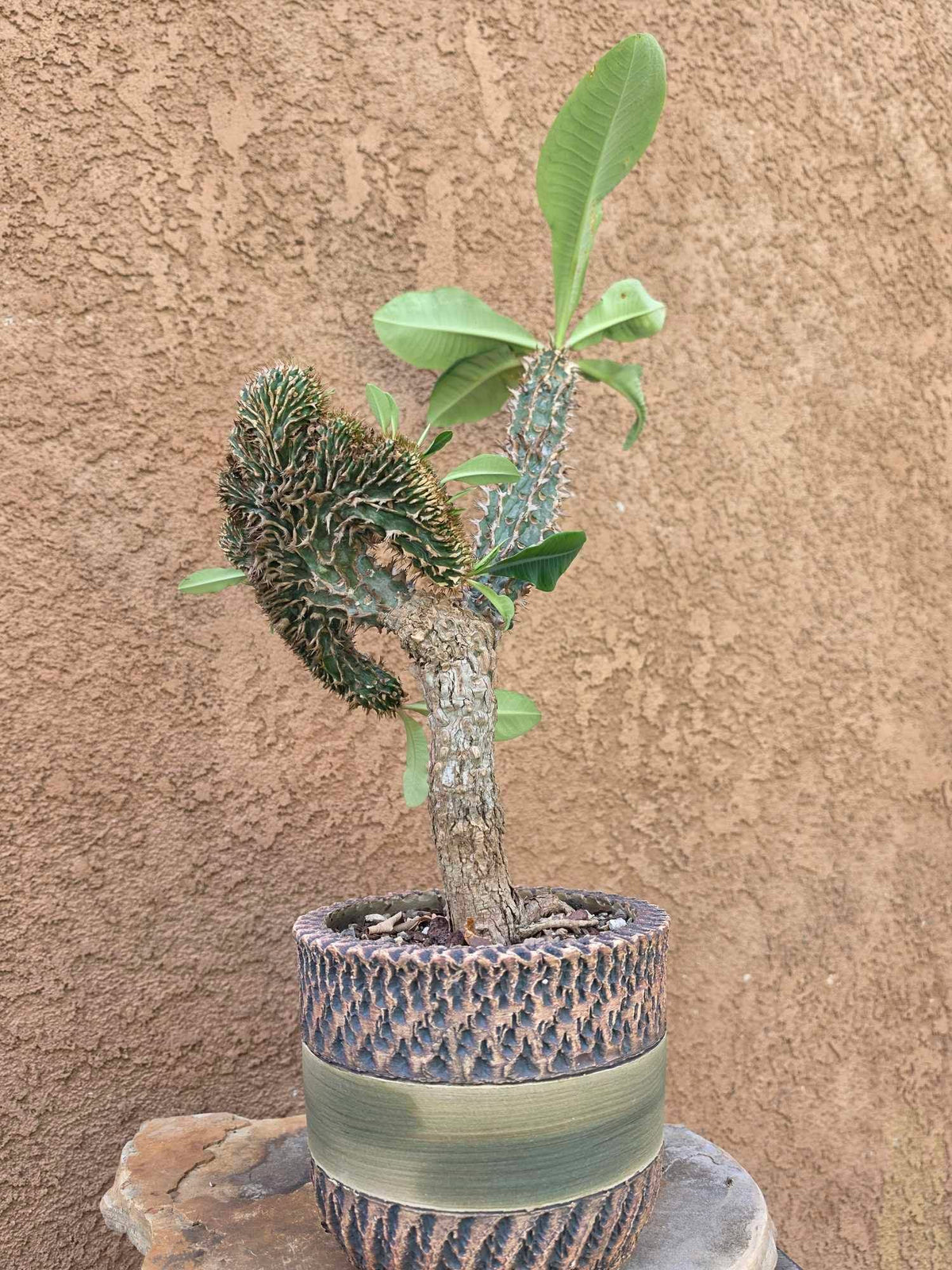
You will receive this exact, BIG, rare specimen — a spectacular collector piece.
We're having a little separation anxiety already over this one.
Measures approximately 17" tall above the soil line × 8" wide.
Showcased here in Handmade Pottery – Glacier Ridge Planter No. 17 (sold separately).
Roots as shown.
Will be shipped bare root.
🌵
Euphorbia viguieri var. capuroniana f. cristata is an extraordinary crested form of a remarkable Madagascan succulent, combining the imposing, spiny architecture of Euphorbia viguieri with the unpredictable sculptural beauty of fasciated growth. The species is celebrated for its thick, heavily armed stems and handsome leaves, but in this exceptional form, portions of the growing tissue have departed from their normal cylindrical development to produce densely folded, irregularly expanded crests. The resulting plant is an astonishing botanical composition, part upright succulent tree and part living sculpture, with a form that would be nearly impossible to duplicate.
This exact specimen is particularly remarkable for the contrast between its two principal growth structures. One branch rises dramatically upward and outward, displaying a long, heavily spined green stem crowned with broad, fresh leaves. Opposite it, a substantial crested section forms a densely textured, irregular mass of compressed growth, its surface covered with intricate ridges, closely arranged spines, and convoluted folds. Both emerge from a thick, weathered central trunk that gives the entire composition a wonderful sense of maturity. At approximately 17" tall above the soil line × 8" wide, this is a substantial and visually unforgettable specimen, with an extraordinary balance between conventional and crested growth. We're having a little separation anxiety already over this one.
Care Instructions
☀️ Light
Provide very bright light with some direct morning sun or strong filtered sunlight. Adequate light encourages sturdy growth, healthy foliage, and well-developed spination. Protect from abrupt exposure to intense afternoon sunlight, especially after shipping, and acclimate gradually to brighter conditions. Crested tissue should be monitored carefully for sunburn.
💧 Water
Water thoroughly during active warm-season growth, allowing the growing medium to dry well between waterings. Reduce watering substantially when temperatures cool or the plant enters dormancy. Seasonal leaf loss may accompany reduced growth and should be considered when adjusting irrigation. Avoid keeping the root zone continuously moist.
🪨 Soil
Requires a highly porous, fast-draining succulent mix with excellent root aeration. A substantial proportion of pumice, lava rock, coarse grit, or similar inorganic material is recommended. Avoid heavy, moisture-retentive soils, particularly during cool weather.
🌡️ Temperature
Warm-growing and frost-sensitive. Protect from freezing temperatures and prolonged cold. As a conservative cultivation precaution, maintain temperatures above approximately 50°F (10°C), especially when the growing medium is moist. Warm conditions are particularly beneficial during active growth.
🌬️ Humidity
Prefers good air circulation and relatively dry conditions. Avoid prolonged periods of cool, stagnant humidity, particularly around the densely folded crested tissue, where moisture can remain trapped more easily than on conventional stems.
📈 Growth Habit
The typical form of Euphorbia viguieri develops an upright, heavily spined succulent trunk with leaves concentrated toward actively growing stem tips. This crested specimen combines a conventional elongated branch with a broad, irregularly expanded growth structure produced by fasciation. Crested tissue may continue developing in unpredictable directions, and individual plants can retain both normal and crested branches.
✍️ Special Note
The extraordinary crested growth is the defining feature of this specimen. Fasciation alters the normal organization of the growing point, producing expanded, compressed, or convoluted stem tissue rather than the usual cylindrical growth. Crested plants should be handled carefully because their irregular surfaces and dense spination can make them especially vulnerable to physical damage. As with other Euphorbias, damaged tissue may release an irritating, potentially toxic milky latex. Wear gloves and avoid contact with skin and eyes. Seasonal leaf loss is possible and does not necessarily indicate declining health.
Why It Stands Out
- Extraordinary Euphorbia viguieri var. capuroniana f. cristata
- Rare crested form of a distinctive Madagascar endemic
- Substantial specimen measuring approximately 17" tall × 8" wide
- Spectacular combination of normal and crested growth
- Large, densely textured crest with intricate folded architecture
- Long, heavily spined ascending branch crowned with broad green leaves
- Thick, weathered central trunk with exceptional character
- Fascinating contrast between open, upright growth and compact fasciated tissue
- Unpredictable sculptural development unique to the individual plant
- Beautifully mature-looking specimen with extraordinary visual presence
- Exceptional addition to an advanced Madagascar, Euphorbia, or crested succulent collection
Collector Notes
Euphorbia viguieri is among the most visually distinctive of Madagascar's succulent Euphorbias, a group whose extraordinary diversity reflects the island's long evolutionary isolation and remarkable range of habitats. Madagascar is home to an exceptional concentration of endemic succulent plants, many of which have evolved highly specialized structures in response to seasonal drought, intense sunlight, and challenging growing conditions. Within this botanical landscape, Euphorbia viguieri is particularly memorable for its upright, heavily spined stems and broad foliage, a combination that gives mature plants an appearance somewhere between a miniature palm, an armored tree, and a conventional succulent.
The variety capuroniana belongs to this fascinating Madagascan lineage, but the crested form seen here introduces an entirely different dimension of botanical interest. In ordinary growth, the plant develops stems from relatively concentrated growing points, producing the familiar elongated architecture of the species. In crested growth, the organization of the growing tissue changes, and the growing point becomes extended or distorted into a broader region. This phenomenon, known as fasciation, can produce flattened fans, convoluted ridges, compressed branching, and densely folded structures that bear little resemblance to the normal growth habit of the same plant.
Fasciation is particularly fascinating because it transforms the architecture of a plant without necessarily changing its underlying species identity. The same genetic individual may produce conventional stems alongside dramatically altered crested tissue, as this specimen so beautifully demonstrates. Its tall, ascending branch retains the recognizable characteristics of Euphorbia viguieri: a substantial green stem, prominent spines, and broad leaves concentrated near the growing tip. The adjacent crest, however, has developed into a dense, irregularly expanded mass in which the normal arrangement of stems and spines has been compressed into a remarkably intricate surface.
The contrast is extraordinary. The conventional branch creates a strong diagonal movement, extending upward and outward from the central trunk, while the crested section forms a compact, heavily textured counterweight. Together they produce a composition with a sense of balance that is entirely natural yet almost deliberately sculptural. The weathered central trunk provides a third visual element, its rough, woody surface connecting the two very different expressions of growth. Few cultivated succulents demonstrate the possibilities of plant development quite so dramatically within a single specimen.
The crested section deserves particularly close attention. Its surface is densely covered with compressed green tissue, pale spines, and irregular ridges, creating an almost geological appearance. In places, the growth resembles folded stone or weathered coral; elsewhere, the tightly packed spines produce a fine, bristling texture. Unlike a conventional stem, whose development can often be anticipated from its established growing pattern, a crest may continue to expand, fold, and change direction in ways that are difficult to predict. This unpredictability is one of the principal reasons crested succulents are so highly prized by specialist collectors.
Another remarkable aspect of Euphorbia viguieri is its seasonal foliage. The broad leaves create a striking contrast with the heavily defended stems, giving actively growing plants a surprisingly lush appearance. Under less favorable conditions, the plant may shed its foliage and reveal a much starker silhouette dominated by spines and succulent tissue. This alternation between leafy growth and a more exposed, armored framework is characteristic of many drought-adapted Madagascan Euphorbias and contributes to their extraordinary visual character throughout the year.
Although crested succulents are sometimes propagated specifically for their unusual forms, the architecture of each mature specimen remains highly individual. The proportions of the crest, the orientation of conventional branches, the distribution of spines, and the development of older woody tissue all contribute to an appearance that cannot be precisely replicated. In this plant, the dramatic upward movement of the leafy branch and the compact complexity of the crest create an especially memorable combination. Its substantial size and established trunk further distinguish it from the small, recently developed crested plants more commonly encountered in cultivation.
At approximately 17" tall above the soil line × 8" wide, this exact specimen is a remarkable collector piece that embodies several of the qualities we value most at Shangri-Ha Cactus Ranch: botanical individuality, unusual developmental architecture, and the unmistakable character that comes with established growth. Its magnificent crest, heavily spined ascending branch, fresh foliage, and weathered trunk combine to create a plant that is genuinely difficult to forget. For collectors of Madagascan Euphorbias, crested succulents, or extraordinary botanical forms, it is an exceptional opportunity to acquire a specimen whose natural architecture is entirely its own.
And yes, we're already having a little separation anxiety over this one.