Shangri-Ha Cactus Ranch
Euphorbia valida
Euphorbia valida
Couldn't load pickup availability
Euphorbia valida — South African Baseball Plant
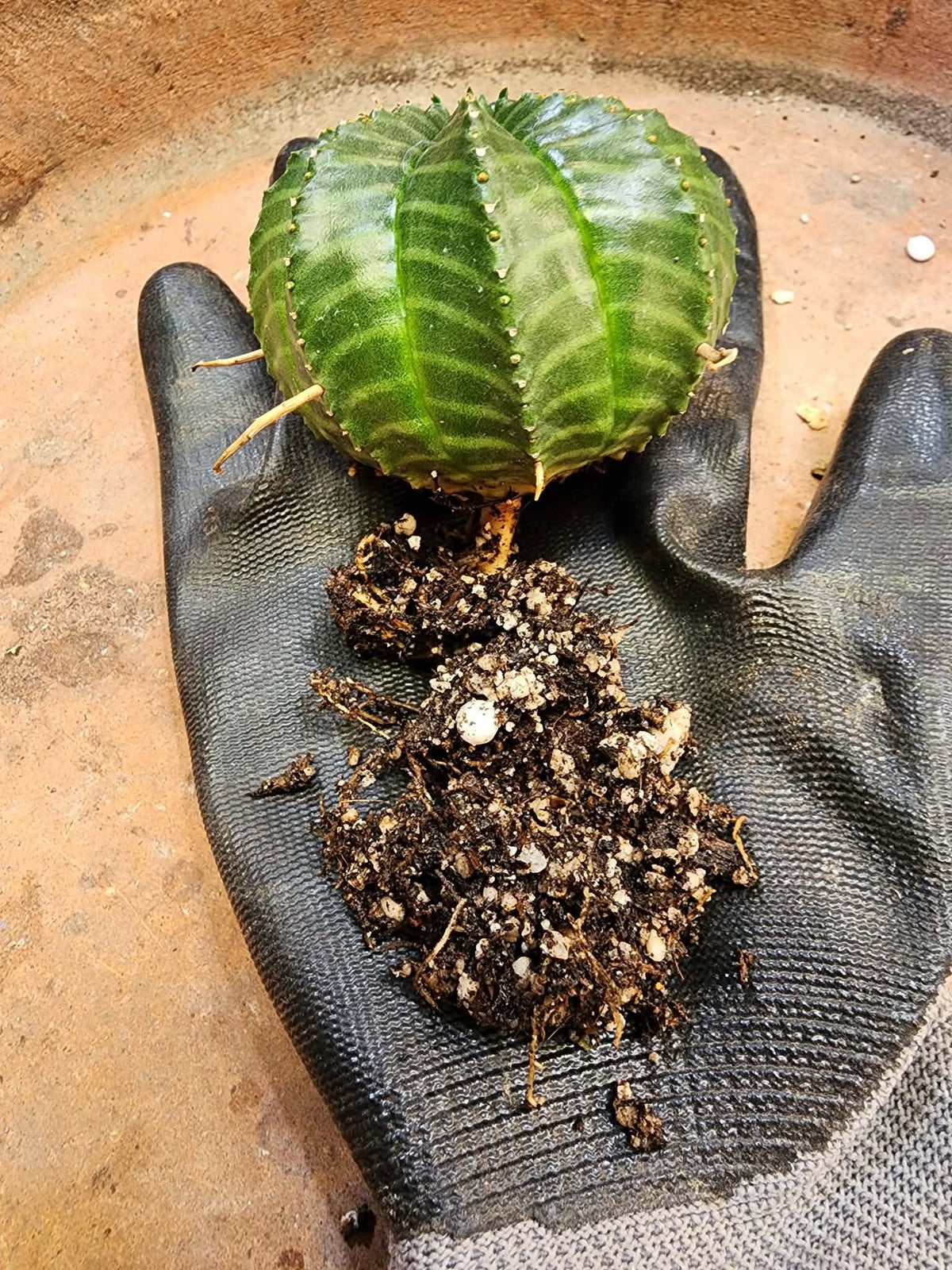
You will receive the exact, rare, seed-grown specimen shown here.
Measures approximately 2.75" wide.
Showcased here in Handmade Pottery — Midnight Flare No. 122 (sold separately).
Roots as shown.
Will be shipped bare root.
🌵
Euphorbia valida is a rare and highly distinctive South African succulent prized for its beautifully rounded, cactiform body and the extraordinary persistent flower stalks that remain on the plant long after blooming. Young plants begin almost spherical, gradually becoming more cylindrical with age while developing the wonderfully bristled silhouette characteristic of mature specimens.
This exact specimen is especially appealing as a seed-grown plant, with a compact 2.75" body and an impressive crown of persistent peduncles radiating from the upper stem. Seed-grown specimens develop their natural architecture slowly from the beginning, making each plant an individual expression of the species rather than a propagated clone.
Care Instructions
☀️ Light
Provide very bright light to several hours of direct sun. Strong light encourages compact growth and maintains the plant's characteristic form. Acclimate gradually to intense sun after shipping or periods in filtered conditions to avoid scorching.
💧 Water
Water thoroughly during active growth, allowing the soil to dry well between waterings. Reduce water substantially during cooler periods and dormancy. Avoid allowing water to remain around the roots for extended periods.
🪨 Soil
Requires an exceptionally fast-draining succulent mix with a high proportion of mineral material. Pumice, lava rock, coarse grit, and similar inorganic components provide the drainage and root aeration this species prefers.
🌡️ Temperature
Prefers warm conditions and should be protected from hard frost and prolonged cold, particularly when the soil is moist. Keep comparatively dry during cool weather.
🌬️ Humidity
Best grown with good airflow and relatively dry conditions. Moderate atmospheric humidity is generally tolerated when drainage and ventilation are excellent, but prolonged cool, damp conditions should be avoided.
📈 Growth Habit
Begins with a rounded, nearly spherical body and gradually becomes more elongated with maturity. The stem is divided into pronounced vertical ribs, while persistent flower stalks accumulate around the upper portion of the plant and create its unmistakable bristled appearance.
✍️ Special Note
One of the most fascinating characteristics of Euphorbia valida is that its old flower stalks persist rather than simply falling away. These dry, woody projections are a normal and highly desirable feature of the species and should not be mistaken for dead or damaged growth.
Like other members of the genus Euphorbia, this plant contains a milky latex sap that can irritate skin and eyes and is toxic if ingested. Handle carefully if the plant is damaged, and keep the sap away from eyes, mouth, children, and pets.
Natural scars, dried flower structures, corking, and other evidence of previous growing seasons are part of a mature specimen's history rather than imperfections. Please review all photographs carefully, as you will receive the exact plant shown.
Why It Stands Out
- Rare seed-grown collector specimen
- Beautifully compact 2.75" body
- Distinctive rounded, cactiform architecture
- Excellent rib development
- Remarkable crown of persistent flower stalks
- Each seed-grown specimen develops individually
- Fascinating transition from spherical to more cylindrical growth with age
- Highly distinctive South African species
- Sculptural appearance even when not in flower
- Established root system
- The exact specimen shown here
Collector Notes
Euphorbia valida comes from South Africa, where it grows as part of an extraordinary assemblage of succulent plants adapted to seasonal rainfall, intense light, and periods of significant water stress.
Its resemblance to a cactus is immediately apparent—and entirely deceptive.
Cacti and euphorbias belong to completely different plant families and evolved independently on different branches of the plant kingdom. Yet under similarly demanding environmental pressures, both groups arrived at some remarkably similar solutions: reduced foliage, water-storing stems, compact forms, and photosynthetic green bodies.
This phenomenon, known as convergent evolution, is one of the reasons plants such as Euphorbia valida are so fascinating.
Its thick stem functions as both reservoir and photosynthetic surface. The body is divided into strong vertical ribs, allowing it to expand as water becomes available and contract gradually as stored moisture is used.
But the feature that gives E. valida its unmistakable personality is above the body itself.
The species produces small euphorbia flowers—technically specialized structures called cyathia—on slender stalks emerging around the crown. After flowering has finished, those stalks can remain attached to the plant, drying into rigid projections that persist season after season.
With time, they accumulate.
A mature plant therefore carries something of its own flowering history with it. New growth and flowers emerge among the remains of earlier seasons, gradually producing the dense crown of radiating stalks for which the species is known.
Those structures are sometimes mistaken for spines.
They aren't.
Unlike true cactus spines, which are modified leaves produced from specialized structures called areoles, the bristles surrounding an older Euphorbia valida are largely the persistent remains of its reproductive structures. Two unrelated groups of plants can therefore arrive at superficially similar appearances through completely different anatomical routes.
The plant itself changes as it ages as well.
Young specimens can be remarkably globular, sometimes resembling a small striped ball resting almost directly on the soil. Over many years the stem slowly elongates, and an older specimen may become noticeably columnar while retaining its pronounced ribbing.
That slow transformation makes seed-grown plants particularly satisfying collector specimens.
A seedling must build the entire structure naturally—from its first tiny stem through successive years of rib development, flowering, expansion, and seasonal growth. No two seedlings need develop in precisely the same way.
At 2.75" wide, this specimen already displays the compact geometry and wonderfully strange crown that make the species so recognizable.
It is a plant constructed from contradictions: rounded yet armored-looking, cactus-like yet not a cactus, simple in overall form yet increasingly complex as the remnants of successive flowering seasons accumulate around its crown.
Small, architectural, and wonderfully peculiar, Euphorbia valida is a beautiful example of the evolutionary inventiveness that makes South Africa one of the world's great centers of succulent diversity.