Shangri-Ha Cactus Ranch
Euphorbia tortillis
Euphorbia tortillis
Couldn't load pickup availability
Euphorbia tortillis — Rare Sculptural Succulent Specimen
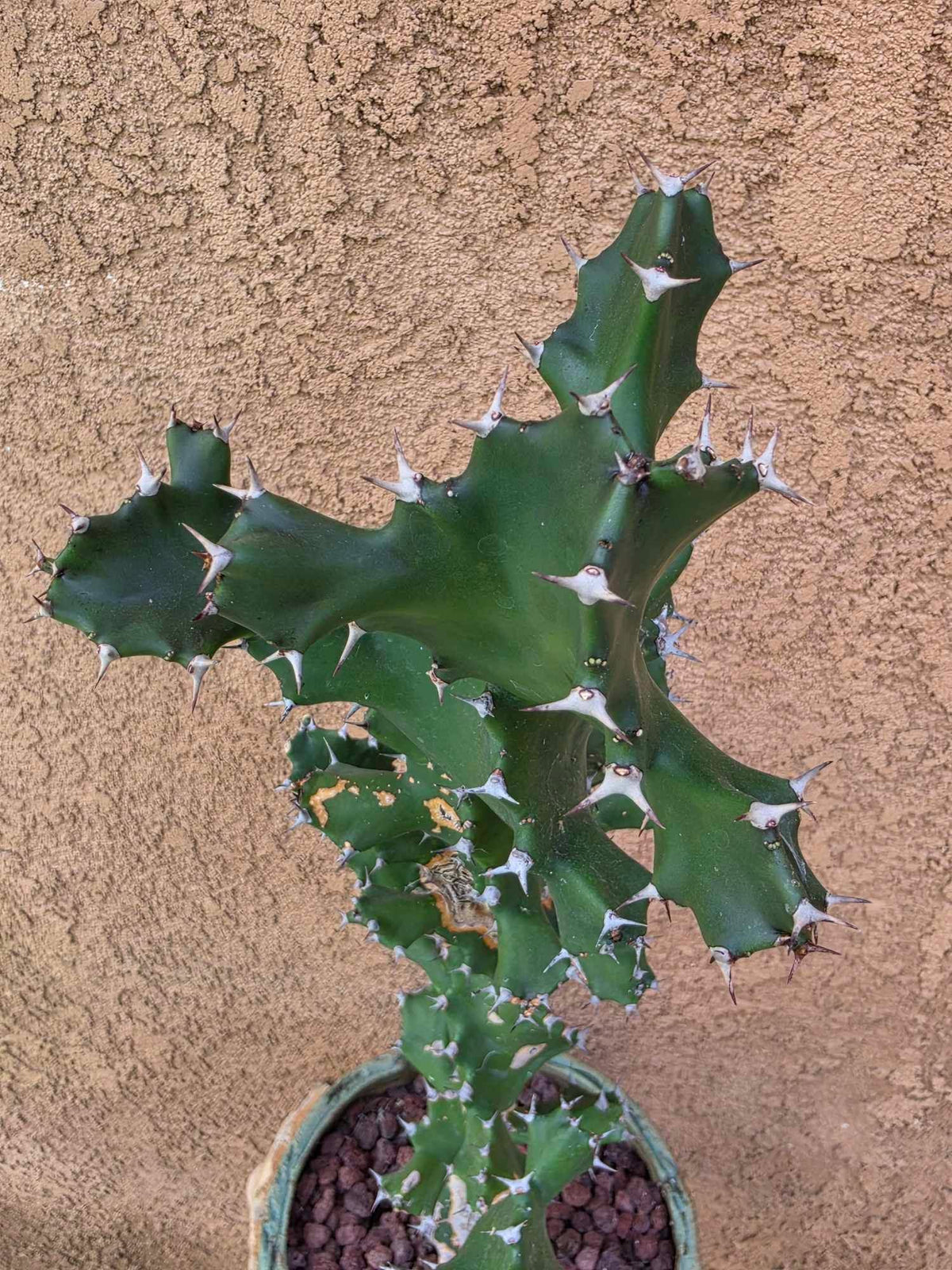
You will receive the exact specimen shown here.
Measures approximately 20" tall above the soil line × 10" wide.
Showcased here in Handmade Pottery — Celadon Relic Bowl No. 62 (sold separately).
Roots as shown.
Will be shipped bare root.
🌵
Euphorbia tortillis is an unusual succulent Euphorbia with a wonderfully irregular, branching architecture that sets it apart from the more familiar columnar and geometrically symmetrical members of the genus. Its fleshy green stems develop angular, undulating contours punctuated by short, pale spines, creating a fascinating interplay of sharp projections, flattened surfaces, and unexpected changes in direction. Rather than forming a conventional upright column, the plant develops an open, sculptural framework in which each branch contributes to an increasingly individual silhouette.
This exact specimen is particularly striking at approximately 20" tall above the soil line × 10" wide. Its substantial green branches rise from a narrow, weathered, woody base, spreading outward into an extraordinary arrangement of irregularly contoured growth. The branching is especially beautiful, with a strong central ascending structure balanced by lateral arms extending in several directions. Pale spines accentuate the edges of the fleshy stems, while areas of natural corking and tan-colored surface scarring introduce additional texture and contrast. The result is a highly architectural specimen with a wonderfully unconventional character, equally compelling for its mature-looking lower trunk and its exuberant green upper growth.
Care Instructions
☀️ Light
Provide very bright light, ideally with several hours of direct sunlight or strong filtered sun. Adequate light encourages sturdy growth and helps maintain the plant's compact, sculptural branching. Acclimate gradually to intense direct sunlight, especially following shipping or a period in protected conditions.
💧 Water
Water thoroughly during active growth, allowing the growing medium to dry well between waterings. Reduce watering substantially during cooler weather or periods of reduced growth. Avoid keeping the roots continuously moist, particularly when temperatures are low. Newly repotted specimens should be allowed to settle into their growing medium before regular watering resumes.
🪨 Soil
Use an exceptionally well-draining succulent mix with a substantial mineral component. Pumice, lava rock, coarse grit, and similar inorganic materials provide aeration and help prevent excess moisture retention. A porous growing medium is especially important for mature, woody-based Euphorbias.
🌡️ Temperature
Prefers warm conditions and should be protected from frost. As a conservative cultivation precaution, maintain temperatures above approximately 50°F (10°C), particularly when the growing medium is damp. Avoid prolonged exposure to cold, wet conditions.
🌬️ Humidity
Prefers good air circulation and conditions that allow the growing medium to dry efficiently. Moderate ambient humidity is generally acceptable, but prolonged combinations of high humidity, cool temperatures, and saturated soil should be avoided.
📈 Growth Habit
An upright, branching succulent with fleshy, irregularly contoured stems and short spines distributed along their edges. As the plant develops, older growth may become increasingly woody and corked, while newer branches retain their green succulent surfaces. Its branching habit produces an open, asymmetrical silhouette rather than a uniformly columnar structure.
✍️ Special Note
The tan-colored corking and surface scarring visible on this exact specimen contribute to its distinctive weathered appearance. These areas should be evaluated as part of the plant's existing condition rather than assumed to be new growth or active disease. As with other Euphorbias, damaged stems can release a potentially toxic, irritating milky latex. Wear gloves when handling damaged tissue and avoid contact with skin and eyes. Exercise particular care when unpacking and repotting because of the plant's spines and irregular branches.
Why It Stands Out
- Unusual and highly sculptural Euphorbia tortillis
- Approximately 20" tall above the soil line × 10" wide
- Extraordinary irregular, branching architecture
- Distinctive angular and undulating green succulent stems
- Short, pale spines accentuating the stem margins
- Beautiful contrast between fresh green growth and weathered woody tissue
- Strong upright central structure with expressive lateral branching
- Naturally asymmetrical, almost abstract silhouette
- Visible corking and surface character that distinguish this exact specimen
- Excellent specimen for collectors drawn to unconventional Euphorbia forms
Collector Notes
The genus Euphorbia is among the most morphologically diverse groups of flowering plants in the world. Its members range from small herbaceous species to shrubs, trees, and extraordinary stem-succulent forms that have independently evolved many of the structural adaptations associated with cacti. Within this enormous genus, the succulent species are particularly fascinating for the diversity of their growth habits. Some develop massive swollen bases, others form orderly columns or dense clusters, while still others produce irregular branching frameworks that seem almost unconcerned with conventional botanical symmetry.
Euphorbia tortillis is especially interesting for the architectural qualities suggested by its contorted, angular growth. The stems of this specimen do not follow the familiar cylindrical or uniformly ribbed patterns seen in many cultivated succulent Euphorbias. Instead, they form an intricate arrangement of flattened and irregularly projecting surfaces, with short spines emerging along the margins. The resulting structure creates an unusual visual rhythm, alternating between broad green surfaces, narrow extensions, and sharply defined points. It is a form that rewards close observation, revealing increasingly intricate details as the eye follows each branch.
One of the most compelling characteristics of this exact plant is the relationship between its older basal structure and its upper succulent growth. Near the soil line, the trunk has developed a rugged, woody appearance, with areas of corking and exposed texture that contrast dramatically with the greener branches above. This transition illustrates an important aspect of many long-lived succulent Euphorbias: their tissues can change considerably in appearance as they mature. Older portions may become more rigid and weathered, while newer growth continues to express the distinctive fleshy architecture of the species.
The arrangement of branches is equally noteworthy. A strong central axis rises through the specimen, but the lateral growth interrupts any suggestion of strict vertical symmetry. Several arms extend outward, creating an open composition with considerable negative space between the branches. The uppermost growth becomes increasingly intricate, with smaller projections and short spines producing an almost coral-like silhouette. The plant's appearance invites comparison with natural sculpture, particularly the weathered branching forms found in arid landscapes.
Succulent Euphorbias are also remarkable examples of convergent evolution. Although many resemble cacti in their water-storing stems and defensive spines, they belong to an entirely different botanical family, Euphorbiaceae. Their reproductive structures are especially distinctive: the tiny flowers are organized into specialized structures called cyathia, which can resemble individual flowers but are actually highly modified inflorescences. These botanical distinctions make the group particularly rewarding for collectors interested not only in unusual appearances but also in the evolutionary strategies plants have developed to survive challenging environments.
This exact Euphorbia tortillis is a particularly beautiful expression of the qualities that make unconventional succulent specimens so desirable. At approximately 20" tall × 10" wide, it has already developed a substantial, visually complex framework, with mature-looking basal tissue, irregular green branching, and an unmistakably individual silhouette. Its combination of rugged texture and animated growth gives it a presence quite unlike the familiar forms of mass-produced succulents. For the dedicated Euphorbia collector or anyone who appreciates the intersection of botanical rarity, natural architecture, and sculptural form, this is a wonderfully distinctive specimen.