Shangri-Ha Cactus Ranch
Euphorbia rossii
Euphorbia rossii
Couldn't load pickup availability
Euphorbia rossii — Rare Flowering Madagascar Succulent
You will receive the exact specimen shown here.
Measures approximately 5" tall above the soil line × 8" wide.
Beautifully flowering, with extraordinary green-and-yellow floral structures.
Showcased here in Handmade Pottery — Desert Birch No. 233 (sold separately).
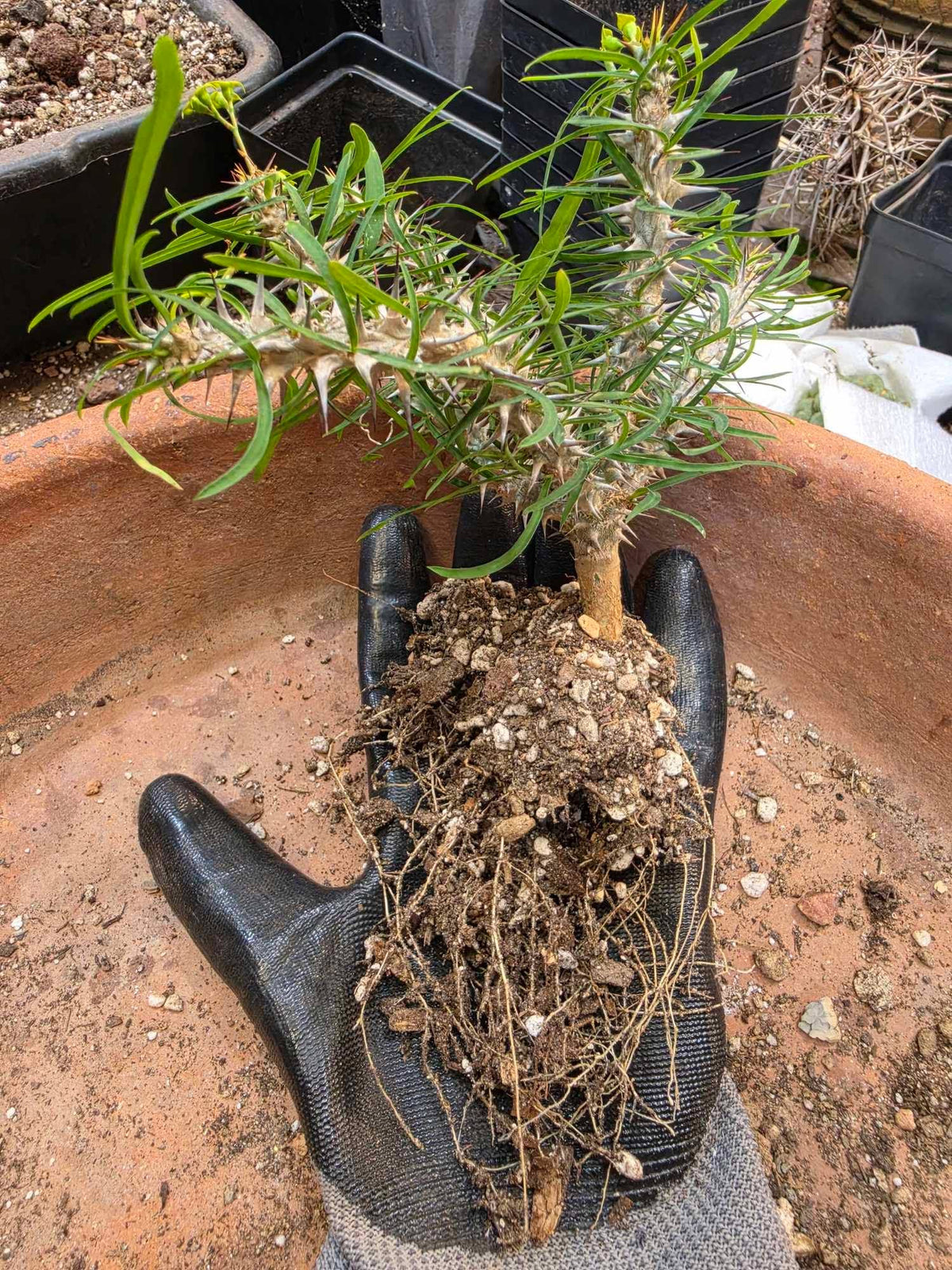
Roots as shown.
Will be shipped bare root.
🌵
Euphorbia rossii is an unusual Madagascan succulent distinguished by its slender, heavily spined branches, narrow green leaves, and exceptionally intricate floral structures. Its open, irregular growth habit creates a delicate, almost wiry silhouette that contrasts beautifully with the formidable spination covering its stems. During active growth, narrow leaves emerge among the spines, softening the plant's appearance, while its remarkable inflorescences introduce an entirely different dimension of botanical interest. The flowers are especially fascinating, with small, glossy yellow reproductive structures nestled within beautifully patterned green bracts, creating miniature compositions of extraordinary detail.
This exact specimen is particularly appealing at approximately 5" tall above the soil line × 8" wide, with several gracefully arching, silver-gray spiny branches extending outward from a compact central framework. Its fine green foliage creates a beautiful contrast against the pale stems and sharp spines, while multiple flowering points add vivid touches of yellow-green throughout the plant. The close-up photographs reveal the remarkable intricacy of the floral structures: softly curved, olive-green bracts densely speckled with reddish-brown markings, surrounding glossy golden-yellow glands and tiny central flowers. Despite its modest height, this specimen has an expansive, naturally sculptural presence, with an abundance of detail that rewards close observation.
Care Instructions
☀️ Light
Provide very bright light with gentle direct morning sun or strong filtered sunlight. Adequate light encourages sturdy growth, healthy foliage, and flowering. Gradually acclimate the plant to stronger sunlight after shipping, particularly if it has been grown under protected conditions. Avoid sudden exposure to intense afternoon sun.
💧 Water
Water thoroughly during active warm-season growth, allowing the growing medium to dry well between waterings. Reduce watering substantially during cooler periods or when growth slows. Avoid prolonged moisture around the roots, especially when temperatures are low. Seasonal changes in foliage and growth activity should guide watering frequency.
🪨 Soil
Requires a highly porous, fast-draining succulent medium with excellent root aeration. A generous proportion of pumice, lava rock, coarse grit, or similar inorganic material is recommended. Avoid dense, water-retentive soils that remain damp for extended periods.
🌡️ Temperature
Warm-growing and frost-sensitive. Protect from freezing temperatures and prolonged cold. As a conservative cultivation precaution, maintain temperatures above approximately 50°F (10°C), particularly when the soil is moist. Warm conditions are preferable during active growth and flowering.
🌬️ Humidity
Prefers good air circulation and conditions that allow the growing medium to dry efficiently. Moderate ambient humidity is generally acceptable, but avoid prolonged combinations of cool temperatures, stagnant air, and wet soil.
📈 Growth Habit
A compact, irregularly branching succulent with slender, heavily spined stems and narrow leaves emerging along actively growing portions. The branches may extend outward in an open, somewhat sprawling arrangement rather than forming a strictly upright column. Its naturally irregular architecture becomes increasingly distinctive as individual stems develop and branch.
✍️ Special Note
The extraordinary floral structures visible in the photographs are a particularly desirable feature of this exact specimen. Like other Euphorbias, Euphorbia rossii produces specialized inflorescences known as cyathia, which contain highly reduced flowers surrounded by modified structures. Flowering is seasonal and cannot be guaranteed to continue after shipping. The plant's slender branches and sharp spines require careful handling. Damaged tissue may release irritating, potentially toxic milky latex; wear gloves and avoid contact with skin and eyes.
Why It Stands Out
- Unusual Euphorbia rossii from Madagascar
- Exact specimen measuring approximately 5" tall × 8" wide
- Beautifully flowering in the photographs
- Extraordinary olive-green floral bracts with fine reddish-brown speckling
- Glossy golden-yellow floral glands and intricate central structures
- Gracefully arching, silver-gray, heavily spined branches
- Delicate narrow green foliage contrasting with formidable spination
- Open, naturally asymmetrical branching architecture
- Remarkable botanical detail in a compact specimen
- Excellent addition to an advanced Madagascar or unusual Euphorbia collection
Collector Notes
Madagascar is one of the world's most extraordinary centers of succulent plant diversity, with an exceptional concentration of endemic species that have evolved in relative isolation over millions of years. Among its most remarkable botanical groups are the succulent Euphorbias, whose extraordinary variety of growth forms reflects adaptation to the island's diverse landscapes, seasonal rainfall patterns, and often challenging environmental conditions. Some develop massive trunks or swollen underground storage organs, while others form compact spiny shrubs, intricate branching structures, or diminutive plants whose most remarkable features are revealed only at close range.
Euphorbia rossii belongs to this fascinating tradition of Madagascan botanical diversity. Its slender, heavily armed stems and narrow foliage create an appearance quite different from the imposing columnar Euphorbias more commonly encountered in cultivation. Rather than relying on substantial stem mass or dramatic geometric symmetry, the plant expresses its character through an intricate network of narrow branches, sharp spines, and delicate leaves. The contrast between these elements gives it an unusual combination of ruggedness and refinement, particularly when the plant is actively growing and flowering.
The floral structures are undoubtedly among the most fascinating features of this specimen. Euphorbias possess one of the most unusual reproductive arrangements in the flowering plant world: the cyathium. Although a cyathium may resemble a single flower, it is actually a specialized inflorescence composed of highly reduced flowers surrounded by modified structures. Typically, a central female flower is accompanied by several male flowers, while nectar-producing glands and surrounding bracts contribute to the appearance of a unified floral display. This remarkable arrangement is a defining botanical characteristic of the genus.
In this particular specimen, the cyathia are exceptionally beautiful. The close-up photographs reveal rounded, slightly pointed green bracts with a fine overlay of reddish-brown speckling, creating an almost intricately painted surface. Within these structures are glossy, golden-yellow glands arranged around the tiny reproductive elements. The combination of patterned green tissue and luminous yellow detail is striking, particularly given the diminutive scale of the individual inflorescences. What might initially appear to be a simple cluster of small flowers becomes, under closer examination, an extraordinary example of botanical specialization.
The relationship between these delicate floral structures and the plant's heavily spined branches is equally compelling. The stems are narrow and pale, with numerous sharp spines projecting outward, creating an almost defensive framework around the fresh green leaves and flowering points. This contrast is characteristic of many unusual succulent plants, in which structures associated with protection and drought adaptation coexist with surprisingly delicate reproductive organs. The result is a plant whose appearance changes dramatically depending on whether it is viewed as a whole or examined in detail.
At approximately 5" tall above the soil line × 8" wide, this exact specimen has developed an especially attractive horizontal spread. Several branches extend outward from the central structure, creating a broad, open silhouette that is considerably more expansive than its height might suggest. The narrow foliage follows the contours of the branches, while the flowering points appear near their growing ends. Its naturally irregular arrangement gives the plant a sense of movement and individuality that would be difficult to achieve through conventional pruning or shaping.
For collectors, one of the great pleasures of unusual Euphorbias is discovering how much botanical complexity can exist within a relatively small plant. A species need not be enormous, heavily crested, or dramatically caudiciform to be extraordinary. Sometimes its greatest appeal lies in the fine structure of its branches, the arrangement of its spines, or the remarkable intricacy of its flowers. Euphorbia rossii is a wonderful example of this quieter kind of botanical distinction, offering a wealth of visual and scientific interest within a compact, naturally sculptural form.
This exact specimen is especially memorable because it brings so many of these qualities together at once: slender silver-gray branches, delicate green leaves, formidable spination, and beautifully developed floral structures with extraordinary green-and-yellow coloration. Its unusual architecture and remarkable flowers make it a particularly rewarding subject for close observation and photography. For collectors of Madagascan succulents, specialist Euphorbias, or plants with fascinating reproductive structures, this is a distinctive and beautifully detailed specimen that embodies the extraordinary diversity of the genus.