Shangri-Ha Cactus Ranch
Euphorbia neriifolia cristata variegata - So big!!
Couldn't load pickup availability
Euphorbia neriifolia f. cristata variegata — Variegated Crested Indian Spurge
You will receive this exact grafted specimen.
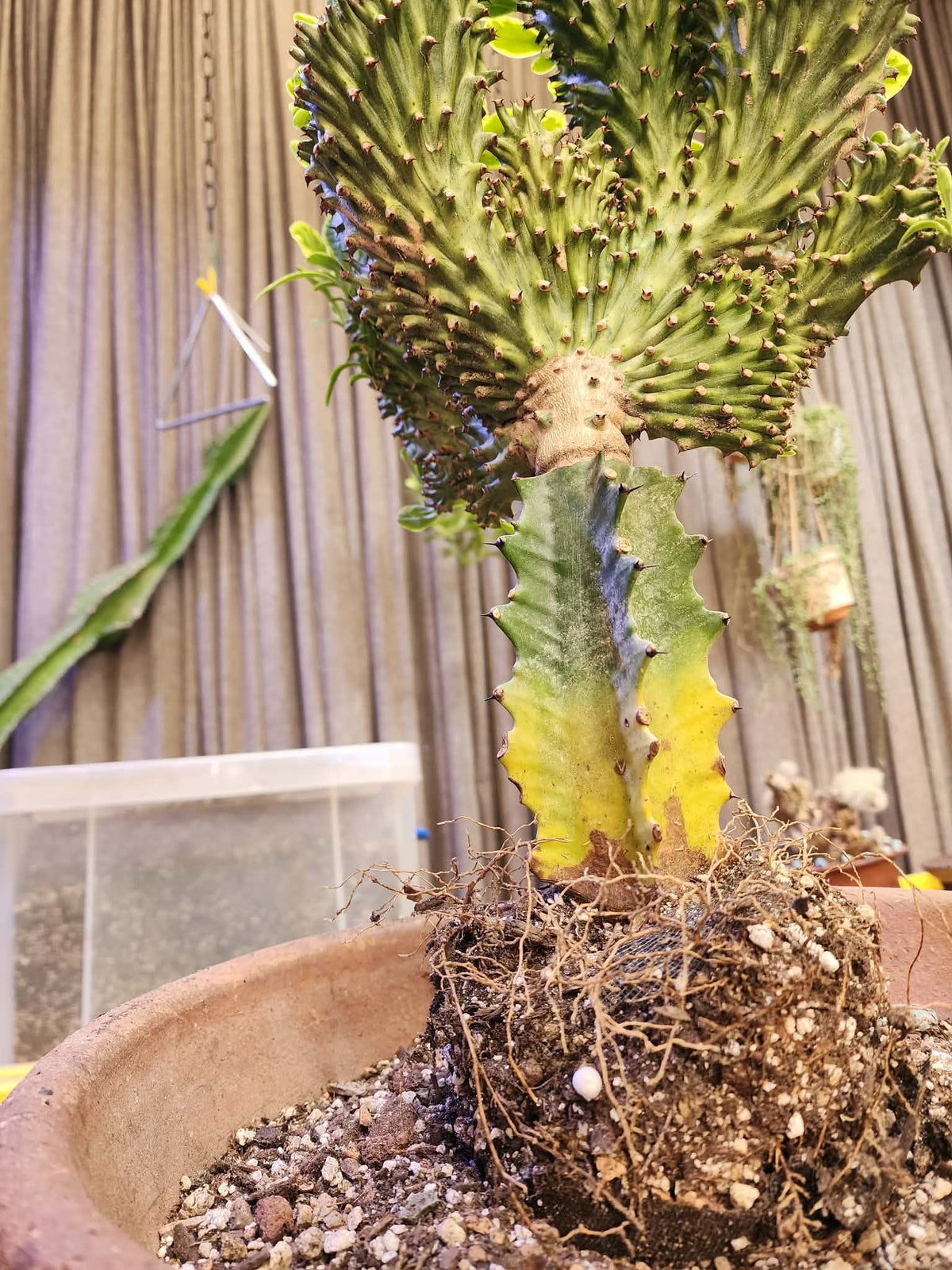
This is a BIG, spectacular established crest!
Scion measures approximately 11" tall × 14" wide.
Entire specimen measures approximately 15" tall.
Showcased here in Handmade Pottery — Volcanic Coil Vessel No. 201 (sold separately).
Roots as shown.
Due to the substantial size of this specimen, shipping will be a little more expensive than usual.
Will be shipped bare root.
🌵
Euphorbia neriifolia f. cristata variegata is an extraordinary crested and variegated form of Indian Spurge, combining two dramatic mutations in a single plant. Instead of producing the conventional upright branching stems of the species, the growing point has developed into a broad, undulating crest, while variegation interrupts the green tissue with areas of cream, ivory, yellow, and pale green.
This exact specimen is exceptional for its sheer scale. The established crest measures approximately 14" across × 11" tall, forming a huge, densely folded fan above its grafting stock. At approximately 15" tall overall, this is no small novelty graft—it is a substantial mature display specimen with years of accumulated crested growth.
Care Instructions
☀️ Light
Provide very bright filtered light or gentle direct sun. Because variegated tissue contains less chlorophyll than fully green growth, it can be more susceptible to scorching under intense afternoon sun. Strong light helps maintain compact growth and attractive coloration, but acclimate gradually after shipping or changes in growing conditions.
💧 Water
Water thoroughly during active growth, then allow the soil to dry substantially before watering again. Reduce watering during cooler or less active periods. Avoid prolonged moisture around both the roots and graft union.
🪨 Soil
Requires a very fast-draining succulent mix with substantial mineral content. Pumice, lava rock, coarse grit, and similar inorganic materials provide excellent drainage and root aeration.
🌡️ Temperature
Prefers warm conditions and should be protected from frost and prolonged cold. Variegated and grafted specimens are particularly best protected from combinations of low temperatures and wet soil.
🌬️ Humidity
Moderate humidity is generally tolerated with excellent airflow and drainage. The many folds of a large crest can trap moisture and debris, so good air circulation around the entire plant is especially beneficial.
📈 Growth Habit
Rather than maintaining a single conventional growing point, the crested meristem expands laterally, producing an increasingly broad fan of folded, twisting growth. As the crest enlarges, new ridges and convolutions develop along its growing edge, gradually creating the elaborate sculptural form seen in mature specimens.
✍️ Special Note
This specimen is grafted, meaning the crested variegated scion is supported by a vigorous rootstock. The graft union is an intentional part of the plant and allows the unusual upper growth to be maintained more reliably than it might be on its own roots.
Variegation can change as new tissue develops. Individual areas may contain different proportions of green and pale tissue, and occasional changes in color distribution are normal.
Like other members of the genus Euphorbia, this plant contains a milky latex sap that can severely irritate skin and eyes and is toxic if ingested. Extra care is warranted with a specimen this large. Wear protection when handling damaged tissue and keep sap away from eyes, mouth, children, and pets.
Natural scars, corking, old growth, irregularities at the graft union, and evidence of previous growing seasons are part of an established collector specimen's history rather than imperfections. Please review all photographs carefully, as you will receive the exact plant shown.
Why It Stands Out
- Enormous 14" wide established crest
- Scion approximately 11" tall
- Approximately 15" tall overall
- Exceptional mature display specimen
- Combines both cresting and variegation
- Extraordinary cream, yellow, pale green, and green coloration
- Dense, deeply folded sculptural growth
- Dramatic fan-shaped architecture
- Established graft supporting substantial mature growth
- Every section of the crest develops differently
- Far beyond the size of typical small novelty grafts
- The exact specimen shown here
Collector Notes
There are two separate botanical accidents responsible for the appearance of this plant.
The first is variegation.
Normal green plant tissue contains abundant chlorophyll, allowing it to capture light and convert that energy into sugars through photosynthesis. In a variegated plant, some tissue produces reduced amounts of chlorophyll—or none at all.
That creates the extraordinary patches of cream, ivory, yellow, and pale green visible throughout this specimen.
Beautiful as those areas are, they come at a biological cost.
Pale tissue contributes less photosynthetic energy than green tissue, which is one reason strongly variegated plants may grow more slowly and require somewhat different handling from their ordinary green counterparts.
Then something even stranger happened.
The plant crested.
Ordinarily, a growing stem is organized around a relatively compact growing point called an apical meristem. New tissue is produced there in an orderly progression, allowing the stem to continue elongating.
In a crested plant, that growing point becomes elongated rather than remaining concentrated in one small location.
Growth begins occurring along a line.
As that line continues producing tissue, the plant can no longer accommodate the new growth as a conventional stem. It begins to buckle, fold, wave, twist, and fan outward.
The result is fasciation—the phenomenon responsible for this extraordinary crest.
And it never produces precisely the same sculpture twice.
One section may curl tightly against itself while another stretches outward. Ridges divide, folds collide, and new growing edges emerge along the perimeter. The larger the crest becomes, the more complex that architecture can become.
That is why size matters enormously with specimens like this one.
A tiny graft demonstrates the mutation.
A 14" mature crest demonstrates what the mutation can actually do.
Years of growth have allowed this specimen to accumulate layer upon layer of folds, producing an object that begins to look less like a conventional plant than coral, geological strata, or some strange living topography.
The graft beneath it is part of that story.
Highly variegated and crested tissue can be less vigorous than ordinary green growth. By joining the unusual scion to a robust compatible rootstock, growers provide it with an established root system capable of supporting growth that might otherwise be considerably more difficult to maintain.
The rootstock does the ordinary work.
Above it, biology gets weird.
And because this specimen combines fasciation with variegation, no two sections of the crest behave visually in exactly the same way. The folds create shadow and depth while changing concentrations of chlorophyll create another layer of pattern across their surfaces.
At approximately 14" wide, the crest has reached the point where those two phenomena become architectural.
It occupies space.
It casts shadows on itself.
Its edges rise, fall, divide, and disappear behind one another.
What began as an abnormality in microscopic growing tissue has eventually produced a living sculpture more than a foot across.
Big, strange, beautifully imperfect, and spectacularly excessive, this established Euphorbia neriifolia f. cristata variegata is exactly the kind of plant that demonstrates why collectors eventually stop asking whether a succulent is beautiful and start asking:
How on earth did a plant decide to do that?
Share