Shangri-Ha Cactus Ranch
Euphorbia neriifolia cristata variegata - So big!!
Euphorbia neriifolia cristata variegata - So big!!
Couldn't load pickup availability
Euphorbia neriifolia f. cristata variegata — Variegated Crested Indian Spurge
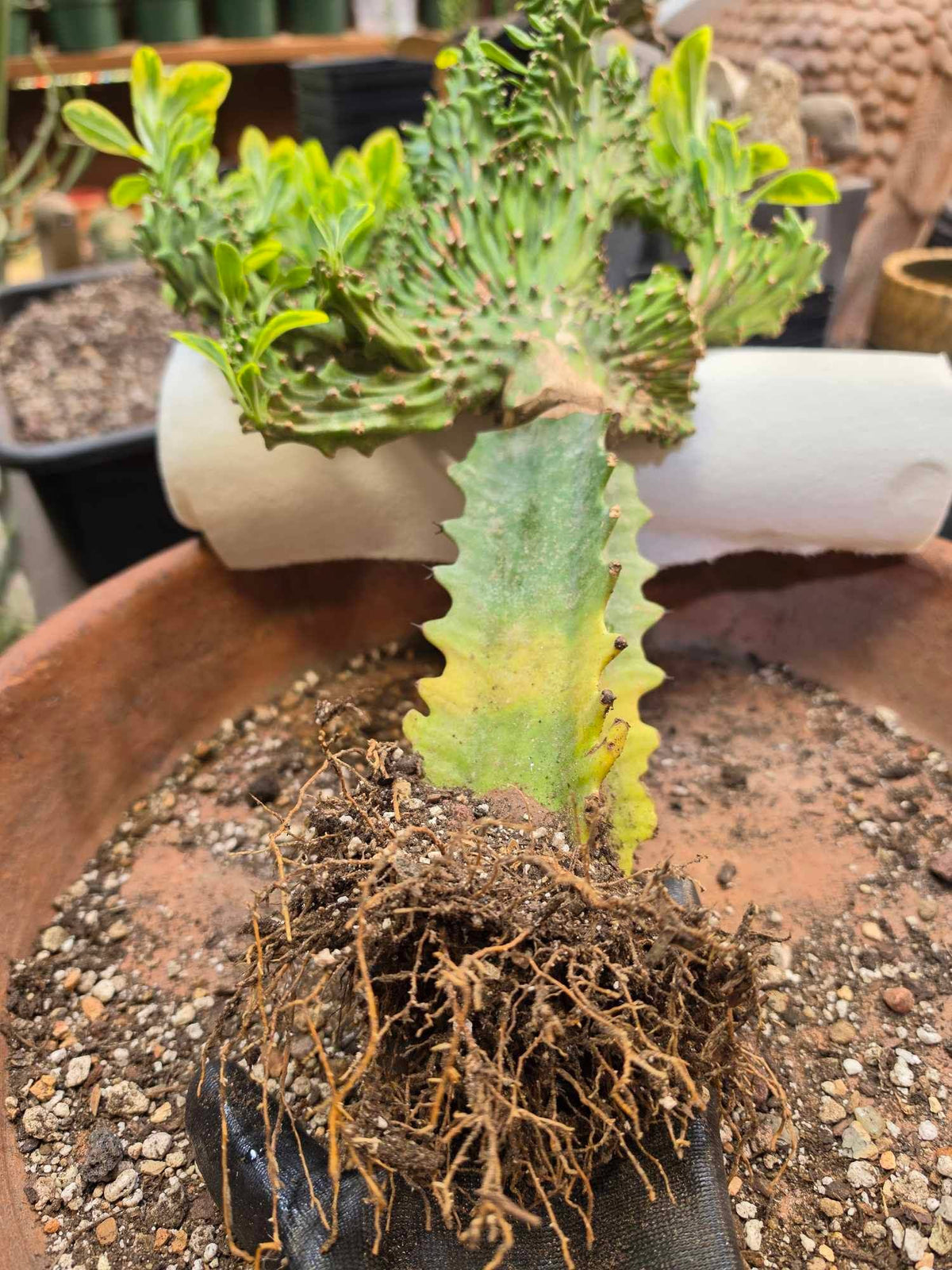
You will receive this exact grafted specimen.
This is a BIG, spectacular established crest!
Scion measures approximately 10" tall × 11" wide.
Entire specimen measures approximately 13" tall.
Showcased here in Handmade Pottery — Turquoise Ledger Vessel No. 25 (sold separately).
Roots as shown.
Will be shipped bare root.
🌵
Euphorbia neriifolia f. cristata variegata is an extraordinary horticultural form of the Indian Spurge, combining two of the most fascinating variations in succulent plant development: cresting and variegation. The species ordinarily develops upright, fleshy, angular stems bearing short spines and seasonal foliage, but in this remarkable form, the growing tissue has expanded into broad, undulating fans and irregularly folded crests. Variegation introduces a further dimension of beauty, with green leaves displaying pale yellow and cream-colored margins and markings. The result is an exuberant, almost fantastical succulent whose architecture is unlike that of the conventional species.
This exact specimen is particularly exceptional for the size, maturity, and complexity of its established crest. The scion alone measures approximately 10" tall × 11" wide, with an extraordinary arrangement of broad, rippling green fans rising from a substantial central crest. Several sections extend upward into tall, deeply folded structures, while others spread outward into smaller, intricately contoured growths. Numerous short spines punctuate the ridged surfaces, and fresh green leaves with beautiful yellow variegation emerge from multiple growing points throughout the crest. Grafted onto a sturdy succulent rootstock, the entire specimen reaches approximately 13" tall. This is a substantial, visually commanding collector piece with an extraordinary degree of sculptural development.
Care Instructions
☀️ Light
Provide very bright light with gentle direct morning sunlight or strong filtered sun. Adequate light supports healthy growth, compact crested development, and attractive foliage. Variegated tissues may be more sensitive to intense sunlight, so protect from sudden exposure to harsh afternoon sun. Acclimate gradually to brighter conditions after shipping.
💧 Water
Water thoroughly during active warm-season growth, allowing the growing medium to dry well between waterings. Reduce watering substantially during cooler periods or when growth slows. Avoid prolonged moisture around the roots and graft union. Because this is a grafted specimen, watering should accommodate the needs of the rootstock as well as the crested scion.
🪨 Soil
Requires a highly porous, fast-draining succulent medium with excellent root aeration. A generous proportion of pumice, lava rock, coarse grit, or similar inorganic material is recommended. Avoid heavy, water-retentive soils. Good drainage is particularly important for established grafted Euphorbias.
🌡️ Temperature
Warm-growing and frost-sensitive. Protect from freezing temperatures and prolonged cold. As a conservative cultivation precaution, maintain temperatures above approximately 50°F (10°C), especially when the growing medium is damp. Avoid sudden temperature extremes and prolonged cold, wet conditions.
🌬️ Humidity
Prefers good air circulation and conditions that allow the growing medium and crested surfaces to dry efficiently. Avoid prolonged combinations of cool temperatures, stagnant humidity, and moisture trapped among the folds of the crest.
📈 Growth Habit
A grafted, crested succulent whose scion develops broad, irregularly expanded fans rather than the conventional upright stems of typical Euphorbia neriifolia. Multiple crested sections may grow in different directions, producing an increasingly complex sculptural crown. Variegated leaves may emerge along actively growing portions, while seasonal foliage changes can alter the plant's appearance throughout the year. Crested growth is inherently unpredictable, and individual specimens develop unique forms.
✍️ Special Note
This is a grafted specimen, with the variegated crested Euphorbia neriifolia scion supported by a separate succulent rootstock. The graft union should be protected from physical damage, and any growth emerging directly from the rootstock should be distinguished from the desired crested scion. Seasonal leaf loss may occur and does not necessarily indicate declining health. Variegation can vary with growth and environmental conditions. As with other Euphorbias, damaged tissue may release irritating, potentially toxic milky latex. Wear gloves when handling damaged stems and avoid contact with skin and eyes.
Why It Stands Out
- Extraordinary Euphorbia neriifolia f. cristata variegata
- BIG, spectacular established crested specimen
- Impressive scion measuring approximately 10" tall × 11" wide
- Entire grafted specimen approximately 13" tall
- Magnificent broad, rippling fan-shaped crest
- Multiple upright and outward-growing crested sections
- Beautiful green foliage with yellow and cream variegation
- Intricate ridged surfaces accented by numerous short spines
- Substantial, mature-looking central crest with exceptional architectural complexity
- Established graft onto a sturdy succulent rootstock
- Remarkable combination of fasciation and variegation
- Exceptional centerpiece for an advanced Euphorbia or crested succulent collection
Collector Notes
Euphorbia neriifolia, commonly known as Indian Spurge, is a distinctive succulent species native to the Indian subcontinent and long appreciated for its unusual combination of fleshy stems, prominent spines, and seasonal foliage. In its typical form, the plant develops upright, branching stems with angular or somewhat cylindrical surfaces, eventually forming a substantial shrub or small tree. Its leaves emerge along actively growing portions of the stems, introducing a surprisingly leafy character to a plant whose succulent architecture is otherwise reminiscent of certain cacti. The species belongs to the enormous genus Euphorbia, whose members exhibit one of the most remarkable ranges of growth forms in the flowering plant world.
The extraordinary specimen offered here represents a dramatic departure from that conventional architecture. Rather than producing the familiar upright stems of typical Euphorbia neriifolia, its growing tissue has developed into an elaborate series of expanded, undulating crests. This phenomenon, known as fasciation, occurs when the organization of a plant's growing point is altered, producing a broader or elongated region of active growth instead of the usual concentrated growing tip. The resulting structures may form flattened fans, intricate folds, convoluted ridges, or densely compressed branching patterns, depending on the species and the particular expression of the growth variation.
In this specimen, fasciation has produced an especially impressive architectural composition. The central crest forms a broad, heavily textured foundation from which multiple additional crested sections rise and spread outward. Some portions develop into tall, vertically oriented fans, while others form shorter, irregularly folded projections that extend horizontally. The surfaces are richly sculptured, with numerous ridges and short spine-bearing points accentuating the contours. This complex arrangement creates an extraordinary sense of movement, as though the plant were continually unfolding into new and unexpected shapes.
The variegation introduces an additional layer of botanical interest. In variegated plants, portions of the tissue contain reduced amounts of chlorophyll or exhibit altered pigment distribution, producing areas of cream, yellow, pale green, or other contrasting coloration. In this particular specimen, the effect is especially attractive in the foliage, where fresh green leaves display beautiful pale yellow margins and markings. These leaves emerge from numerous points throughout the crest, softening the heavily sculptured green framework and introducing a delicate contrast to the spiny succulent tissue beneath them.
The combination of cresting and variegation is particularly desirable because it brings together two distinct forms of horticultural variation within a single plant. Fasciation changes the physical organization of growth, while variegation changes the distribution of pigmentation. Each can produce highly individual results, and together they create specimens whose appearance is exceptionally difficult to duplicate. Even plants propagated from the same horticultural form may develop different proportions, crest orientations, and patterns of foliage coloration as they mature.
Grafting adds another fascinating dimension to this specimen. The crested, variegated scion is supported by a separate succulent rootstock, allowing the unusual upper growth to develop on an established root system. Grafting is widely employed in the cultivation of rare, slow-growing, unusually formed, or chlorophyll-reduced succulents, particularly when their ornamental characteristics make conventional cultivation more challenging. The visible union between scion and rootstock is an important part of the plant's horticultural history, illustrating the specialized cultivation techniques used to preserve and develop extraordinary forms.
One of the most compelling qualities of this exact specimen is its substantial size. Small crested Euphorbias can be fascinating, but an established crest of this scale offers an entirely different visual experience. With a scion measuring approximately 10" tall × 11" wide, the plant has developed a broad, complex crown with numerous individual growth sections. Its overall height of approximately 13" gives it considerable presence, while the width and depth of the crest create a sculptural composition that can be appreciated from multiple angles.
The foliage is equally important to the overall effect. The fresh, variegated leaves appear at numerous points across the crest, creating a lively contrast with the mature, heavily ridged succulent tissue. Depending on growing conditions and seasonal activity, the plant may carry abundant foliage or reveal more of its underlying sculptural framework. This changing relationship between leaves and stems contributes to the visual interest of Euphorbia neriifolia and makes the plant especially rewarding to observe over time.
This exact Euphorbia neriifolia f. cristata variegata is a remarkable collector specimen that embodies several of the most desirable qualities of unusual succulent cultivation: substantial established growth, extraordinary fasciation, beautiful variegation, and a complex, highly individual architecture. Its magnificent broad crest, multiple upright fans, fresh yellow-edged foliage, and impressive overall proportions make it an exceptional centerpiece for a serious collection. For enthusiasts of crested Euphorbias, variegated succulents, and extraordinary botanical forms, this is a spectacular opportunity to acquire a plant whose sculptural character is entirely its own.