Shangri-Ha Cactus Ranch
Euphorbia hedyotoides - 2 Feet Tall!
Euphorbia hedyotoides - 2 Feet Tall!
Couldn't load pickup availability
Euphorbia hedyotoides — Massive Old Madagascan Caudiciform Specimen
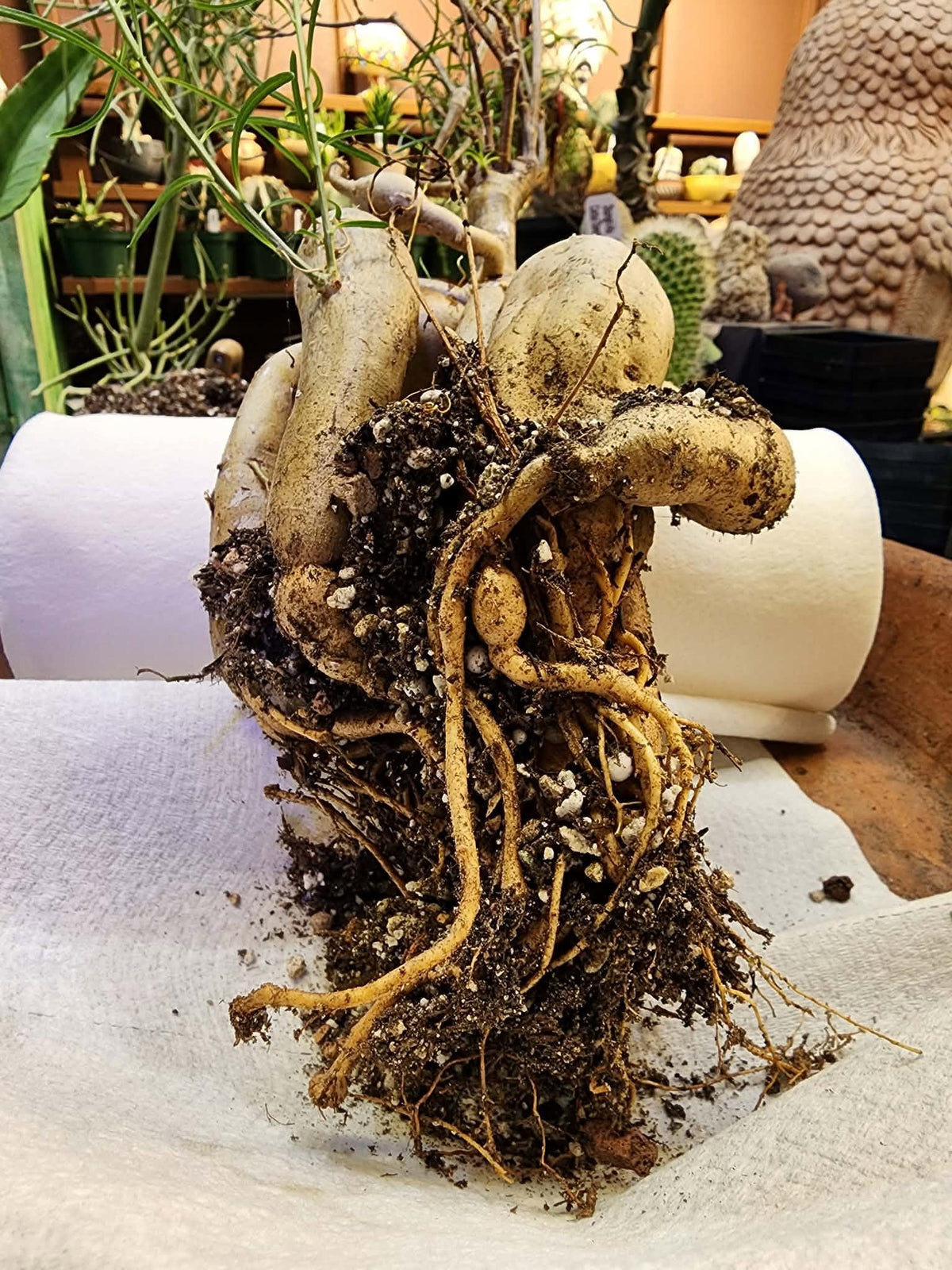
You will receive the exact, massive, old specimen shown here.
Amazing caudex!
Native to Madagascar.
Measures approximately 25" tall above the soil line.
This is a very large specimen and will be more expensive to ship due to its size.
Roots as shown.
Showcased here in one-of-a-kind handmade pottery — Terra Cotta Atlas Vessel No. 49 (sold separately).
Will be shipped bare root.
🌵
Euphorbia hedyotoides is an extraordinary caudiciform Euphorbia native to Madagascar, an island renowned for its remarkable concentration of endemic plants and some of the most unusual succulent growth forms on Earth. Unlike the familiar spiny, cactus-like Euphorbias, this species develops a substantial woody, swollen base from which its aboveground growth emerges, creating an appearance that is closer to an ancient miniature tree than a conventional succulent.
The species belongs to a fascinating group of Madagascan Euphorbias that have evolved swollen storage structures as adaptations to environments where moisture availability can be highly seasonal. Rather than relying exclusively on fleshy leaves or thick green stems, these plants invest heavily in the development of a caudex—a specialized structure capable of storing resources and supporting survival through unfavorable conditions.
With age, the caudex can become increasingly substantial, developing the irregular contours, woody textures, and architectural complexity that make established specimens so desirable among collectors.
And then there is this specimen.
Standing approximately 25 inches tall above the soil line, this is an exceptionally imposing example of Euphorbia hedyotoides. Its most remarkable feature is its enormous, mature caudex, a structure that gives the entire plant the presence of something far older and more substantial than its container might suggest.
This is not a small starter plant whose character remains a promise for the future. It is an established, old specimen whose principal attraction is already fully apparent.
The caudex is the centerpiece.
Its considerable size represents the accumulation of growth over an extended period, although the plant's precise age cannot be determined reliably from its dimensions alone. What is immediately evident is the extraordinary physical development of a species whose swollen base is among its defining botanical characteristics.
At 25 inches tall, this is a plant intended to command attention. Its sculptural presence makes it particularly appealing to collectors who appreciate the strange intersection of botanical adaptation, natural architecture, and the passage of time.
Shown here in our Terra Cotta Atlas Vessel No. 49, a one-of-a-kind handmade piece available separately, the specimen has the visual authority of a small botanical monument.
Care Instructions
☀️ Light
Provide very bright light with some direct sunlight, preferably gentle morning sun or filtered sunlight during the hottest part of the day. Strong light supports healthy, compact growth, but established specimens should be acclimated gradually following shipping or changes in growing conditions. Avoid suddenly exposing previously sheltered stems or caudex surfaces to intense afternoon sun.
💧 Water
Water carefully during active growth, allowing the growing medium to dry appropriately between waterings. Although the caudex stores resources, this does not mean the plant should remain completely dry while actively growing. Reduce watering substantially when growth slows or the plant enters dormancy, particularly during cooler periods. Avoid prolonged saturation around the roots and caudex, as rot can develop when moisture persists under unfavorable conditions.
🪨 Soil
Use a very fast-draining, mineral-rich succulent mix with generous proportions of pumice, lava rock, coarse grit, decomposed granite, or similar inorganic materials. Some organic material may be included to support root activity, but the overall substrate should remain open and porous. Excellent drainage is especially important for a valuable, mature caudiciform specimen.
🌡️ Temperature
This is a warmth-loving Madagascan Euphorbia and should be protected from frost. Maintain relatively warm conditions, particularly during periods of active growth. Avoid prolonged exposure to cold, damp conditions, which can be particularly damaging to caudiciform plants.
🌬️ Humidity
Provide good air circulation and avoid persistently humid, stagnant conditions. In climates with high atmospheric humidity, careful watering and a highly porous substrate are especially important.
📈 Growth Habit
Euphorbia hedyotoides develops a swollen, woody caudex that supports its aboveground growth. Its seasonal activity may vary with temperature, light, and moisture availability. Established specimens can develop increasingly distinctive proportions as the caudex enlarges and the plant matures.
✍️ Special Note
This is a large, old, established caudiciform specimen, and its substantial size requires special consideration when handling, repotting, and shipping.
The caudex should be protected from unnecessary damage, and the plant should be repotted with care to preserve the established root system. Avoid burying portions of the caudex that have long been exposed above the soil line without considering their previous growing conditions.
Like other members of the genus, Euphorbia hedyotoides may produce irritating and toxic milky latex sap if damaged. Avoid contact with skin and especially eyes, wear gloves when handling damaged tissue, and keep the plant away from children and pets.
Natural corking, woody surfaces, scars, irregularities, and other signs of age are expected on mature caudiciform plants. These characteristics contribute to the individuality of an established specimen.
Shipping Note: Because this plant measures approximately 25 inches tall above the soil line and has a substantial caudex, shipping will be more expensive than for a typical small succulent. It will be shipped bare root, with careful attention to protecting its valuable structure.
Please review all photographs carefully, as you will receive the exact specimen shown.
Why It Stands Out
• Euphorbia hedyotoides, an unusual caudiciform species native to Madagascar
• Massive, old, established specimen
• Approximately 25" tall above the soil line
• Extraordinary, substantially developed caudex
• Distinctive woody, tree-like growth habit
• Remarkable example of caudiciform adaptation
• Architectural presence rarely associated with conventional succulents
• Mature character that cannot be reproduced quickly from a young plant
• Particularly appealing to collectors of Madagascan Euphorbias
• A dramatic botanical specimen suitable for a prominent display
• Showcased in Terra Cotta Atlas Vessel No. 49, sold separately
• The exact specimen shown here
Collector Notes
Some plants spend their lives growing upward.
Others spend a remarkable amount of energy preparing for the possibility that growing at all may someday become difficult.
Euphorbia hedyotoides belongs to the latter group.
Its story begins in Madagascar, the enormous island off the southeastern coast of Africa whose long geographical isolation has produced one of the world's most extraordinary collections of endemic plants.
Madagascar is home to an astonishing diversity of Euphorbias. Some resemble cacti, with thick green stems and formidable spines. Others grow as shrubs or small trees. Still others have evolved swollen underground or partially exposed storage structures that seem almost disproportionate to the plants they support.
Among these unusual forms, the caudiciform Euphorbias are particularly fascinating.
A caudex is not simply a thick trunk.
Depending on the species, it may develop from swollen stem tissue, root tissue, or a combination of structures. Its principal biological importance lies in the storage of water and other resources, allowing the plant to endure periods when conditions are unfavorable for active growth.
For a plant living in an environment with strongly seasonal moisture availability, this represents an extraordinary investment in survival.
Instead of producing only the tissues required for immediate growth, the plant builds a reserve.
And over time, that reserve can become the most visually remarkable part of the entire organism.
In Euphorbia hedyotoides, the swollen, woody base is central to the plant's character. As the specimen develops, the caudex becomes an increasingly prominent architectural feature, giving the plant a solidity and apparent permanence that contrasts beautifully with its more temporary seasonal growth.
It is a fascinating relationship between endurance and renewal.
The caudex remains, storing resources and supporting the plant through changing conditions. Above it, growth responds to the opportunities presented by warmth, light, and moisture.
This separation between long-term storage and seasonal activity is one of the defining pleasures of growing caudiciform plants.
The collector is not simply watching a plant become larger.
The collector is watching an organism whose entire architecture reflects a strategy for surviving uncertainty.
And that brings us to this particular specimen.
At approximately 25 inches tall above the soil line, it is an imposing example of a species whose most desirable qualities develop gradually.
The caudex is extraordinary.
There is something profoundly satisfying about a plant that has invested so much of its growth into a single substantial structure. Unlike the comparatively rapid production of leaves or young stems, the development of a mature caudex represents an accumulation of growth that cannot simply be hurried.
The precise age of this specimen is unknown, and it would be misleading to assign a number based solely on its size.
Caudiciform plants can grow at very different rates depending on their genetics, cultivation history, growing conditions, and the resources available to them.
But age is not always best appreciated as a number.
Sometimes it is visible in the character of the plant itself.
In the development of woody tissues, the increasing complexity of the caudex, and the substantial proportions that distinguish an established specimen from a young one.
This is particularly important when evaluating collector plants.
A small Euphorbia hedyotoides may possess all the botanical potential of a much larger example, but it cannot yet offer the same physical presence.
That distinction matters.
For collectors of caudiciform plants, maturity is often the principal attraction. The appeal lies not merely in owning a particular species, but in acquiring an individual whose growth has already produced something exceptional.
A substantial caudex becomes a record of the plant's development.
Its shape is not manufactured according to a predetermined design. It emerges through the interaction of inherited growth patterns, environmental conditions, and time.
No two mature specimens need develop in precisely the same way.
That individuality is part of their fascination.
There is also an important distinction between a caudiciform Euphorbia and the more familiar succulents commonly sold for their colorful leaves, symmetrical rosettes, or seasonal flowers.
With a plant such as Euphorbia hedyotoides, the structure itself is the principal ornament.
The swollen base, the relationship between caudex and aboveground growth, and the unusual proportions of the whole specimen are what give it its character.
It is botanical sculpture, but sculpture produced by biological necessity rather than artistic intention.
The form exists because it serves the plant.
That it also happens to be beautiful is a remarkable consequence.
Madagascar's caudiciform flora offers some of the finest examples of this relationship between function and appearance. Across the island, unrelated plants have evolved extraordinary swollen trunks, enlarged roots, and water-storing stems in response to the challenges of their environments.
The results can appear almost fantastical.
Some resemble bottles. Others suggest ancient trees reduced to miniature proportions. Still others seem to have concentrated the greater part of their existence into an enormous, irregular base from which comparatively modest growth emerges.
What unites them is the extraordinary importance of stored resources.
A plant that can survive an unfavorable season has the opportunity to grow again when conditions improve.
A plant that cannot may never have that opportunity.
The caudex is, in a very real sense, an investment in the future.
And in a mature specimen, it is an investment that has become visible.
This is why collectors are so often drawn to older caudiciform plants.
They possess a quality that is difficult to describe in purely horticultural terms. Their forms suggest endurance, accumulated experience, and a kind of botanical patience that seems almost foreign to the pace of ordinary life.
A mature caudex does not announce itself with the fleeting brilliance of a flower.
It simply remains.
Year after year, growing when conditions permit, conserving resources when they do not, and gradually developing into something that could not have existed without the passage of time.
At 25 inches tall, this Euphorbia hedyotoides has reached a scale at which those qualities can be appreciated immediately.
It is not a plant that disappears among smaller pots on a crowded shelf.
It deserves room.
Room for the extraordinary caudex to be seen, room for the entire structure to be appreciated, and a setting that respects the unusual proportions of an established Madagascan specimen.
The Terra Cotta Atlas Vessel No. 49 provides just such a presentation. Its handmade character and earthy material offer a fitting visual companion to a plant whose appeal lies in natural form, texture, and age.
The vessel is available separately, but the relationship illustrates an important principle in displaying mature caudiciform plants.
The container should support the composition without competing with the specimen.
And with a plant of this scale, the specimen has more than enough presence of its own.
There is one final consideration worth mentioning.
Plants such as this are not interchangeable commodities.
A young specimen can be propagated and grown. Another plant of the same species may eventually become available. But an established individual with a particular caudex, a particular history of growth, and a particular combination of proportions cannot simply be reproduced on demand.
That is the difference between acquiring a species and acquiring a specimen.
One is a botanical identity.
The other is an individual.
This Euphorbia hedyotoides offers both: a fascinating Madagascan species and a substantial, old caudiciform plant whose most remarkable characteristic has already taken shape.
It is large, unusual, and wonderfully architectural.
And its most extraordinary feature is not something that can be added, manufactured, or hurried.
The caudex is what time has made of it.