Shangri-Ha Cactus Ranch
Euphorbia groenewaldii
Euphorbia groenewaldii
Couldn't load pickup availability
Euphorbia groenewaldii — Rare South African Succulent Collector Specimen
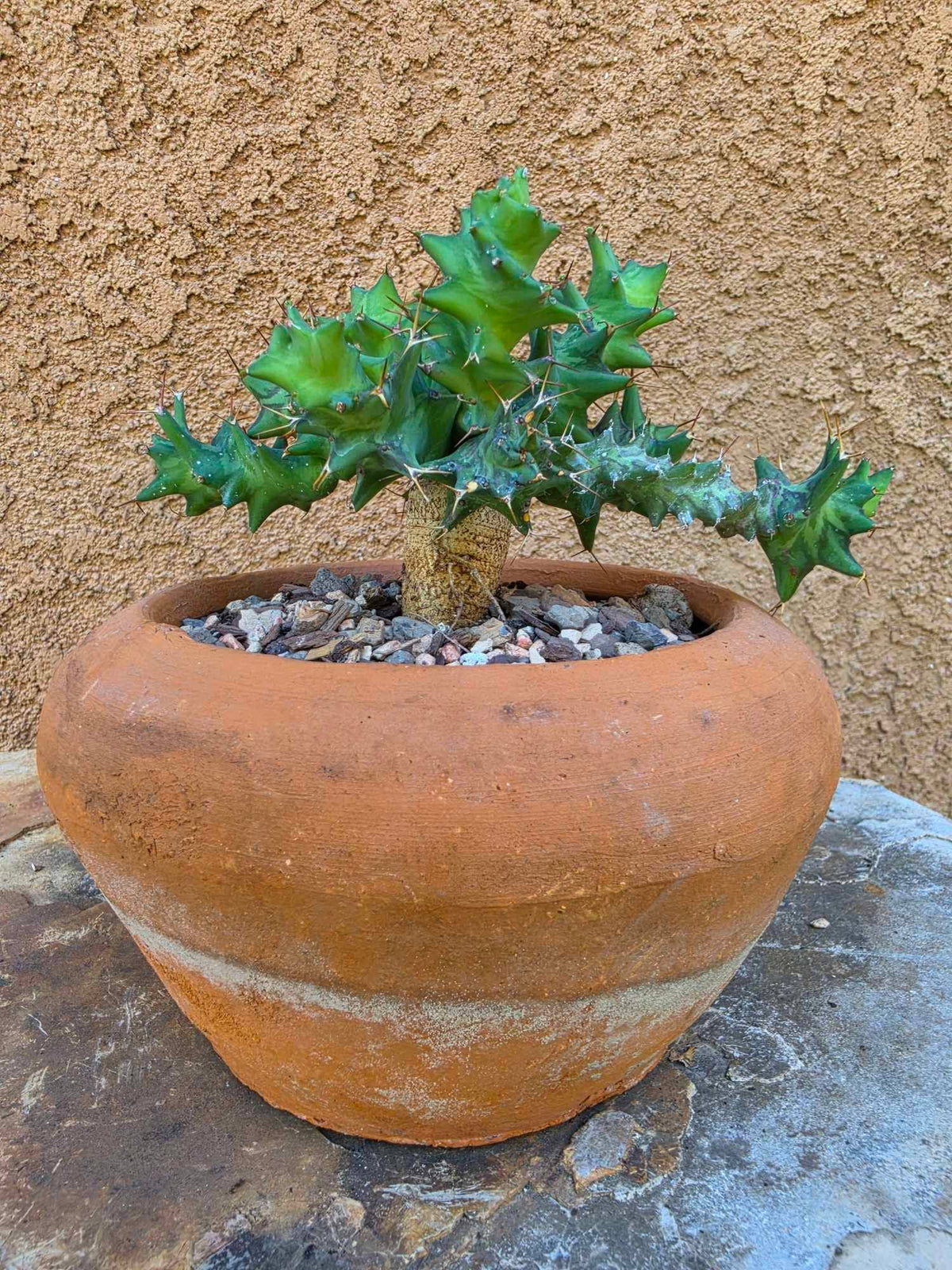
You will receive this exact, large specimen.
Measures approximately 6" wide × 4" tall above the soil line.
Showcased here in Tuscany Earthen Terra Cotta Pottery – Terracotta Solstice Planter No. 231 (sold separately).
Roots as shown.
Will be shipped bare root.
🌵
Euphorbia groenewaldii is a remarkable South African succulent distinguished by its extraordinary angular stems, sharply projecting tubercles, and formidable spination. Unlike the familiar rounded or columnar architecture of many succulent Euphorbias, this species develops an intricate arrangement of irregularly contoured, fleshy branches whose surfaces are interrupted by dramatic, pointed projections. The result is a plant of exceptional sculptural character, with a densely textured, almost crystalline appearance that seems more like an assemblage of natural mineral forms than conventional succulent growth. Its rich green coloration and sharply defined architecture make it particularly compelling for collectors drawn to the unusual structural diversity of the genus.
This exact specimen is especially impressive at approximately 6" wide × 4" tall above the soil line, with a substantial, spreading crown of thick, deeply angular green branches emerging from a sturdy central base. The individual stems display prominent triangular projections and sharp spines, creating a remarkable interplay of ridges, points, and irregular surfaces. Several branches extend outward in a broad, balanced arrangement, while others rise toward the center, producing a dense, architectural silhouette with considerable depth and complexity. Its mature-looking structure and beautifully developed branching make this an exceptional example of the species, with an extraordinary amount of visual presence for its relatively compact height.
Care Instructions
☀️ Light
Provide very bright light with several hours of gentle direct sunlight or strong filtered sun. Adequate light encourages compact growth, healthy stem coloration, and well-developed spination. Gradually acclimate the plant to intense direct sunlight, particularly after shipping or a period in protected growing conditions.
💧 Water
Water thoroughly during active warm-season growth, allowing the growing medium to dry completely or nearly completely between waterings. Reduce watering substantially during cooler periods or when growth slows. Avoid prolonged moisture around the roots, especially when temperatures are low. Established specimens generally benefit from a conservative watering approach in highly porous soil.
🪨 Soil
Requires an exceptionally fast-draining succulent mix with excellent aeration. A generous proportion of pumice, lava rock, coarse grit, or similar inorganic material is recommended. Avoid dense, organic-rich soils that retain moisture for extended periods. A mineral-dominant mix is particularly suitable for maintaining healthy roots in cultivation.
🌡️ Temperature
Prefers warm growing conditions and should be protected from frost. As a conservative cultivation precaution, maintain temperatures above approximately 50°F (10°C), especially when the soil is damp. Avoid prolonged exposure to cold, wet conditions.
🌬️ Humidity
Prefers relatively dry conditions with excellent air circulation. Moderate ambient humidity is generally tolerated when temperatures are warm and the growing medium drains rapidly, but prolonged combinations of cool temperatures, stagnant air, and moisture should be avoided.
📈 Growth Habit
A branching succulent that develops thick, irregularly angled stems with prominent pointed tubercles and sharp spines. Mature specimens can form dense, spreading arrangements of interconnected branches, creating a complex sculptural crown. Individual stems may extend outward or upward, giving established plants a naturally irregular, architectural appearance.
✍️ Special Note
The distinctive sharply projecting stem structures and prominent spines require care when handling, unpacking, or repotting. As with other Euphorbias, damaged tissue may release an irritating, potentially toxic milky latex. Wear gloves and avoid contact with skin and eyes. The angular projections are part of the plant's natural growth architecture and should be protected from physical damage during handling.
Why It Stands Out
- Rare and highly distinctive Euphorbia groenewaldii
- Unusual South African succulent species
- Exact, large specimen measuring approximately 6" wide × 4" tall
- Extraordinary angular, deeply sculptured green stems
- Dramatic triangular projections and sharply pointed tubercles
- Prominent spines accentuating the irregular stem surfaces
- Substantial, spreading crown with beautifully developed branching
- Remarkable interplay of ridges, points, and geometric forms
- Dense, almost crystalline architectural silhouette
- Exceptional addition to an advanced Euphorbia or unusual succulent collection
Collector Notes
Southern Africa is one of the world's great centers of succulent plant diversity, with an extraordinary concentration of species adapted to environments characterized by seasonal rainfall, intense sunlight, and often challenging soil conditions. Among the most remarkable members of this flora are the succulent Euphorbias, whose astonishing range of forms includes massive tree-like species, compact globular plants, heavily armed shrubs, and intricate branching succulents with highly specialized stem structures. The diversity of these plants reflects millions of years of adaptation and evolutionary experimentation, producing some of the most architecturally unusual plants in cultivation.
Euphorbia groenewaldii is particularly fascinating for its departure from the conventional geometric patterns associated with many succulent species. Rather than forming a smooth column or an orderly arrangement of ribs, the plant develops thick, angular stems punctuated by prominent pointed projections. These structures create an irregular, almost crystalline surface, with numerous changes in direction and sharply defined contours. The resulting architecture is visually complex, revealing new details as the specimen is viewed from different angles.
The remarkable stem projections are central to the plant's ornamental appeal. Each branch appears to be constructed from a succession of angular segments, with prominent tubercles extending outward and spines emerging from their tips or margins. The green surfaces between these projections are relatively broad and fleshy, providing the succulent tissue necessary for water storage and photosynthesis. This combination of substantial stem mass and pronounced defensive structures gives the plant an appearance that is simultaneously rugged and surprisingly intricate.
This exact specimen demonstrates the species' sculptural potential particularly well. At approximately 6" wide × 4" tall above the soil line, it has developed a substantial crown of thick, irregularly branching stems. Several branches extend horizontally, creating a broad silhouette, while others rise upward through the center of the plant. The interaction between these different growth directions produces an almost deliberately composed arrangement, with strong horizontal movement balanced by the sharp vertical projections of the individual tubercles.
One of the most interesting aspects of succulent Euphorbias is their evolutionary relationship to cacti. Although many Euphorbias resemble cacti in their fleshy stems, defensive spines, and adaptation to dry environments, the two groups belong to entirely different botanical families. Their similarities are examples of convergent evolution, in which unrelated organisms develop comparable structures in response to similar environmental pressures. In Euphorbias, the spines frequently arise from modified stipules or other specialized structures, rather than the areoles that characterize true cacti.
The genus is equally distinctive in its reproductive biology. Euphorbias produce specialized inflorescences known as cyathia, which contain highly reduced male and female flowers arranged within a cup-like structure. Although the flowers may be relatively inconspicuous compared with the dramatic stems of many succulent species, their unusual organization is one of the defining characteristics of Euphorbiaceae. For collectors interested in botanical diversity, these reproductive structures provide another fascinating distinction between Euphorbias and superficially similar succulent plants.
In cultivation, established branching Euphorbias often become increasingly individual as their stems develop in different directions. The proportions, angles, and relationships between branches create a natural architecture that cannot be precisely duplicated. This is especially apparent in specimens with strongly angular growth, where even small changes in stem direction can dramatically alter the overall silhouette. Over time, the accumulation of branching and mature stem tissue can transform a relatively simple young plant into an intricate, sculptural composition.
This exact Euphorbia groenewaldii is a beautiful example of that process. Its substantial green branches, dramatic pointed projections, and broad, densely developed crown give it an extraordinary presence despite its compact height. The contrast between its vivid green succulent tissue and the warm, weathered terracotta of the accompanying planter further emphasizes its unusual architecture. For the dedicated Euphorbia collector, the enthusiast of South African succulents, or anyone drawn to plants with remarkable natural geometry, this is a particularly distinctive specimen whose sculptural character is entirely its own.