Shangri-Ha Cactus Ranch
Euphorbia decaryi - Wrinkled Leaf Spurge
Euphorbia decaryi - Wrinkled Leaf Spurge
Couldn't load pickup availability
Euphorbia decaryi — Wrinkled Leaf Spurge
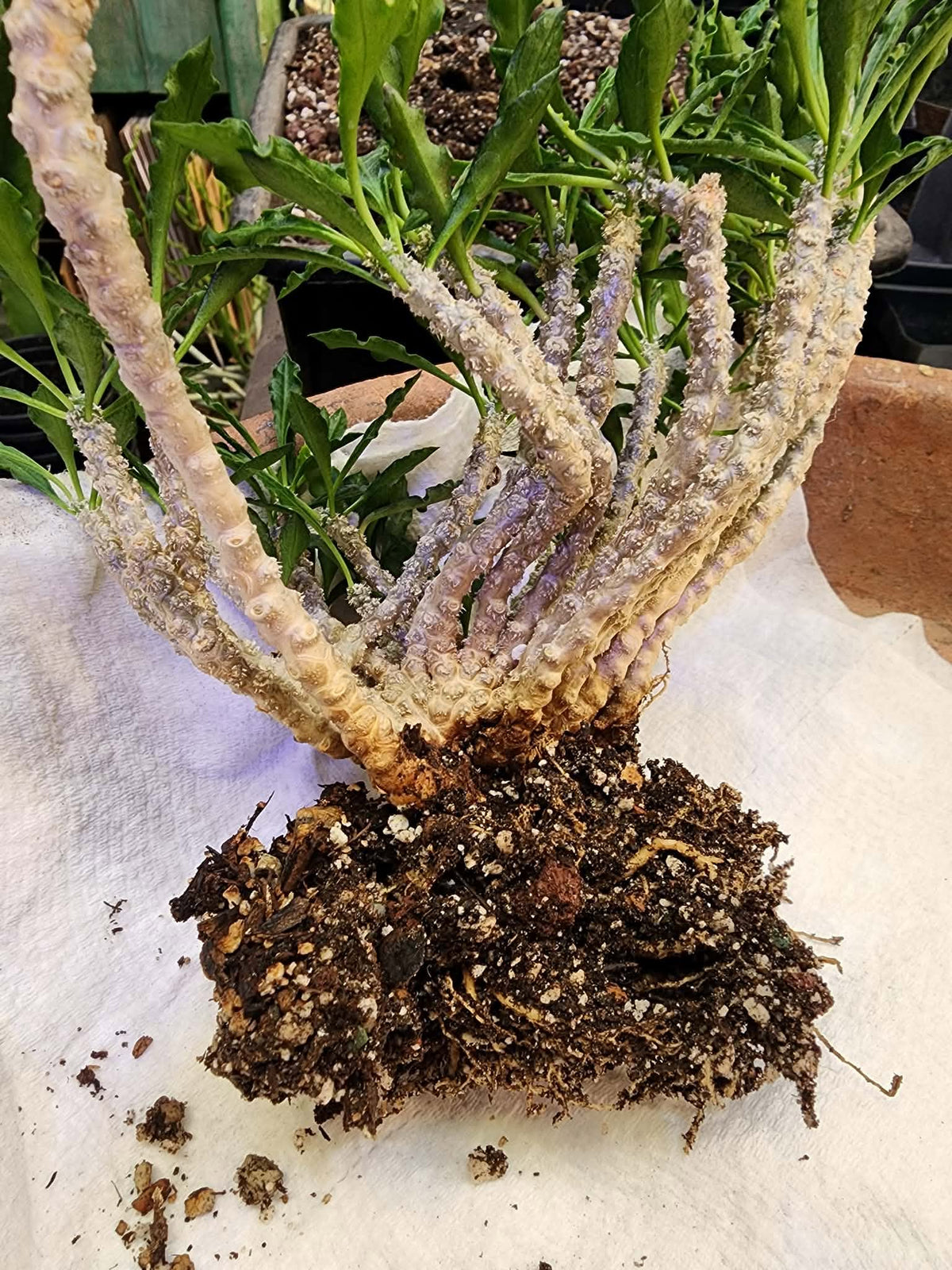
You will receive the exact specimen shown here.
Measures approximately 15" wide × 6" tall.
Showcased here in Handmade Pottery — Ember Falls Planter No. 202 (sold separately).
Roots as shown.
Will be shipped bare root.
🌵
Euphorbia decaryi is an extraordinary Madagascan succulent prized for its combination of creeping, twisting stems and remarkably textured leaves. Rather than relying on size or symmetry for its appeal, this species builds an intricate ground-hugging structure of gnarled stems topped with leathery leaves whose deeply undulating surfaces give rise to the common name Wrinkled Leaf Spurge.
This exact specimen is particularly impressive for its 15" overall spread, forming a broad, mature network of branching stems rather than the small individual starts in which the species is more commonly encountered. At approximately 6" tall, it remains relatively low while traveling outward, producing a sprawling, almost bonsai-like composition of aged stems and densely textured foliage.
Care Instructions
☀️ Light
Provide very bright filtered light to several hours of gentle direct sun. Strong light encourages compact growth and good coloration, but protect from abrupt exposure to intense afternoon sun, particularly after shipping or periods under filtered conditions.
💧 Water
Water thoroughly during active growth, then allow the soil to dry substantially before watering again. Reduce watering during cooler or less active periods. Although succulent, Euphorbia decaryi appreciates somewhat more regular moisture during active growth than many extremely xeric desert euphorbias, provided drainage is excellent.
🪨 Soil
Requires a very fast-draining succulent mix with substantial mineral content. Pumice, lava, coarse grit, and similar inorganic materials help maintain excellent root aeration while preventing prolonged moisture around the underground and basal portions of the plant.
🌡️ Temperature
Prefers warm conditions and should be protected from frost and prolonged cold. Madagascan euphorbias generally perform best when kept comfortably warm, particularly when moisture is present around the roots.
🌬️ Humidity
Moderate humidity is generally tolerated when accompanied by good airflow and excellent drainage. Avoid prolonged cool, stagnant, wet conditions.
📈 Growth Habit
Develops as a low, spreading succulent with branching, often partially subterranean or ground-hugging stems. Over time, established plants can form surprisingly broad colonies, with older twisting stems creating an increasingly complex structure beneath the foliage.
✍️ Special Note
The wonderfully wrinkled, undulating foliage is a normal and defining characteristic of the species, not an indication that the plant is dehydrated or unhealthy. Individual leaves can vary considerably in size, coloration, and degree of surface texture.
Like other members of the genus Euphorbia, this plant contains a milky latex sap that can irritate skin and eyes and is toxic if ingested. Handle carefully if stems are damaged or the plant is pruned, and keep the sap away from eyes, mouth, children, and pets.
As with any mature collector succulent, old stems, natural scars, leaf loss, corking, and evidence of previous growing seasons are part of the specimen's history rather than imperfections. Please review all photographs carefully, as you will receive the exact plant shown.
Why It Stands Out
- Remarkable 15" overall spread
- Mature, established collector specimen
- Extraordinary wrinkled and undulating foliage
- Broad, low-growing architectural form
- Complex network of mature branching stems
- Beautifully gnarled, almost bonsai-like character
- Highly distinctive Madagascan species
- Each leaf develops its own individual texture
- Substantial mature specimen rarely encountered at this scale
- Excellent established root system
- The exact specimen shown here
Collector Notes
Euphorbia decaryi is native to Madagascar, an island whose long geographic isolation has produced one of the world's most extraordinary concentrations of endemic plants and animals. The genus Euphorbia is especially diverse there, with numerous species evolving highly specialized forms found nowhere else naturally.
E. decaryi is among the strangest.
At first glance, the leaves command attention. They are thick and leathery, but instead of presenting a smooth surface, they develop pronounced waves, folds, puckers, and wrinkles. The result can look almost artificial—more like crumpled fabric or textured paper than ordinary foliage.
Beneath those leaves is an equally interesting plant.
The stems grow horizontally and branch repeatedly, frequently hugging the soil surface and developing a gnarled, woody appearance with age. Portions may grow at or beneath the surface while newer branches emerge into the light, allowing an established specimen gradually to occupy an increasingly broad area.
That growth habit explains why width matters so much with this particular plant.
At approximately 15" across but only 6" tall, this specimen demonstrates the species' natural architecture beautifully. It has not simply grown upward into a larger version of a young plant. It has traveled outward, branched, aged, and accumulated structure.
Older stems become increasingly sculptural as foliage is shed and replaced. New leaves emerge from active growth points while the underlying network records previous seasons, producing the wonderful contrast between fresh foliage and mature woody-looking growth.
The species also illustrates just how misleading the word “succulent” can be. There is no single succulent shape. Some store water in enormous columnar stems; others form spheres, rosettes, tubers, or underground caudices. Euphorbia decaryi takes another path entirely, spreading close to the earth beneath a canopy of remarkably engineered leaves.
And those wrinkles aren't incidental decoration.
By producing an uneven surface rather than a simple flat leaf blade, the plant creates a highly textured interface with its environment—one of the many unusual morphological solutions found among Madagascar's endemic flora.
At 15" wide, this specimen has had sufficient time to develop the sprawling, interwoven character that makes mature E. decaryi dramatically more interesting than a young start.
Low, strange, beautifully gnarled, and covered in leaves that appear almost deliberately crumpled, this old Euphorbia decaryi is a wonderful example of why Madagascar remains one of the great botanical laboratories of the natural world.