Shangri-Ha Cactus Ranch
Euphorbia confinalis subsp. rhodesia variegata 'Zebra' x 5
Euphorbia confinalis subsp. rhodesia variegata 'Zebra' x 5
Couldn't load pickup availability
Euphorbia confinalis subsp. rhodesia variegata ‘Zebra’ × 5 — Variegated Lebombo Euphorbia
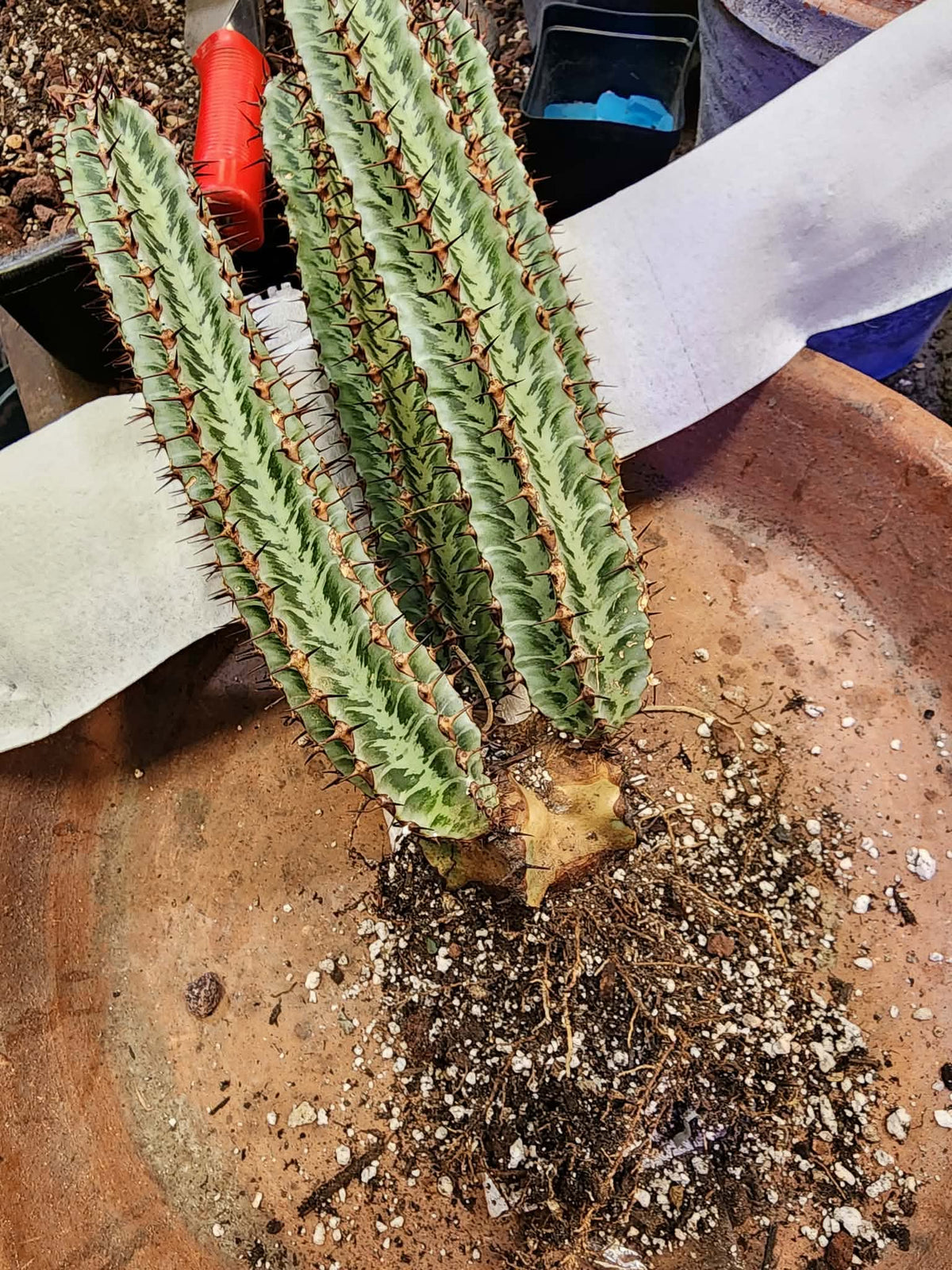
You will receive this exact specimen.
This BIG, established specimen features 5 arms!
Measures approximately 10.5" tall above the soil line.
Beautiful architectural variegated specimen with dramatic blue-green coloration, creamy yellow striping, and bold contrasting spination.
Showcased here in Handmade Pottery — Obsidian Basin No. 5 (sold separately).
Roots as shown.
Will be shipped bare root.
🌵
Euphorbia confinalis subsp. rhodesia is a striking southern African succulent euphorbia prized for its strongly vertical growth, angular ribbing, and formidable paired spines. In the variegated ‘Zebra’ form, that already architectural structure is amplified by dramatic bands and sectors of creamy yellow against blue-green tissue, producing a beautifully graphic plant whose coloration changes from rib to rib and stem to stem.
This is a large, established five-armed specimen, measuring approximately 10.5" tall above the soil line. Rather than a single young column, it has developed into a substantial multi-stemmed plant with five strong upright arms creating an impressive clustered silhouette. The combination of mature branching, blue-green epidermis, luminous cream-yellow variegation, and dark contrasting spination gives this specimen tremendous visual presence from every angle.
Care Instructions
☀️ Light
Provide very bright light to several hours of direct sun. Strong light encourages sturdy, compact growth and helps maintain the dramatic contrast of the variegation. Because cream and yellow tissue contains less chlorophyll and can be more susceptible to sun damage, acclimate gradually to intense direct sunlight after shipping or periods under filtered light.
💧 Water
Water thoroughly during active warm-season growth, then allow the soil to dry completely before watering again. Reduce watering significantly during cooler months. Established succulent euphorbias store considerable moisture within their stems and are far more tolerant of dryness than prolonged wet soil.
🪨 Soil
Requires an exceptionally fast-draining succulent mix with generous mineral content. Pumice, lava, coarse grit, and similar inorganic materials provide excellent drainage and root aeration. Avoid dense or moisture-retentive soil.
🌡️ Temperature
Thrives in warm conditions and should be protected from frost and prolonged cold. Variegated specimens can be somewhat less forgiving of environmental extremes than fully green plants. Keep the root system particularly dry during cool weather.
🌬️ Humidity
Prefers relatively dry conditions with excellent air circulation. Avoid prolonged cool humidity or stagnant moisture around the stems and root zone.
📈 Growth Habit
Develops as an upright, candelabra-like succulent with strongly ribbed stems. Established plants can branch from the base or along older growth, eventually producing a substantial multi-columned silhouette. The five developed arms on this specimen already demonstrate the mature architectural character for which the species is prized.
✍️ Special Note
Like other members of the genus Euphorbia, this plant contains a milky latex sap that can irritate skin and eyes and is toxic if ingested. Handle carefully when pruning, repotting, or if a stem is damaged, and keep the sap away from eyes, mouth, children, and pets.
Variegation is naturally variable. Future growth may differ in the proportion and arrangement of blue-green, cream, and yellow tissue displayed by the existing stems.
As with any mature collector succulent, natural surface marks, scars, corking, changes in coloration, and evidence of previous growing seasons are part of the specimen's history rather than imperfections. Please review all photographs carefully, as you will receive the exact plant shown.
Why It Stands Out
- BIG, established collector specimen
- Five substantial upright arms
- Approximately 10.5" tall above the soil line
- Highly architectural candelabra-like form
- Dramatic blue-green coloration
- Beautiful creamy yellow variegation
- Bold contrasting paired spines
- Different variegation patterns across individual stems
- Strong, mature multi-stemmed silhouette
- Excellent established root system
- Increasingly impressive as the five arms develop
- The exact specimen shown here
Collector Notes
Euphorbia confinalis is native to southern Africa, where plants inhabit warm, seasonally dry landscapes and develop into imposing succulent shrubs or small trees. Subspecies rhodesia is associated with the species' more northerly range and carries the same unmistakable architectural language: upright ribbed stems armed along their margins with paired spines.
Although superficially cactus-like, this plant is not a cactus at all.
That resemblance is an excellent example of convergent evolution. Cacti evolved primarily in the Americas, while many succulent euphorbias evolved independently in Africa. Faced with similarly hot, dry environments, both lineages arrived at remarkably similar solutions: water-storing stems, reduced leaves, protective spines, and compact surfaces designed to conserve moisture.
The variegated ‘Zebra’ form adds another dimension.
Areas of the epidermis produce reduced amounts of chlorophyll, replacing uniform green with bands and sectors of cream and yellow. Against the plant's cool blue-green tissue and dark spines, those pale areas create the strong striped appearance responsible for the ‘Zebra’ name.
And because the variegation is expressed independently through developing tissue, each arm becomes its own composition.
That is particularly important in this specimen. With five established arms, the plant provides far more than a single example of the pattern. Each upright stem contributes another sequence of ribs, stripes, spines, and color transitions, and together they create the dense vertical rhythm characteristic of a much older plant.
The branching also fundamentally changes its presence. A single young stem demonstrates the species; a five-armed specimen begins to demonstrate what the species can eventually become.
At approximately 10.5" tall above the soil line, this plant already has substantial mass and maturity, yet the architecture has room to become increasingly dramatic as the individual columns continue upward and develop in relation to one another.
Boldly striped, heavily armed, beautifully blue-green, and already carrying five established columns, this ‘Zebra’ is a superb example of an African succulent that achieves the visual drama of a cactus through an entirely separate evolutionary path.