Shangri-Ha Cactus Ranch
Euphorbia columnaris — 15-Head Grafted Collector Specimen
Euphorbia columnaris — 15-Head Grafted Collector Specimen
Couldn't load pickup availability
Euphorbia columnaris — 15-Head Grafted Collector Specimen
You will receive this exact, large mature specimen featuring 15 heads!
Scion measures 6" tall × 6" wide.
Entire specimen measures 9" tall above the soil line.
This is a grafted specimen.
Showcased here in Handmade Pottery — Ivory Fault Bowl No. 135 (sold separately).
Roots as shown.
Will be shipped bare root.
🌵
Euphorbia columnaris is an extraordinary succulent Euphorbia native to Somalia, prized by collectors for its compact columnar growth, strongly defined ribs, and distinctive paired spines. Mature plants develop an almost armored appearance, with closely spaced spine shields creating repeating patterns along the ribs. In cultivation it remains an unusual and highly architectural species, particularly when allowed to develop multiple growing points.
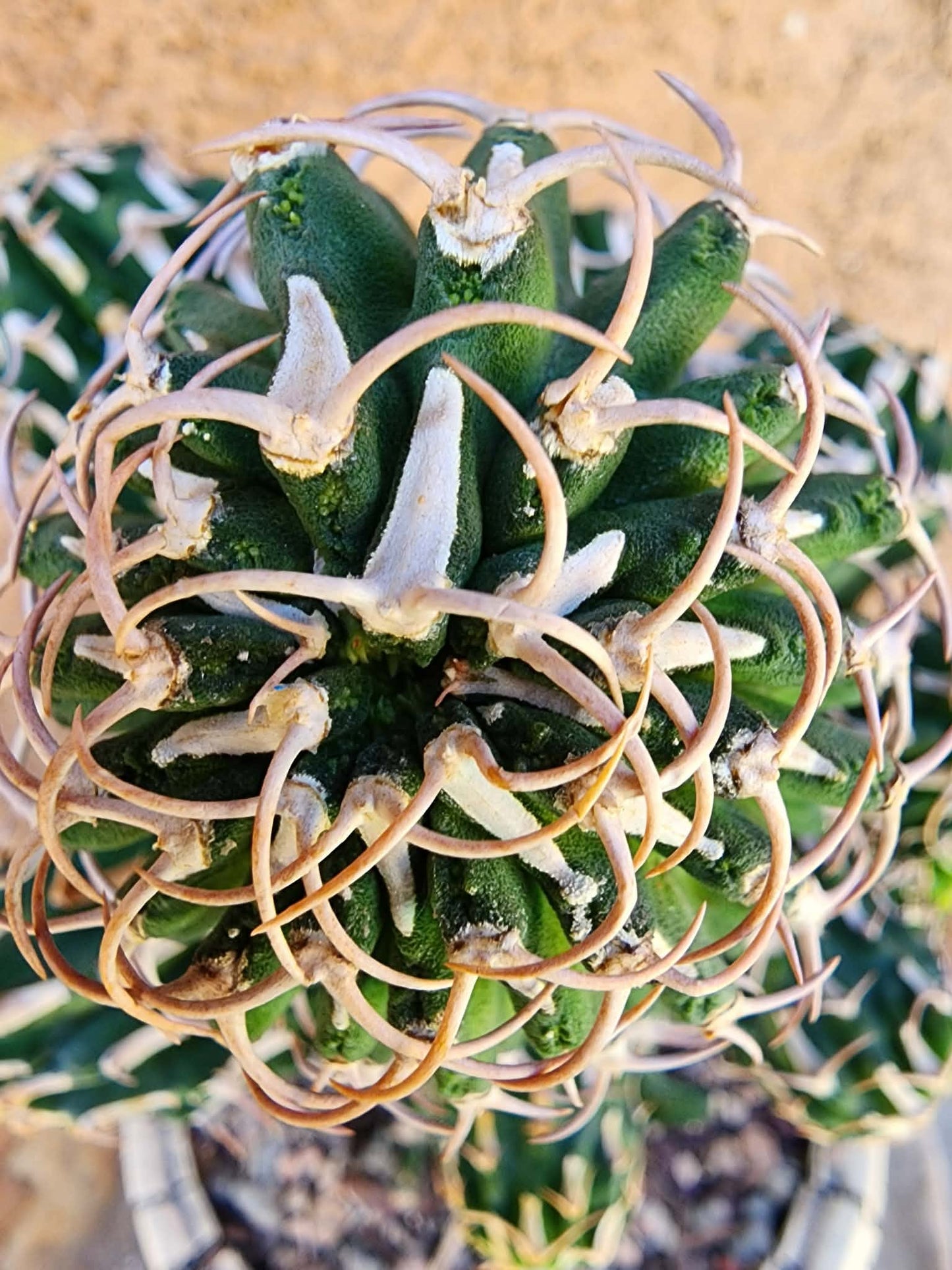
This is an especially impressive 15-headed grafted specimen, with a scion measuring approximately 6" tall × 6" wide and an overall height of 9" above the soil line. Rather than the simple solitary column associated with younger examples, this plant has developed a dense crown of individual heads of varying sizes. Their arrangement creates a remarkably complex silhouette, with fresh lime-green growth contrasting beautifully against the deeper green mature tissue and pale spination.
Care Instructions
☀️ Light
Very bright light to strong filtered sun. Good light encourages compact growth, strong spine development, and characteristic coloration. Acclimate gradually to intense direct sunlight after shipping, particularly in very hot climates.
💧 Water
Water thoroughly during active growth, allowing the growing medium to dry completely between waterings. Reduce watering significantly during cooler or dormant periods. Euphorbia columnaris is adapted to arid conditions and is considerably more tolerant of dryness than prolonged moisture around the roots.
🪨 Soil
Requires an exceptionally fast-draining, mineral-rich succulent mix. Pumice, lava, coarse grit, and similar inorganic materials are excellent additions. Avoid heavy or moisture-retentive soils, particularly around the rootstock of grafted specimens.
🌡️ Temperature
Prefers warm conditions and should be protected from frost and prolonged cold. When temperatures fall, keep the plant substantially drier. A warm growing season combined with a dry, protected winter generally produces the best results.
🌬️ Humidity
Prefers low humidity with excellent air circulation. Avoid prolonged cool, damp conditions and stagnant moisture around the plant, graft union, or root zone.
📈 Growth Habit
The species naturally develops stout, ribbed columnar stems armed with regularly arranged paired spines. Plants may remain relatively simple when young but can eventually branch, creating increasingly complex architecture. This specimen has developed an unusually dense 15-headed crown, transforming the normal columnar structure into a broad cluster of tightly arranged growing points.
✍️ Special Note
This is a grafted specimen. Grafting is frequently used in the cultivation of unusual or slow-growing succulent forms because a vigorous rootstock can support the scion and encourage stronger, faster development. The lower stem visible beneath the Euphorbia columnaris crown is therefore the rootstock and is intentionally part of the plant.
As with all Euphorbias, damaged tissue can release a milky latex sap that is irritating to skin and eyes and should not be ingested. Handle carefully, particularly when pruning or repotting, and keep the sap away from eyes, mouth, children, and pets.
Please review all photographs carefully, as you will receive the exact plant shown.
Why It Stands Out
- Extraordinary 15-headed specimen
- Large, mature collector plant
- Scion measures an impressive 6" tall × 6" wide
- 9" total height above the soil line
- Dense, beautifully developed crown
- Numerous heads at different stages of growth
- Dramatic ribbed architecture
- Distinctive pale paired spination
- Beautiful contrast between lime-green new growth and mature deep-green tissue
- Grafted for vigorous established growth
- Strong, sculptural silhouette from every angle
- Established root system
- The exact specimen shown here
Collector Notes
Euphorbia columnaris comes from the dry landscapes of northern Somalia, part of a region renowned among succulent collectors for an extraordinary concentration of highly specialized Euphorbia species. Plants growing in these environments contend with intense sun, limited and irregular rainfall, rocky mineral soils, and long periods of drought—conditions that have produced some of the most remarkable succulent architecture in the genus.
Its name is wonderfully straightforward. The specific epithet columnaris means columnar or column-like, describing the upright form of its stems.
But the simplicity of the name belies the extraordinary surface of the plant.
The stems are divided into pronounced ribs whose margins carry repeating spine-bearing structures. Pale paired spines project outward from the rich green body, producing a rhythmic pattern that becomes increasingly elaborate as the plant matures. Viewed from above, the growing tips reveal the underlying symmetry particularly clearly: ribs radiate outward around the center while new spine development traces the perimeter.
This specimen takes that architecture considerably further.
Instead of presenting as a single upright column, the scion has divided repeatedly until it now carries 15 individual heads. Large established heads form the upper framework while smaller offsets occupy the spaces between them, creating a remarkably dense colony emerging from a single grafted crown.
The variation in their sizes also allows the plant's developmental history to remain visible. The largest heads represent earlier growth, while increasingly smaller heads document successive rounds of branching and offset formation. Bright green centers identify the newest active growth, surrounded by progressively older tissue carrying mature ribs and spines.
Grafting has played an important role in producing this scale and complexity. For collectors, grafting is not simply a method of propagation; it can provide difficult or exceptionally slow-growing plants with a vigorous root system capable of supporting development that might require considerably longer on their own roots.
And in this specimen, the graft creates an unusually dramatic presentation.
The relatively simple dark-green rootstock rises like a trunk beneath the scion before disappearing beneath a broad, intricate crown of E. columnaris. The effect is almost tree-like: a single supporting stem carrying an entire miniature canopy of ribbed, spiny heads.
At 15 heads, 6" across the scion, and 9" tall above the soil line, this is far beyond a small starter graft. It is an established collector specimen whose years of branching have created something genuinely individual—a dense, beautifully structured colony of Euphorbia columnaris carried above a single vigorous rootstock.
One graft. Fifteen growing heads. And a remarkable amount of living architecture packed into just six inches of crown.