Shangri-Ha Cactus Ranch
Euphorbia caerulescens — Blue Euphorbia
Euphorbia caerulescens — Blue Euphorbia
Couldn't load pickup availability
Euphorbia caerulescens — Blue Euphorbia
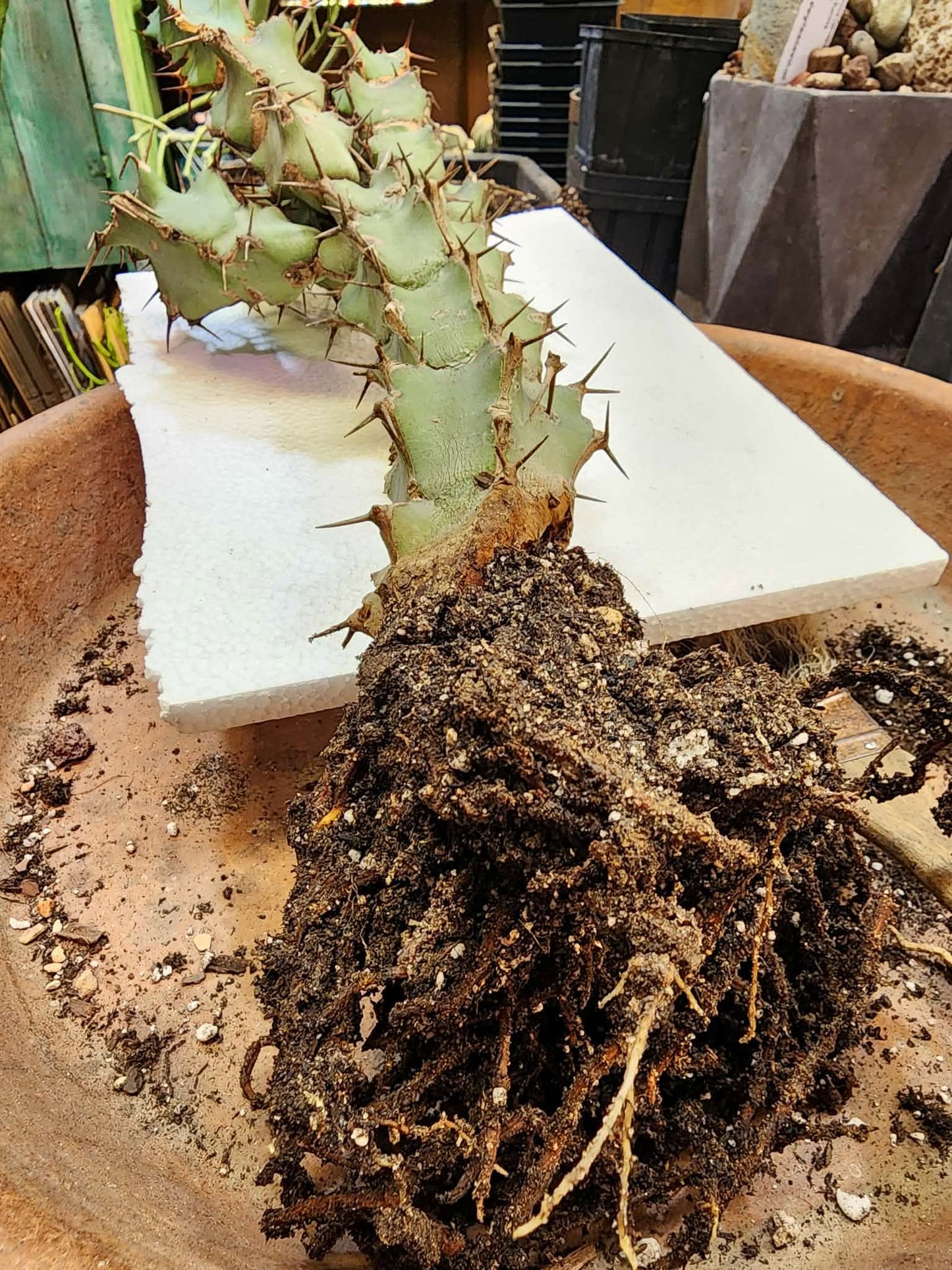
You will receive this exact, rare specimen.
Measures approximately 13" tall above the soil line × 6.5" wide.
Roots as shown.
Showcased here in Handmade Pottery – Turquoise Ledger Vessel No. 25 (sold separately).
Will be shipped bare root.
🌵
Euphorbia caerulescens, commonly known as Blue Euphorbia, is a striking succulent shrub native to South Africa and prized for the beautiful blue-green to glaucous coloration of its angular stems. Strongly ribbed, armed with paired spines, and naturally architectural, the species develops an unmistakable candelabra-like presence as it matures. Its cool-toned epidermis can become especially pronounced in strong light, giving established plants the steely blue coloration responsible for its common name.
This exact specimen has already developed wonderful mature character, with a substantial upright central stem supporting a dense cluster of irregularly ascending branches. The combination of powdery blue-green growth, dark contrasting spines, and increasingly complex branching gives it a rugged, almost miniature-tree silhouette. At approximately 13" tall above the soil line, this is a beautifully established specimen with considerable presence and plenty of future architectural potential.
Care Instructions
☀️ Light
Bright light to full sun. Strong light helps maintain compact growth and the characteristic blue-green coloration. Gradually acclimate to intense direct sunlight, particularly after shipping or when moving the plant outdoors.
💧 Water
Water thoroughly during active growth, then allow the soil to dry completely before watering again. Reduce watering substantially during cooler months. Mature plants are drought tolerant, but prolonged wet soil should be avoided.
🪨 Soil
Requires a very fast-draining, mineral-rich succulent mix. Pumice, lava rock, coarse grit, or similar inorganic material can be incorporated generously to promote excellent drainage and root aeration.
🌡️ Temperature
Warm-growing and tolerant of heat. Protect container-grown specimens from hard frost and prolonged freezing conditions, particularly when the soil is wet.
🌬️ Humidity
Prefers dry conditions with good air circulation. Avoid prolonged cool, damp conditions.
📈 Growth Habit
An upright, branching succulent shrub that develops multiple angular, spiny stems and can form a substantial thicket-like plant with age. New branches emerge from established stems, gradually producing the dense, irregular candelabra architecture characteristic of mature specimens.
✍️ Special Note
Like all Euphorbias, this plant contains a milky latex sap that can cause significant irritation to skin and eyes and is toxic if ingested. Wear protection when pruning or handling damaged stems, and use care around the paired spines.
Why It Stands Out
- Rare South African Euphorbia
- Commonly known as Blue Euphorbia
- Beautiful glaucous blue-green coloration
- BIG 13" tall established specimen
- Dense, mature branching
- Strong architectural silhouette
- Attractive contrasting dark spines
- Excellent statement specimen for a Euphorbia collection
Collector Notes
Euphorbia caerulescens is native to South Africa's Eastern Cape, where it occurs in dry, rocky country and develops into dense, heavily armed stands. Its specific epithet references the bluish coloration that distinguishes the species, and well-grown plants can display an exceptional range of cool blue-green, gray-green, and almost turquoise tones depending upon light, growing conditions, and the age of the stems.
The species belongs to that remarkable group of succulent Euphorbias whose growth has converged visually with columnar cacti despite belonging to an entirely different botanical family. Its photosynthetic stems are divided into pronounced angles or ribs, while paired spines line the margins. Unlike a cactus, however, those spines do not arise from true cactus areoles—a useful reminder that the resemblance is the result of adaptation to similarly demanding dry environments rather than close relationship.
Young plants can begin rather simply, but E. caerulescens becomes increasingly interesting as branching develops. New stems emerge from older growth and gradually produce an irregular, three-dimensional structure. In mature plants, that architecture can become dense and imposing, giving the species much of its value as a specimen Euphorbia.
This exact plant is already displaying that transition beautifully. Its established central structure supports numerous substantial branches at varying heights, while the newest growth retains particularly vivid blue-green coloration. At approximately 13" tall, it has moved well beyond the appearance of a young starter plant and is developing the complex, sculptural character that makes mature Euphorbia caerulescens such a satisfying species to grow.