Shangri-Ha Cactus Ranch
Euphorbia beharensis
Euphorbia beharensis
Couldn't load pickup availability
Euphorbia beharensis
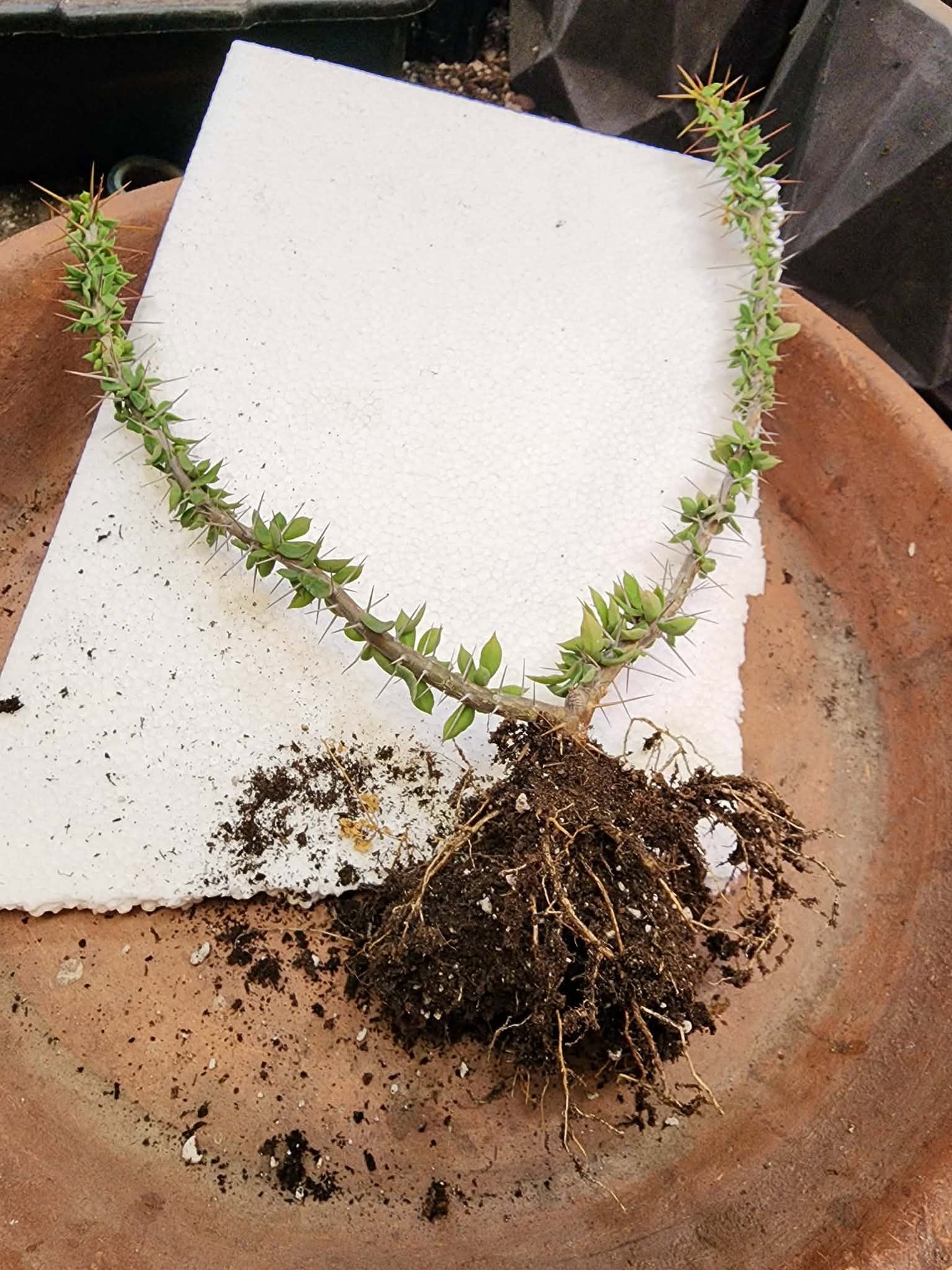
You will receive this exact, rare specimen.
Measures approximately 10" tall above the soil line × 10" wide.
Roots as shown.
Showcased here in Handmade Pottery – Excavated Form No. 157 (sold separately).
Will be shipped bare root.
🌵
Euphorbia beharensis is a fascinating and uncommon Madagascan Euphorbia, native to the dry landscapes of southern Madagascar. It is prized for an extraordinarily spare, architectural growth habit: slender woody stems armed with long, prominent spines and punctuated during active growth by small green leaves. The effect is wonderfully primitive and almost skeletal—a plant whose beauty comes as much from line and structure as from foliage.
This exact specimen is particularly striking for its dramatic two-armed form. From a low, established base, two long stems sweep outward and upward in opposite directions, creating an almost antler-like silhouette. The widely spaced spines and small fresh leaves accentuate every curve of the stems, while the open center gives the plant an unusual sense of movement and negative space. At approximately 10" × 10", it is a beautifully developed example of one of Madagascar's more unusual sculptural Euphorbias.
Care Instructions
☀️ Light
Bright light to full sun. Strong light encourages compact, sturdy growth and good spine development. Gradually acclimate to intense direct sunlight, particularly after shipping or when moving the plant outdoors.
💧 Water
Water thoroughly during active growth, allowing the soil to dry well between waterings. Reduce watering considerably during cooler months and whenever the plant enters dormancy or sheds its leaves.
🪨 Soil
Requires a very fast-draining, mineral-rich succulent mix with excellent aeration. Avoid heavy or moisture-retentive soils.
🌡️ Temperature
Warm-growing and frost-sensitive. Protect from freezing temperatures and prolonged cold, especially when the soil is damp.
🌬️ Humidity
Prefers dry conditions and excellent air circulation. Avoid prolonged cool, humid conditions.
📈 Growth Habit
A branching, spiny Madagascan Euphorbia with slender woody stems that become increasingly architectural with age. Small leaves are produced along active growth and may be shed seasonally or in response to dry conditions, leaving the formidable spined framework of the plant fully exposed.
✍️ Special Note
Like all Euphorbias, this plant contains a milky latex sap that can irritate skin and eyes and is toxic if ingested. Its long, sharp spines also require careful handling when moving or repotting the plant.
Why It Stands Out
- Rare Madagascan Euphorbia
- Dramatic two-armed specimen
- Approximately 10" tall × 10" wide
- Unusual open, architectural silhouette
- Long, prominent spination
- Active leafy growth along both stems
- Beautifully established base
- Excellent specimen for a Madagascan Euphorbia collection
Collector Notes
Euphorbia beharensis is part of Madagascar's extraordinary radiation of endemic Euphorbias, many of which have evolved highly specialized forms in response to the island's seasonally dry environments. Rather than relying on a dense canopy of permanent foliage, this species makes the structure of the plant itself the dominant visual feature: narrow stems, formidable spines, and relatively small leaves combine into an unmistakably xerophytic architecture.
Its appearance can also change considerably through the seasons. During active growth, the stems become dotted with fresh green leaves, softening the plant's silhouette. When conditions become drier or cooler and foliage is reduced, the underlying structure takes over—the long spines and bare stems creating an almost skeletal form. That transformation is part of the appeal of growing the species over time.
This specimen already has an especially expressive shape. Its two long stems diverge dramatically from the base before turning upward, producing a broad, open silhouette with remarkable negative space between them. It is less a conventional potted succulent than a small piece of living sculpture.
For collectors drawn to the stranger members of the genus, Euphorbia beharensis represents exactly what makes Madagascar's Euphorbia flora so compelling: an unusual species with a highly specialized structure, tremendous character, and a form that becomes more individual as it matures.