Shangri-Ha Cactus Ranch
Euphorbia abdelkuri - HUGE! - 9 Arms! 33" Tall! Collector Specimen
Euphorbia abdelkuri - HUGE! - 9 Arms! 33" Tall! Collector Specimen
Couldn't load pickup availability
Euphorbia abdelkuri — Huge 9-Arm Specimen
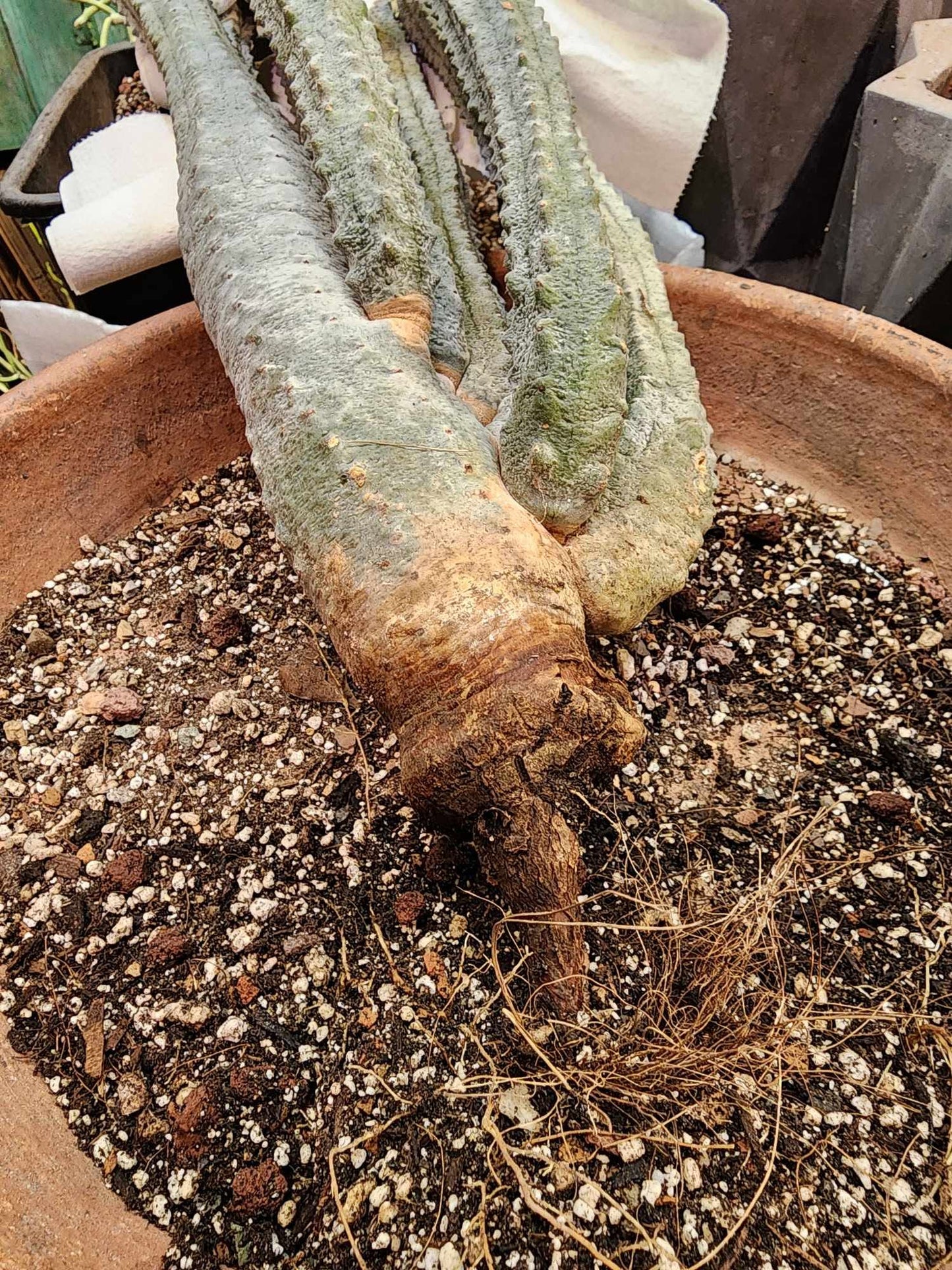
You will receive this exact, incredible specimen.
Massive specimen measuring 33" tall above the soil line.
Features 9 arms!
Showcased here in Handmade Pottery - Reed Weave Planter No. 195 (sold separately).
This is a BIG and heavy specimen and will be a little expensive to ship.
Roots as shown.
Will be shipped bare root.
🌵
Euphorbia abdelkuri is one of the most extraordinary and geographically isolated succulent euphorbias in cultivation, native to the remote island of Abd al Kuri in the Socotra Archipelago of Yemen. Almost otherworldly in appearance, the species develops upright, columnar stems with a remarkable grey-green to chalky blue-grey surface, shallow ribs, and closely patterned margins. Unlike many familiar columnar euphorbias, it is essentially spineless, giving mature plants an unusually monolithic, stone-like appearance.
This is an exceptionally large, multi-branched specimen, standing approximately 33" above the soil line and carrying an extraordinary nine arms. At this scale, the characteristic surface texture, massive stems, mature branching, and ghostly coloration of the species become enormously impressive. This is not a small collector plant waiting years to acquire presence—it is already a commanding mature specimen.
Care Instructions
☀️ Light
Very bright light to full sun. Strong light helps maintain sturdy, compact growth and the characteristic grey-blue coloration. Acclimate gradually to intense direct sunlight after shipping or periods under filtered light, particularly because freshly exposed tissue can scorch.
💧 Water
Water thoroughly during active warm-season growth, then allow the soil to dry completely before watering again. Euphorbia abdelkuri is highly adapted to arid conditions and is considerably more tolerant of drought than excessive moisture. Water very sparingly during cool weather or dormancy.
🪨 Soil
Requires an exceptionally fast-draining, highly mineral succulent mix. Pumice, lava, coarse grit, and similar inorganic components are particularly useful. Excellent drainage and aeration around the roots are essential; prolonged moisture in dense soil can quickly lead to rot.
🌡️ Temperature
A warmth-loving species originating in an extremely arid subtropical environment. Protect from frost and prolonged cold. Mature specimens are best kept warm and dry during winter, particularly when temperatures fall below approximately 50°F.
🌬️ Humidity
Prefers dry conditions and excellent air circulation. Avoid prolonged cool humidity, especially when the plant is not actively growing. The combination of low temperatures and excessive moisture is substantially more dangerous than drought.
📈 Growth Habit
Develops thick, upright, ribbed stems that gradually branch to produce imposing multi-column specimens. Growth is relatively slow, making large, heavily branched plants especially impressive. Mature specimens can develop substantial weight and eventually require a heavy, stable container to support their tall architecture.
✍️ Special Note
Euphorbia abdelkuri has an extraordinarily restricted natural distribution: it is endemic to Abd al Kuri, an arid island in the Socotra Archipelago lying between the Horn of Africa and the Arabian Peninsula. Its species name directly references its island home.
Like other members of the genus Euphorbia, this species produces a white latex sap when damaged. The sap is toxic and strongly irritating to skin and especially eyes. Because this specimen is exceptionally large and heavy, use particular care when unpacking, handling, and repotting it. Gloves and eye protection are recommended.
Why It Stands Out
- Exceptional mature Euphorbia abdelkuri
- Massive 33" height above the soil line
- Extraordinary 9-arm specimen
- Thick, beautifully developed mature stems
- Spectacular chalky grey-blue coloration
- Remarkable textured, almost stone-like surface
- Essentially spineless architecture
- Extremely restricted island origin
- Slow-growing species at an impressive mature scale
- A genuinely commanding collector specimen
- The exact plant shown here
Collector Notes
There are rare plants, and then there are plants whose entire natural existence is tied to one tiny place on the map. Euphorbia abdelkuri belongs firmly to the latter group.
Its home is Abd al Kuri, a remote, intensely arid island at the western edge of Yemen's remarkable Socotra Archipelago. The island lies in the waters between the Arabian Peninsula and the Horn of Africa, in a region celebrated among plant collectors for extraordinary levels of endemism. Euphorbia abdelkuri evolved within this isolated landscape and is found naturally nowhere else.
Its appearance seems entirely appropriate to that origin. Thick columns rise vertically with little of the conventional leafy ornamentation associated with most plants. The stems are coated in muted grey-green to blue-grey tones and patterned with shallow ribs and finely textured margins, producing a surface that can resemble weathered stone, coral, or something almost geological. It is one of those remarkable succulents that can appear less like vegetation than a fragment of its native landscape.
Large specimens tell that story particularly well. With time, individual columns branch from the base and lower portions of the plant, gradually creating a cluster of parallel stems. Because Euphorbia abdelkuri is not a fast-growing species, achieving substantial height and extensive branching requires considerable time.
And that is what makes this particular plant remarkable.
Standing approximately 33" tall above the soil line and carrying nine substantial arms, this is an enormous established specimen by the standards in which E. abdelkuri is ordinarily offered. Viewed closely, every column carries the wonderfully strange ribbing and chalky surface characteristic of the species; viewed as a whole, the nine stems create a dense vertical composition with tremendous presence.
Small Euphorbia abdelkuri are fascinating because of what they may eventually become. This one has already become it.