Shangri-Ha Cactus Ranch
Didierea madagascariensis - Octopus Tree
Didierea madagascariensis - Octopus Tree
Couldn't load pickup availability
Didierea madagascariensis
Madagascar Octopus Tree
You will receive this exact specimen.
Measures approximately 9" tall above the soil line.
This is our first time encountering this extraordinary species and our first time offering it at Shangri-Ha Cactus Ranch.
Showcased here in Handmade Pottery – Mineral Falls Vessel No. 169 (sold separately).
Roots as shown.
Will be shipped bare root.
🌵
Didierea madagascariensis is one of Madagascar's most extraordinary endemic succulents—a fiercely spined, tree-forming species native to the island's remarkable southern spiny forests. Its thick upright stems are armored with formidable clusters of pale spines, while long, narrow green leaves emerge between them during active growth. The combination is wonderfully improbable: part succulent tree, part living fortress, with a primitive, almost otherworldly appearance unlike the familiar architecture of either cacti or Euphorbias.
This exact specimen is a particularly exciting young example at approximately 9" tall above the soil line. Its stout blue-gray trunk is already densely armed with the species' dramatic radiating spines, while an abundance of fresh, narrow green leaves creates a wild crown around the upper portion of the plant. At this size, the contrast between the delicate foliage and oversized defensive spination is especially striking. For us, it is also a milestone specimen—the first Didierea madagascariensis we have encountered and the first we have ever offered at Shangri-Ha Cactus Ranch.
Care Instructions
☀️ Light
Bright light to full sun. Strong light encourages compact, sturdy growth and the characteristic heavily armored form. Gradually acclimate to intense direct sunlight after shipping, particularly if the plant has been grown under protected conditions.
💧 Water
Water thoroughly during active warm-season growth, allowing the soil to dry well between waterings. Reduce water substantially when the plant becomes dormant or sheds its leaves. Avoid keeping the root zone continuously moist, especially during cooler weather.
🪨 Soil
Requires a very fast-draining, mineral-rich succulent mix with excellent aeration. A generous proportion of pumice, lava rock, coarse grit, or similar inorganic material is recommended.
🌡️ Temperature
Warm-growing and frost-sensitive. Protect from freezing temperatures and prolonged cold. This Madagascar native performs best with warmth during its active growing season and considerably drier conditions during cool periods.
🌬️ Humidity
Prefers relatively dry conditions and excellent air circulation. Avoid prolonged combinations of cool temperatures, high humidity, and wet soil.
📈 Growth Habit
A slow-growing, upright succulent tree that develops a thick, heavily spined trunk and eventually branches to form an extraordinary irregular crown. In habitat, mature plants can become substantial trees, while cultivated specimens develop their distinctive armored architecture gradually over many years.
✍️ Special Note
Didierea madagascariensis can be seasonally deciduous, shedding some or all of its narrow leaves in response to drought, cooler conditions, or dormancy. Leaf loss is therefore not necessarily an indication of decline. Its exceptionally sharp spines require considerable care when handling, unpacking, or repotting.
Why It Stands Out
- Extraordinary Madagascar endemic
- Our first-ever offering of the species at SHCR
- Approximately 9" tall above the soil line
- Dramatic blue-gray succulent trunk
- Formidable radiating spines
- Beautiful fresh narrow-leaved growth
- Remarkable contrast between delicate foliage and heavy armament
- Develops into an imposing succulent tree with age
- Iconic species of Madagascar's southern spiny forest
- Exceptional addition to an advanced Madagascar or succulent-tree collection
Collector Notes
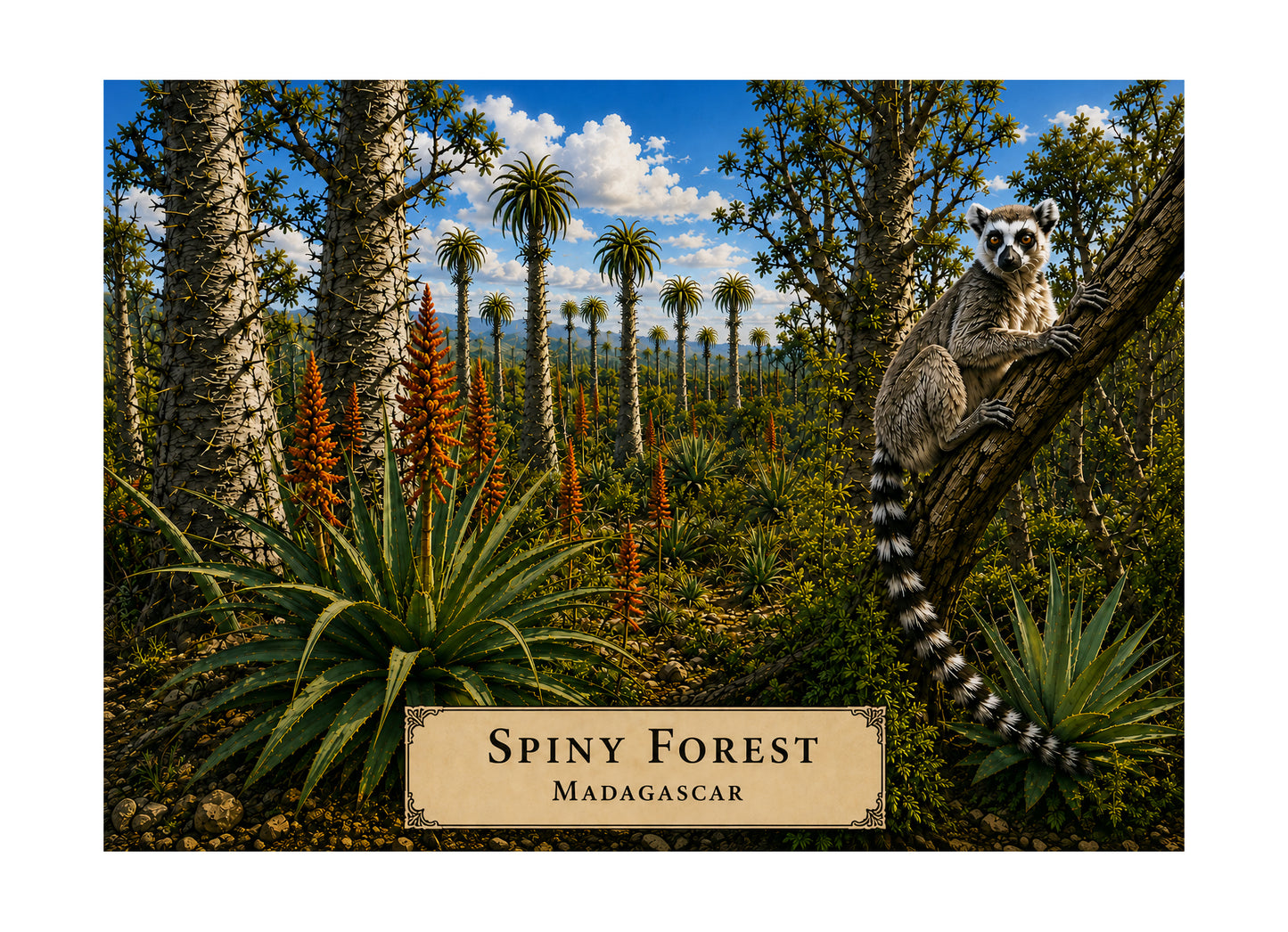
Didierea madagascariensis belongs to Didiereaceae, a remarkable plant family whose most famous members are inseparably associated with Madagascar. The species occurs naturally in the island's arid southwest, particularly within the celebrated Madagascar spiny thickets, one of the world's most distinctive dryland ecosystems and a landscape characterized by an extraordinary concentration of plants found nowhere else on Earth.
Its appearance invites comparison with the columnar cacti of the Americas, but Didierea is not a cactus. Its cactus-like architecture is another striking example of convergent evolution: unrelated plants subjected to similarly hot, dry environments independently evolved water-storing stems, reduced or seasonally absent foliage, and formidable defensive spines. Yet Didierea retains its own unmistakable identity, particularly when actively growing and its long, slender leaves emerge among the spine clusters.
The mature plant bears little resemblance in scale to the compact specimen seen here. Given time, D. madagascariensis can develop into a substantial succulent tree with a thickened trunk and numerous ascending branches, creating the bizarre, tentacular silhouette that inspired the common name Octopus Tree. In the spiny forests of southern Madagascar, mature plants contribute to a landscape so unusual that it can appear almost extraterrestrial—a vertical maze of thorns, succulent trunks, and drought-adapted vegetation.
Its seasonal foliage is another fascinating adaptation. During favorable warm and moist conditions, leaves provide additional photosynthetic surface, while under drought stress the plant can shed them and rely more heavily on its succulent structure. This ability to alternate between leafy growth and a stark armored framework allows the species to respond dynamically to an environment where rainfall is limited and unpredictable.
This exact specimen represents an especially exciting stage in that transformation. At approximately 9" tall, its blue-gray trunk is already remarkably stout and heavily protected, yet the fresh green leaves exploding between those pale spines give it an almost exuberant appearance. Over time, that compact armored stem has the potential to develop into the extraordinary branching architecture for which the species is celebrated. As our first-ever Didierea madagascariensis at Shangri-Ha Cactus Ranch, it is both an unusual collector specimen and a wonderful introduction to one of Madagascar's most extraordinary botanical lineages.