Shangri-Ha Cactus Ranch
Copiapoa cinerea subs. haseltoniana - Very Rare - Collector Specimen
Copiapoa cinerea subs. haseltoniana - Very Rare - Collector Specimen
Couldn't load pickup availability
Copiapoa cinerea subsp. haseltoniana — Extremely Rare 8-Head Old Collector Specimen
You will receive this exact specimen.
VERY RARE — we have only one.
Rarely does a specimen such as this reach the market, and this one is extraordinary.
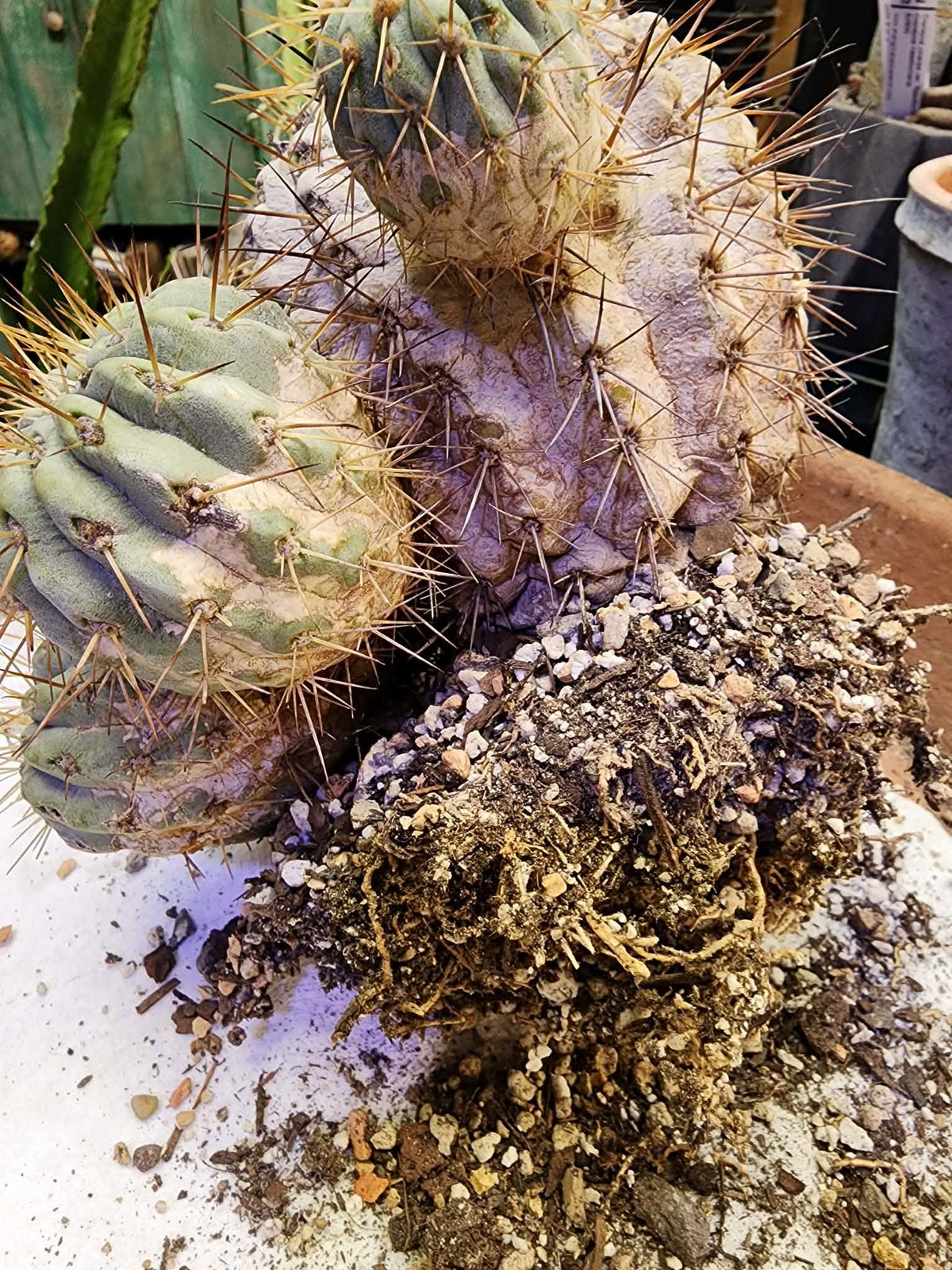
Boasts an incredible 8 heads!
Measures approximately 9" wide × 6" tall.
This exceptionally old specimen is estimated to be approximately 40–50 years old.
Showcased here in Handmade Pottery — Ivory Mesh Basin No. 46 (sold separately).
Roots as shown.
Will be shipped bare root.
🌵
Copiapoa cinerea subsp. haseltoniana is one of the great collector plants of the Atacama Desert—a slow-growing Chilean cactus prized for its remarkable epidermal coloration, powerful spination, and the extraordinary character acquired by old plants after decades of growth. Mature specimens develop an appearance that simply cannot be replicated quickly: weathered surfaces, corking, scars, changing spine patterns, and increasingly complex clustering all become part of the architecture of the plant.
This is an exceptionally old, eight-headed collector specimen, measuring approximately 9" wide × 6" tall and estimated to be 40–50 years old based on its size, extensive mature growth, pronounced corking, and highly developed clustering. Eight substantial heads crowd together into a dense colony, displaying beautiful blue-green to glaucous coloration beneath strong golden-brown spination and extensive areas of pale, weathered corking.
At $2,800, this is one of the rarest and most significant collector cacti we have offered at Shangri-Ha Cactus Ranch. Only one specimen is available—the exact plant shown here.
Care Instructions
☀️ Light
Very bright light to full sun. Copiapoa develops its most characteristic compact form, strong spination, and epidermal coloration under excellent light. Acclimate carefully after shipping or any period under filtered conditions; an old specimen should never be moved abruptly into dramatically stronger exposure.
💧 Water
Water conservatively during active growth, allowing the growing medium to dry completely between waterings. Mature Copiapoa are extraordinarily well adapted to arid conditions and should never remain in wet soil. Reduce watering substantially during cooler periods and keep particularly dry during winter dormancy.
🪨 Soil
Requires an exceptionally fast-draining, highly mineral growing medium. Pumice, lava, coarse grit, and other inorganic components are ideal. Excellent drainage and root aeration are especially important with an old specimen of this caliber.
🌡️ Temperature
Prefers warm, dry conditions during active growth. Protect from hard frost and prolonged cold, particularly when container grown. Avoid the combination of cold temperatures and wet roots.
🌬️ Humidity
Adapted to one of the driest regions on Earth, but its native environment is also strongly influenced by coastal fog. In cultivation, provide excellent air circulation and avoid prolonged stagnant moisture around the body or root zone.
📈 Growth Habit
Extremely slow growing. Young plants generally begin as solitary globose bodies, while old specimens can eventually offset and develop substantial multi-headed colonies. The development of eight established heads on this specimen represents many years of accumulated growth.
✍️ Special Note
The extensive pale tan and cream areas visible on this specimen are mature corking and old growth scars accumulated over many years. They are not defects to be disguised or removed. On an old collector cactus, this weathering forms part of the historical record of the plant and contributes enormously to its character.
This specimen is estimated to be approximately 40–50 years old, but because its complete propagation history is not documented, this should be understood as an informed age estimate rather than a documented germination date.
Please review all photographs carefully. You will receive the exact specimen shown.
Why It Stands Out
- VERY RARE
- Only one available
- Estimated 40–50 years old
- Extraordinary 8-headed colony
- Impressive 9" wide × 6" tall
- Exceptionally slow-grown mature specimen
- Beautiful blue-green to glaucous epidermis
- Dramatic golden-brown spination
- Extensive mature corking and weathered character
- Decades of visible growth history
- Highly developed clustered architecture
- Extremely difficult to replace at this size and maturity
- One of the rarest collector cacti offered by SHCR
- The exact specimen shown here
Collector Notes
Copiapoa cinerea and its closely allied forms belong to a remarkable group of cacti native to the Atacama Desert of northern Chile, one of the driest environments on Earth.
This is a landscape where the idea of a cactus merely “tolerating drought” hardly describes the challenge.
Rainfall can be extraordinarily scarce, and the survival of plant communities is intimately connected with the peculiar climatic conditions of Chile's Pacific coast. Moisture carried inland by coastal fog—locally known as the camanchaca—can provide critically important atmospheric moisture in landscapes where conventional rainfall may be absent for extraordinary periods.
It is under these conditions that Copiapoa developed some of the most distinctive plants in the cactus world.
Subspecies haseltoniana is particularly prized for the combination of its pale to blue-green epidermis and striking yellowish to golden spination. On mature plants, the contrast can be spectacular: cool, almost mineral-looking bodies emerging through a dense framework of warm-colored spines.
But the defining characteristic of an old Copiapoa is time.
These are not plants whose mature appearance can be reproduced through a few seasons of rapid cultivation. Their extraordinary character accumulates slowly. Bodies expand and contract. Old areoles age. Spines weather. Epidermal surfaces change. Previous growth becomes corked and hardened. New heads emerge and gradually establish themselves beside the original stem.
Eventually, the plant ceases to look like a collection of individual cactus heads and begins to look like a colony.
That transformation is beautifully evident here.
This specimen carries eight developed heads packed into an extraordinary 9" wide mass. Looking down into the colony reveals successive generations of growth competing for space, with individual heads pushing against and around one another. Areas of fresh blue-green epidermis sit immediately beside decades-old corked tissue, while long golden and brown spines cross the spaces between the heads.
The extensive corking is particularly important to understanding this plant.
On a young commercial cactus, buyers are accustomed to seeing uninterrupted epidermis. On an old specimen, that expectation misses much of what makes the plant valuable. Corking, old scars, changing growth patterns, and weathered tissue constitute a physical record of previous growing seasons. They tell us immediately that we are not looking at something recently produced for sale.
And at an estimated 40–50 years old, this specimen has had an enormous number of growing seasons to record.
Its precise age cannot be established without documented provenance dating back to propagation, which is why we present 40–50 years as an estimate rather than a certainty. What is unmistakable is its maturity: the eight-headed architecture, extensive old tissue, substantial dimensions, and accumulated character could only have developed over a very long period.
There is another reason plants like this deserve particular respect. Wild populations of Copiapoa face significant conservation pressures, and mature plants have historically been vulnerable to illegal collection. Serious cultivation of propagated material therefore has an important role in allowing collectors to appreciate these extraordinary plants without placing additional pressure on habitat populations.
Rarely does an old Copiapoa of this scale and character become available.
Eight heads. Nine inches across. Decades of accumulated growth. Extensive natural corking. Extraordinary spination. And an appearance that no young plant—regardless of genetics or price—can reproduce without the one ingredient that cannot be manufactured:
time.