Shangri-Ha Cactus Ranch
Astrophytum ornatum cv. Fukuryu Hania - Japan
Astrophytum ornatum cv. Fukuryu Hania - Japan
Couldn't load pickup availability
Astrophytum ornatum cv. Fukuryu Hania
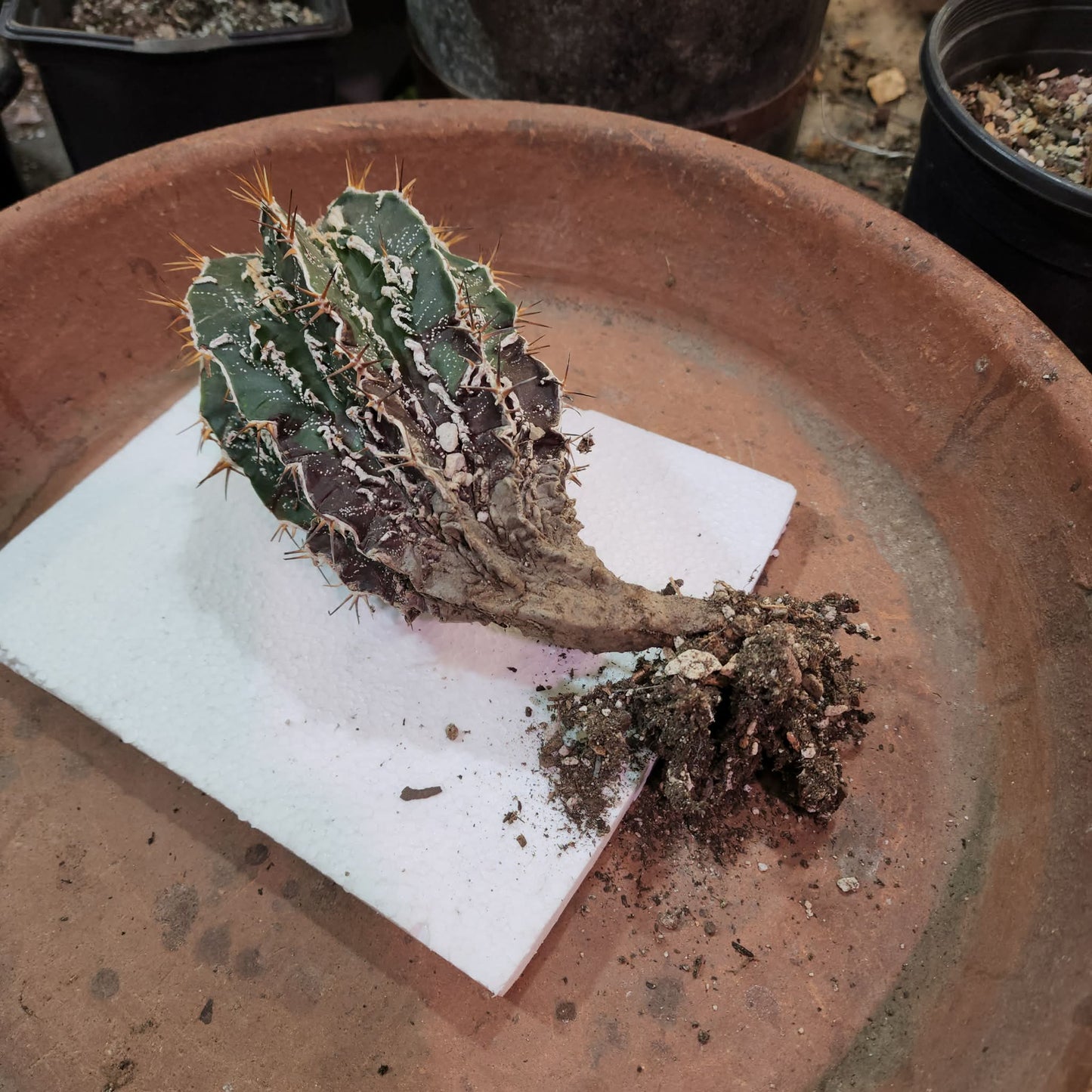
You will receive this exact specimen.
Measures 5" tall.x 4.5" wide
Roots as shown.
Showcased here in one-of-a-kind handmade pottery (sold separately).
Will be shipped bare root.
The Astrophytum ornatum cv. Fukuryu Hania is a highly prized Japanese cultivar of the "Monk's Hood" cactus. It is distinguished by its unique combination of "Fukuryu" characteristics (extra, irregular ridges or "warts" on the ribs) and "Hania" (or Hannya) features, which include wrinkled edges and a dense, white woolly pattern along the rib lines.
APPEARANCES and CHARACTERISTICS
This cactus is low-maintenance but requires specific light and soil conditions to thrive:
- Appearance: Initially globose (spherical), it becomes columnar with age, reaching heights of 30 to 120 cm. It often appears star-shaped when viewed from above.
- Ribs & Ridges: Typically has 5 to 10 ribs. The "Fukuryu" trait adds irregular raised ridges between the main ribs, while "Hania" forms have a more wrinkled, felted surface.
- Spines: Features 5–11 stout radial spines (2–4 cm long) and usually one larger central spine. These start amber-yellow, turning brown and eventually grey as they age.
- Flowers: Produces large, lemon-yellow flowers (7–12 cm wide) at the apex during the hottest months.
- Growth Rate: While generally the fastest-growing and easiest of the Astrophytum genus, it is still considered slow-growing by general plant standards.
CARE and GROWING CONDITIONS
- Light: Requires abundant, bright, and direct light. Ideally, it should receive at least 8 hours of filtered sunlight daily.
- Watering: Use the "soak and dry" method. Water sparingly from March to October and keep it completely dry during the winter dormancy period to prevent root rot.
- Soil: Needs a very permeable, coarse mineral soil. A mix with at least 50–70% inorganic material (like perlite, pumice, or gravel) is recommended.
- Temperature: Prefers warm temperatures (above 20°C/68°F) for growth. It is surprisingly cold-hardy if kept bone-dry, potentially surviving temperatures as low as -10°C (14°F) for brief periods.
- Repotting: Repot every 2 to 3 years in the spring to refresh the soil.