Shangri-Ha Cactus Ranch
Astrophytum myriostigma cv. Onzuka cristata
Astrophytum myriostigma cv. Onzuka cristata
Couldn't load pickup availability
Astrophytum myriostigma cv. Onzuka cristata — Crested Onzuka Bishop's Cap
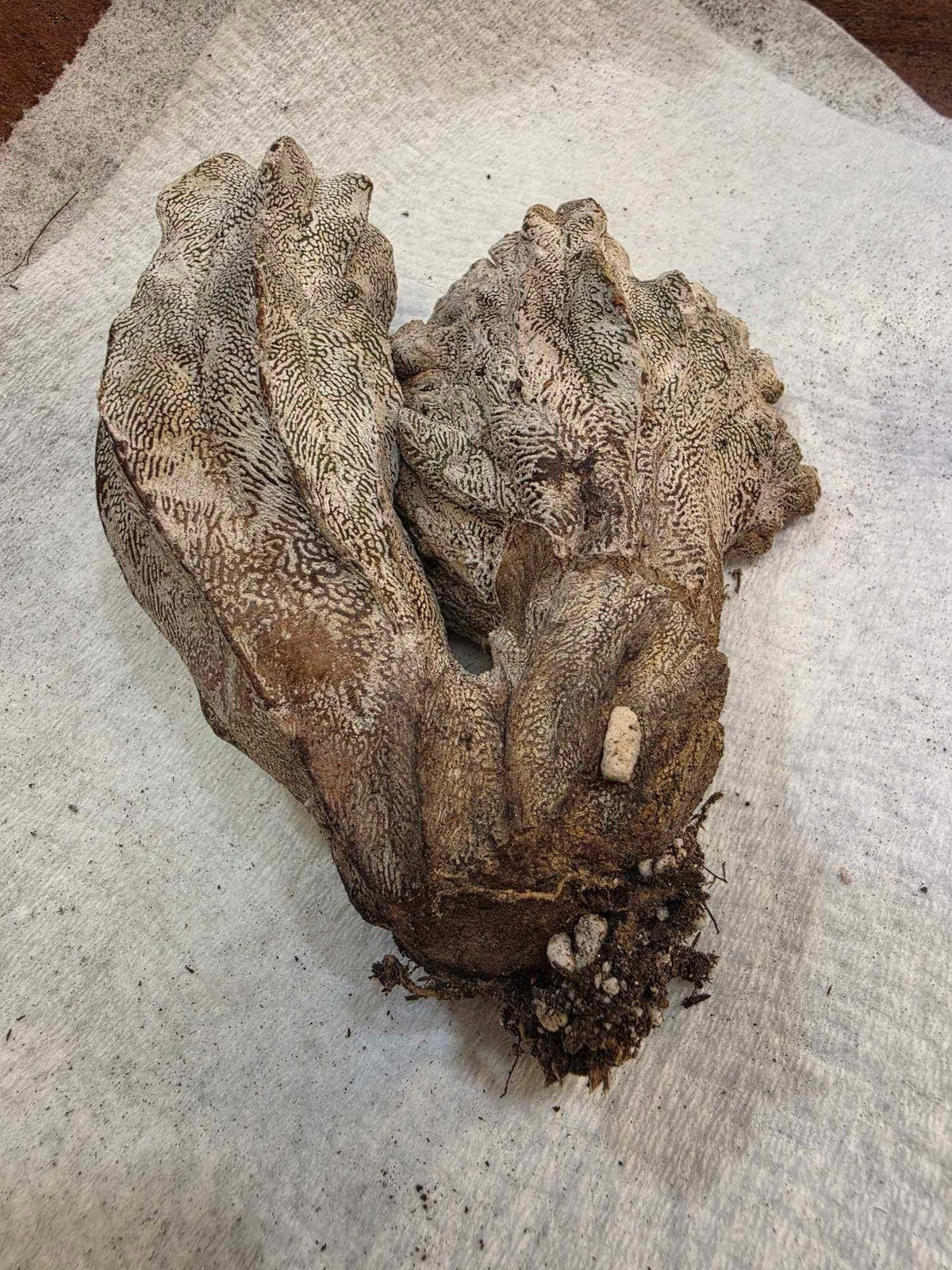
You will receive this exact crested specimen.
Measures approximately 4.5" wide.
This is a de-graft. We will include a complimentary Clonex rooting gel pack to help encourage additional root development.
Showcased here in Handmade Pottery — Midnight Flare Vessel No. 122 (sold separately).
Will be shipped bare root.
🌵
Astrophytum myriostigma cv. Onzuka cristata is an extraordinary cultivated cactus combining two of the most fascinating horticultural developments within the genus Astrophytum: the distinctive white markings of the celebrated Onzuka cultivar and the remarkable, undulating architecture of crested growth.
The result is a plant that seems to have abandoned nearly every conventional rule of cactus symmetry.
And done so rather beautifully.
The parent species, Astrophytum myriostigma, is native to Mexico, where it inhabits rocky slopes, limestone-rich terrain, and dry environments characterized by intense sunlight and seasonal rainfall.
Commonly known as the Bishop's Cap cactus, the species is famous for its geometric body, prominent ribs, and generally spineless appearance.
Its name is particularly appropriate.
Astrophytum refers to a star-shaped plant, while myriostigma alludes to the countless tiny markings that can cover its surface.
These markings are formed by specialized epidermal structures called trichomes, which give many specimens their characteristic silvery-white appearance.
The horticultural cultivar Onzuka, developed through Japanese cactus breeding, is especially prized for its unusually dense, often strikingly patterned white flecking.
Rather than the comparatively uniform dusting associated with many ordinary Astrophytum myriostigma plants, Onzuka specimens can display elaborate concentrations of white markings that create an almost ornamental effect.
But the designation cristata introduces an entirely different botanical phenomenon.
Crested growth occurs when the plant's growing tissue develops along an elongated or broadened meristem rather than maintaining a conventional single growing point.
Instead of producing the familiar rounded or columnar body, the cactus develops a continuous, irregular growth line that may fold, fan, twist, and undulate as it matures.
The resulting forms can resemble coral, folded fabric, miniature mountain ranges, or intricately carved stone.
No two crested specimens develop in precisely the same way.
And then there is this specimen.
Measuring approximately 4.5 inches wide, this crested Onzuka presents the extraordinary intersection of distinctive cultivated surface markings and the unpredictable architecture of cristate growth.
Unlike an ordinary Bishop's Cap cactus, whose beauty lies largely in its orderly geometry, a crested specimen is celebrated for the way it disrupts that symmetry.
The growth line becomes elongated.
The body develops folds and curves.
And the plant begins to resemble a miniature botanical sculpture rather than a conventional cactus.
This specimen is particularly interesting because it is a de-graft.
Grafting is commonly used in the cultivation of unusual cactus forms, particularly those whose growth habits make them difficult or slow to establish on their own roots.
A de-grafted specimen has been separated from its former rootstock and is being transitioned toward independent growth.
This process requires patience, appropriate growing conditions, and careful attention to root development.
To assist with that transition, we are including a complimentary Clonex rooting gel pack, which may be used as a rooting aid according to the manufacturer's instructions.
Successful rooting cannot be guaranteed, and the plant should be treated as a specimen requiring attentive establishment rather than as an ordinary, fully rooted cactus.
Presented here in Handmade Pottery — Midnight Flare Vessel No. 42, the plant's sculptural character is beautifully suited to a distinctive handmade vessel.
The pottery is available separately.
Care Instructions
☀️ Light
Provide very bright, indirect light or gentle morning sunlight while the plant is establishing its own root system.
Although Astrophytum myriostigma appreciates strong light when established, crested and recently de-grafted specimens may be more vulnerable to intense sun exposure, particularly during the rooting process.
Avoid prolonged, direct afternoon sunlight until the plant is well established and has been gradually acclimated.
Bright, filtered light is especially suitable during the initial transition.
💧 Water
Watering requires particular caution because this specimen is a de-graft.
Do not treat it like a fully established, actively rooted cactus.
If the cut surface has not completely healed, allow it to dry and callus thoroughly before attempting rooting. Once properly callused, position the plant in an appropriate rooting medium and manage moisture conservatively.
Avoid saturating the substrate or allowing prolonged dampness around the base.
As new roots develop, watering may be introduced gradually according to the plant's condition, temperature, and growing environment.
Once established, water during active growth and allow the substrate to dry thoroughly between waterings.
Reduce watering significantly during cool or dormant periods.
🪨 Soil
Use an exceptionally well-draining, mineral-rich cactus substrate.
Pumice, coarse grit, lava rock, and similar inorganic materials are excellent components.
For a de-grafted specimen, a clean, airy rooting medium is particularly important because excessive moisture around the cut base can encourage rot before roots have developed.
Avoid dense, moisture-retentive soils.
Choose a shallow, stable container appropriate to the plant's form and rooting condition. The specimen should be supported securely without burying substantial portions of the crested body.
🌡️ Temperature
Maintain warm, stable conditions during root establishment.
Temperatures of approximately 70–85°F are generally favorable for active cactus rooting, provided the plant is protected from excessive heat and intense direct sunlight.
Avoid frost, prolonged cold, and large temperature fluctuations.
Do not attempt to encourage rooting in cold, wet conditions.
Once established, the plant can be managed similarly to other cultivated Astrophytum myriostigma specimens, with appropriate protection during winter.
🌬️ Humidity
Provide good air circulation and avoid persistently humid, stagnant conditions.
Crested growth can create folds and recessed areas where moisture may accumulate.
These surfaces should not remain wet for extended periods.
During root establishment, ventilation is especially important for reducing the risk of fungal problems and rot.
📈 Growth Habit
Typical Astrophytum myriostigma develops a rounded to columnar body with prominent ribs, usually without spines.
The Onzuka cultivar is distinguished by its highly developed white surface markings.
The cristate form develops an elongated growing region that produces irregular folds, fans, and undulating ridges.
As the plant matures, the crest may broaden, curl, or develop increasingly complex contours.
Growth can be unpredictable, and the ultimate shape depends on the individual plant's genetics, growing conditions, and developmental behavior.
Crested specimens may occasionally produce more conventional growth points, sometimes called reversions.
✍️ Special Note
This specimen is a de-graft and requires special attention to root establishment.
A de-grafted cactus is not equivalent to a fully established specimen growing on a mature root system.
Please examine the photographs carefully to evaluate the base and any existing root development.
We are including a complimentary Clonex rooting gel pack to assist with the rooting process.
Clonex is a horticultural rooting product, but its effectiveness for this particular cactus cannot be guaranteed. Follow the manufacturer's instructions, and remember that correct callusing, sanitation, temperature, and moisture management are essential.
Do not apply rooting gel to an unhealed wound in a manner that traps moisture or interferes with proper callus formation.
Handle the crested body carefully during planting. Its irregular surfaces and growth edges may be more vulnerable to mechanical damage than those of a conventional rounded cactus.
Avoid placing unnecessary pressure on the crest when supporting the plant.
Natural corking, scarring, and variations in coloration may occur with age or as a result of previous grafting and cultivation.
The designation cristata describes an abnormal growth form, not a separate naturally occurring species.
Please review all photographs carefully, as you will receive the exact specimen shown.
Why It Stands Out
• Astrophytum myriostigma cv. Onzuka cristata, an exceptional cultivated cactus form
• Approximately 4.5" wide
• Combines the distinctive Onzuka cultivar with extraordinary crested growth
• Parent species originates from Mexico
• Celebrated for elaborate white surface markings
• Unusual elongated growing point creates sculptural folds and undulations
• Fascinating departure from conventional Bishop's Cap symmetry
• A highly individual architectural collector specimen
• De-grafted specimen requiring careful root establishment
• Complimentary Clonex rooting gel pack included
• Particularly appealing to collectors of crested and unusual Astrophytum cultivars
• Intriguing combination of Japanese horticultural selection and cristate growth
• Showcased in Handmade Pottery — Midnight Flare Vessel No. 42, sold separately
• The exact specimen shown here
Collector Notes
There is something wonderfully rebellious about a crested cactus.
Most cacti spend their lives following a remarkably consistent architectural plan.
A growing point.
A series of ribs.
A recognizable silhouette.
And, with enough time, a larger version of essentially the same form.
But occasionally, nature abandons the blueprint.
The growing point becomes a line.
The line begins to fold.
And what might have been a perfectly ordinary cactus becomes something entirely unexpected.
That is the fascination of cristate growth.
It is not simply an unusual shape.
It is a different way of growing.
And when that phenomenon occurs in an Onzuka Astrophytum, the result is especially compelling.
The Onzuka cultivar is already an extraordinary achievement of horticultural selection, admired for its elaborate white markings and decorative surface.
Add crested growth, and the plant acquires another dimension entirely.
The familiar geometry of the Bishop's Cap gives way to folds, curves, and irregular contours.
Its surface markings follow those contours, creating an interplay between pattern and structure that can be endlessly fascinating.
There is also something particularly interesting about a de-grafted specimen.
It represents a transition.
A plant that has been supported by another cactus is being given the opportunity to establish itself independently.
That process requires patience and a willingness to participate in the plant's continued development.
For some collectors, that is part of the appeal.
Not simply acquiring a finished botanical object, but helping an unusual plant establish the foundation for its next chapter.
At approximately 4.5 inches wide, this crested Onzuka already possesses the kind of individuality that makes unusual cactus collecting so rewarding.
Its future growth may take directions that cannot be predicted today.
More folds.
More curves.
An increasingly elaborate sculptural form.
Or something entirely unexpected.
And perhaps that is the most wonderful thing about a crested cactus.
It has absolutely no intention of becoming ordinary.