Shangri-Ha Cactus Ranch
Astrophytum asterias — Monstrose Cluster Form (Collector Specimen)
Astrophytum asterias — Monstrose Cluster Form (Collector Specimen)
Couldn't load pickup availability
Astrophytum asterias — Monstrose Cluster Form (Collector Specimen)
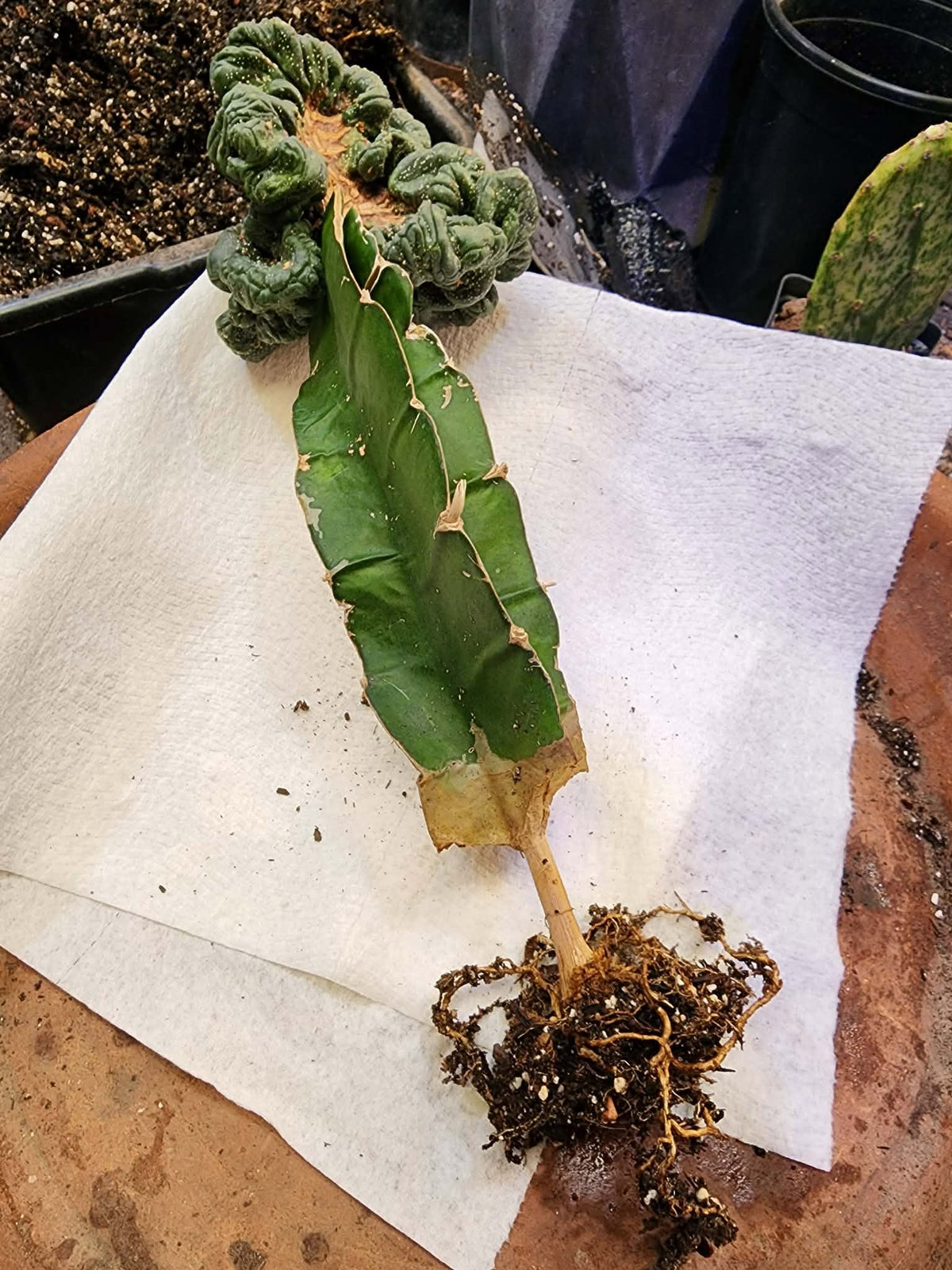
You will receive this exact specimen.
Scion measures 6" wide × 5" tall.
Entire specimen measures 11" tall.
Showcased here in Handmade Pottery — Canyon Crest Planter No. 68 (sold separately).
Roots as shown.
Will be shipped bare root.
🌵
Astrophytum asterias is one of the most distinctive and highly collected members of the genus, prized for its flattened, spineless body, geometric rib structure, woolly areoles, and characteristic patterning of minute white trichomes across the epidermis. In monstrose forms, that familiar symmetry is disrupted, producing irregular growth points, offsets, folds, and proliferating heads that can transform the normally solitary, disciplined architecture of the species into something remarkably sculptural.
This is an exceptional mature monstrose cluster form, with a substantial 6" wide × 5" tall scion composed of numerous tightly arranged growth points. Rather than presenting as a single flattened star, the plant has developed into a dense, irregular mass of overlapping heads, each contributing its own ribs, woolly areoles, and changing geometry. At 11" tall overall, the specimen has tremendous presence and represents years of developed monstrose growth rather than the small, recently propagated material more commonly encountered.
Care Instructions
☀️ Light
Bright light with several hours of gentle direct sun is ideal. Strong light helps maintain compact growth, pronounced form, and attractive epidermal coloration. Protect from sudden exposure to intense midday or afternoon sun, particularly after shipping, as Astrophytum asterias can scorch if not properly acclimated.
💧 Water
Water thoroughly during active warm-season growth, then allow the growing medium to dry completely before watering again. Reduce watering substantially as temperatures cool and keep nearly dry during winter dormancy. Avoid allowing moisture to remain around the base or crown for prolonged periods.
🪨 Soil
Requires an exceptionally fast-draining, mineral-rich cactus mix. Pumice, lava, coarse grit, and other inorganic components are particularly useful for maintaining excellent root aeration. Avoid dense, highly organic, or moisture-retentive soil.
🌡️ Temperature
Prefers warm growing conditions during the active season. Protect from frost and prolonged cold. During winter, cool conditions can be tolerated considerably better when the plant is kept dry.
🌬️ Humidity
Best grown with low to moderate humidity and excellent air circulation. Dense monstrose growth creates numerous folds and protected spaces where moisture can linger, making good airflow especially important.
📈 Growth Habit
Typical Astrophytum asterias develops as a solitary, low, flattened body divided into broad ribs. Monstrose specimens depart dramatically from this pattern, producing irregularly organized growth points and proliferating offsets. Over time, selected forms can develop into substantial clusters whose architecture bears little resemblance to the simple symmetry of the typical species.
✍️ Special Note
Monstrose growth results from an abnormal organization of the plant's growing tissue, causing development to depart from the species' usual symmetrical pattern. Because that growth is inherently irregular, every mature monstrose specimen develops differently. The resulting folds, offsets, heads, rib transitions, and asymmetries are part of the character that makes these plants particularly desirable to collectors.
As with any mature collector cactus, natural surface marks, old growth, corking, minor scars, and irregularities are part of the specimen's history rather than imperfections. Please review all photographs carefully, as you will receive the exact plant shown.
Why It Stands Out
- Exceptional mature collector specimen
- Massive 6" wide × 5" tall scion
- Impressive 11" overall height
- Highly unusual monstrose cluster form
- Numerous tightly packed growth points
- Complex, irregular rib development
- Characteristic woolly Astrophytum areoles
- Beautifully sculptural three-dimensional form
- Dramatic departure from typical A. asterias symmetry
- Years of established clustered growth
- Every angle presents a different structure
- The exact specimen shown here
Collector Notes
Astrophytum asterias is native to a limited region of southern Texas and northeastern Mexico, where it grows low to the ground in open, often sparsely vegetated habitat. Unlike many familiar cacti, it possesses no spines. Instead, its visual identity comes from geometry: a flattened body divided into broad ribs, prominent woolly areoles, and an epidermis typically scattered with tiny white trichomes.
The species' ordinary growth pattern is remarkably disciplined.
A classic A. asterias viewed from above resembles a carefully constructed star or geometric medallion. Its ribs radiate from a central growing point with a degree of regularity that has made the species one of the foundational plants of serious Astrophytum collecting and breeding.
Monstrose growth changes that architecture completely.
Instead of maintaining a single orderly growing point, the plant begins producing irregular zones of growth. Ribs may divide, terminate, merge, or redirect themselves. New heads emerge where the typical species would remain solitary. As these growth points accumulate, the familiar star-shaped body can eventually disappear into an extraordinary cluster of repeating but imperfect forms.
That unpredictability is precisely the attraction.
No two mature monstrose plants develop according to an identical plan. Even genetically similar material can diverge considerably over time as individual growth points expand, compete for space, offset, and reshape the overall silhouette. A mature specimen therefore becomes increasingly individual with age.
This plant demonstrates that transformation beautifully.
Its 6" wide × 5" tall scion has developed well beyond a simple monstrose deviation into a substantial colony of tightly compressed growth. Numerous heads crowd against one another, creating deep valleys, raised ridges, woolly points, and abrupt transitions in direction. Viewed from different angles, individual asterias-like structures appear and then disappear again into the larger mass.
At 11" tall overall, it also possesses the scale necessary for that architecture to have real visual impact. This is not simply an unusual young graft whose eventual form remains to be seen; it is an established collector specimen in which years of irregular development have already produced a complex and highly individual structure.
Typical Astrophytum asterias is celebrated for symmetry. This specimen is compelling for precisely the opposite reason.
Dense, unpredictable, mature, and impossible to duplicate exactly, this monstrose cluster represents the species' normally precise geometry beautifully coming undone.