Shangri-Ha Cactus Ranch
Aloe Nobilis 'Gold Tooth' variegata - Highly Variegated
Aloe Nobilis 'Gold Tooth' variegata - Highly Variegated
Couldn't load pickup availability
Aloe nobilis ‘Gold Tooth’ Variegata — Highly Variegated
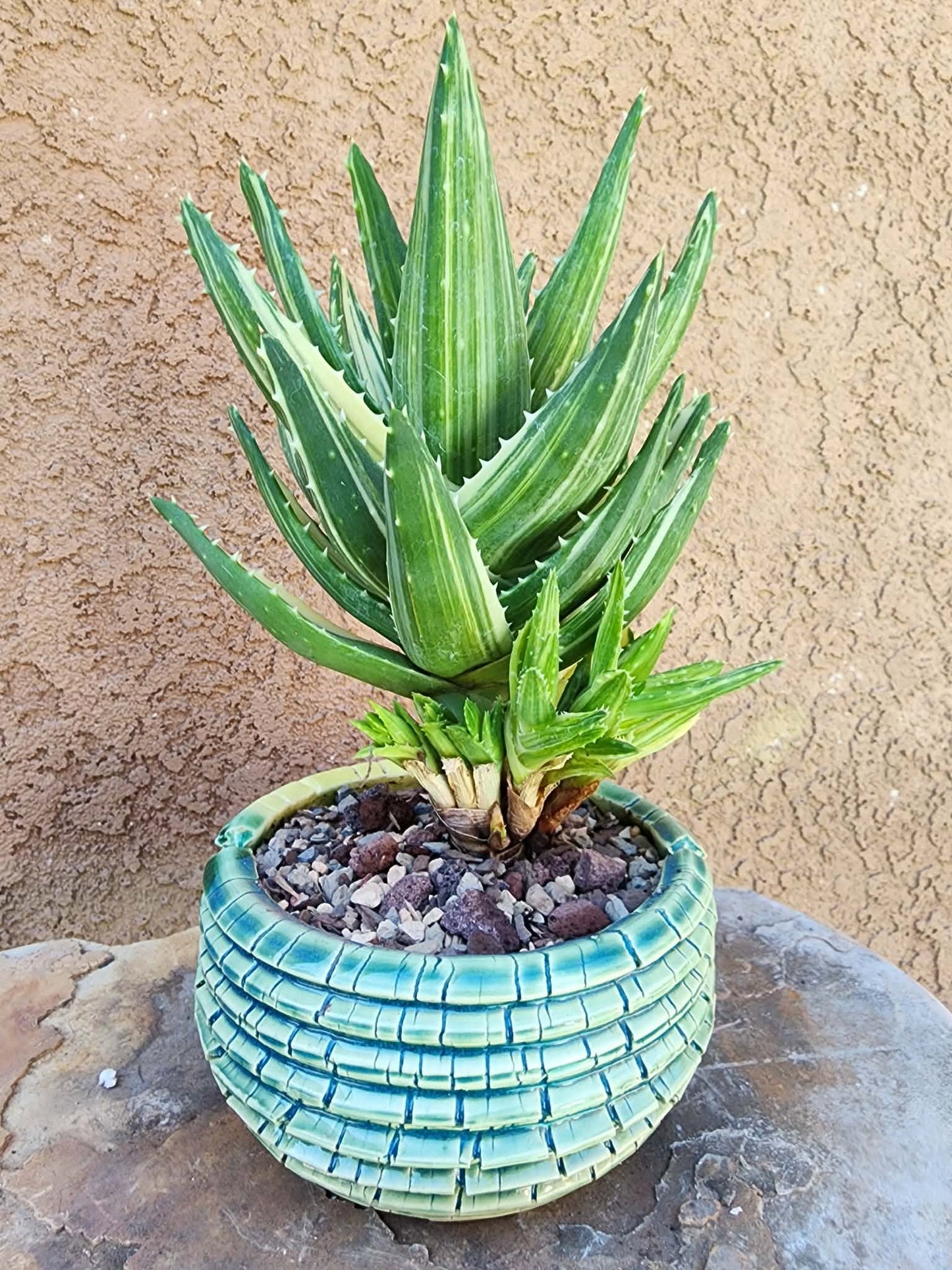
You will receive this exact, large specimen.
Highly variegated.
Measures 9" tall x 6.5" wide.
Showcased here in Handmade Pottery – Citron Coil Vessel No. 97 (sold separately).
Will be shipped bare root.
🌵
Aloe × nobilis ‘Gold Tooth’ Variegata is a wonderfully architectural variegated aloe combining the strong, sharply toothed rosettes associated with ‘Gold Tooth’ with dramatic longitudinal striping in shades of deep green, lime, cream, and brilliant yellow. Although Aloe × nobilis is a horticultural hybrid rather than a naturally occurring wild species, its ancestry lies among the extraordinary aloes of South Africa. This exceptional specimen is highly variegated, with mature leaves displaying beautifully irregular bands of contrasting color while the younger basal growth emerges with particularly intense yellow and chartreuse pigmentation. At 9" tall x 6.5" wide, it is already a substantial, beautifully developed plant, with multiple growing points creating an increasingly complex silhouette. The combination of strong upright form, pronounced marginal teeth, vivid striping, and remarkably bright new growth makes this an especially expressive example of the variegated form.
Care Instructions
☀️ Light
Very bright light to partial or full sun. Strong light helps maintain compact growth and vivid coloration, but highly variegated portions contain less chlorophyll and can be more susceptible to scorching. Acclimate gradually to intense direct sunlight, particularly after shipping or a change in growing conditions.
💧 Water
Water thoroughly during active growth, then allow the soil to dry well before watering again. Reduce watering substantially during cooler months. Avoid allowing water to remain trapped in the rosettes or around the crown for prolonged periods.
🪨 Soil
Requires a fast-draining succulent mix with substantial mineral content and excellent aeration around the roots. Avoid dense, moisture-retentive soils.
🌡️ Temperature
Protect from hard frost and prolonged freezing conditions. This aloe performs best with warmth during active growth and should be kept considerably drier during cool weather.
🌬️ Humidity
Prefers relatively dry conditions with good air circulation. Strong airflow is especially beneficial around clustered growth where moisture can otherwise remain trapped between leaves.
📈 Growth Habit
Forms upright, toothed rosettes and offsets readily with maturity, gradually developing into a dense cluster of multiple growing points. Individual leaves may display dramatically different amounts and patterns of variegation, and new offsets can emerge with coloration distinct from the older portions of the plant.
✍️ Special Note
The × in Aloe × nobilis identifies the plant as a hybrid. It has long circulated in cultivation under the simpler name Aloe nobilis, which remains commonly encountered in the nursery trade. Its precise parentage has been treated differently by botanical and horticultural sources, but its ancestry is associated with South African Aloe species. Variegation is naturally variable: individual leaves and offsets may contain different proportions of green, yellow, cream, and chartreuse tissue, and future growth may emerge with more or less chlorophyll.
Why It Stands Out
- Large 9" tall x 6.5" wide specimen
- Exceptionally high degree of variegation
- Brilliant yellow and chartreuse basal growth
- Dramatic longitudinal green, cream, and yellow striping
- Multiple active growing points
- Strong architectural rosette form
- Distinctive toothed leaf margins
- South African Aloe ancestry
- Increasingly complex clustering habit with maturity
- Every leaf develops its own variegation pattern
Collector Notes
Aloe × nobilis has an interesting history because, despite frequently being encountered simply as Aloe nobilis, it is not regarded as a naturally occurring Aloe species. It is an old horticultural hybrid whose ancestry traces to South African aloes. Its exact parentage has been interpreted differently over time, which makes the hybrid designation particularly useful: it acknowledges what is known without assigning the plant a false wild provenance. ‘Gold Tooth’ is prized for the vigorous, sculptural growth and conspicuously toothed foliage that give mature plants their formidable architecture.
Variegation transforms that architecture completely. Instead of a uniformly green rosette, each leaf becomes an individual composition of longitudinal bands and streaks ranging from rich chlorophyll-green to lime, cream, and nearly luminous yellow. This specimen is particularly compelling because several stages of that development are visible simultaneously. The established upper growth carries strong green-and-yellow striping, while younger growth near the base is dramatically brighter, including leaves with extensive yellow and chartreuse tissue. Multiple growing points are already contributing to the plant's expanding architecture, giving it considerably more presence than a small juvenile rosette. At 9" tall x 6.5" wide, this is a bold, established variegated aloe whose coloration and form should continue to evolve with every successive flush of growth.