Shangri-Ha Cactus Ranch
Aloe brevifolia – Crocodile Plant
Aloe brevifolia – Crocodile Plant
Couldn't load pickup availability
Aloe brevifolia — Crocodile Plant
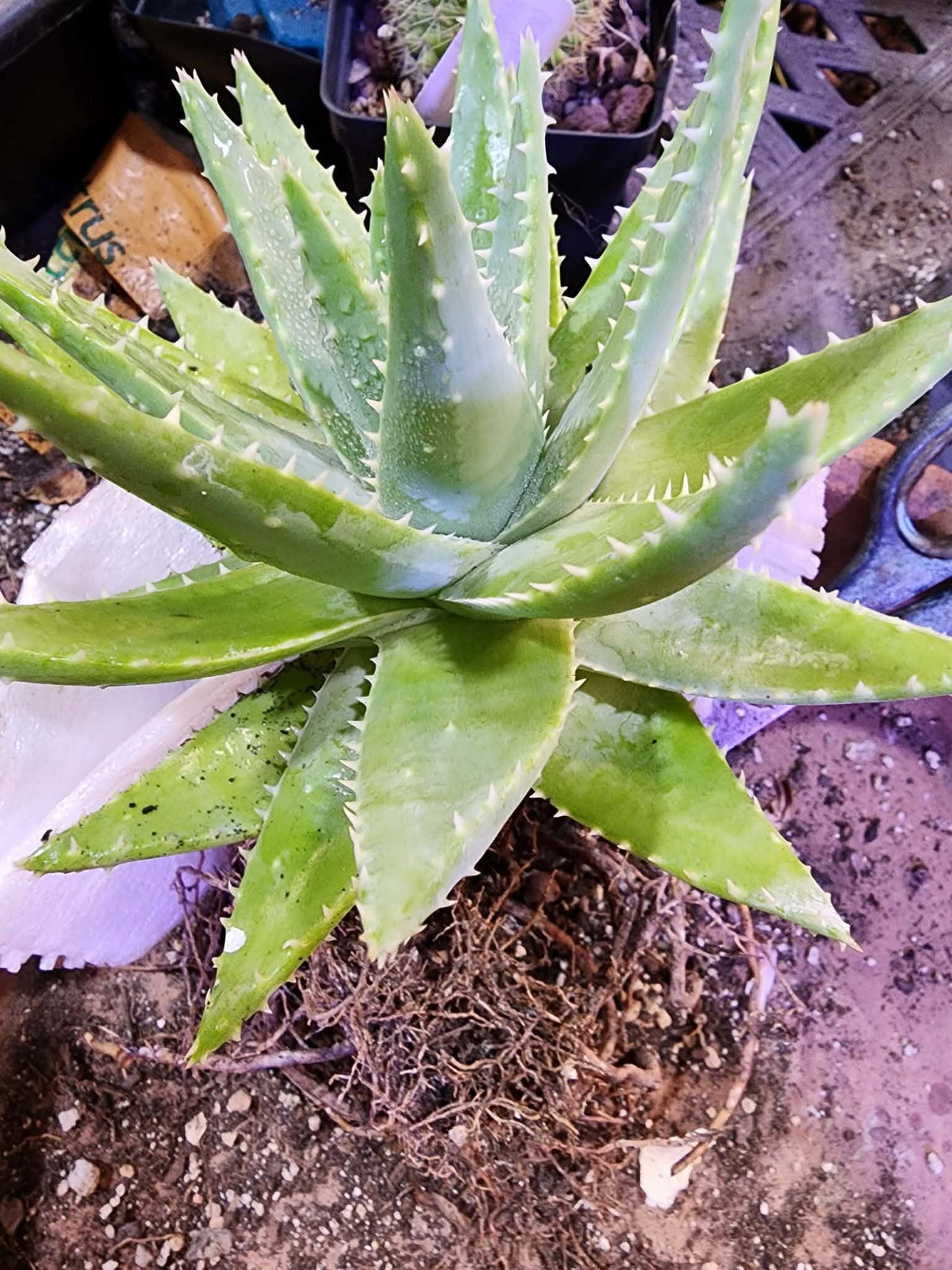
You will receive this exact specimen.
Measures approximately 8" wide × 6" tall.
Showcased here in Handmade Pottery — Cracked Earth Basin No. 137 (sold separately).
Roots as shown.
Will be shipped bare root.
🌵
Aloe brevifolia, commonly known as the Crocodile Plant or Short-Leaved Aloe, is a distinctive South African succulent native to the Western Cape, where it grows in rocky, well-drained habitats influenced by the region's Mediterranean climate. Its botanical name comes from the Latin brevis, meaning short, and folium, meaning leaf—a wonderfully straightforward description of a plant whose compact, triangular foliage distinguishes it from many of its taller relatives.
The species forms dense rosettes of thick, blue-green to gray-green leaves, each edged with small, pale teeth. The leaves are unusually broad and short, overlapping in a tightly organized arrangement that gives the plant an almost armored appearance. Its common name, Crocodile Plant, is particularly appropriate: there is something distinctly reptilian about those serrated margins and the way the pointed leaves fit together like protective scales.
Unlike the towering tree aloes or the large, sprawling species familiar to many succulent enthusiasts, Aloe brevifolia remains comparatively low-growing. Over time, established plants can produce offsets, gradually developing into colonies of closely packed rosettes. In favorable conditions, mature specimens may also produce upright flower stalks bearing tubular flowers in shades of orange to coral-red, introducing a striking contrast to the cool coloration of the foliage.
And then there is this specimen.
Measuring approximately 8" wide × 6" tall, this is a generously sized example of a species frequently offered as a much smaller nursery plant. Its substantial dimensions give it a sculptural presence, while the characteristic short, toothed leaves provide the unmistakable architectural quality that makes Aloe brevifolia so appealing.
Presented here in Handmade Pottery — Cracked Earth Basin No. 137, the plant's rugged, prehistoric character is beautifully complemented by the earthy texture of the vessel. The pottery is available separately.
Care Instructions
☀️ Light
Provide very bright light with several hours of direct sunlight. Morning sun and some protection from intense afternoon heat are beneficial in particularly hot climates. Strong light encourages compact growth and attractive foliage coloration. Acclimate gradually after shipping to prevent sunburn.
💧 Water
Water thoroughly during active growth, allowing the substrate to dry between waterings. Aloe brevifolia originates from a region with predominantly winter rainfall, although cultivated plants may adapt to different seasonal watering schedules. Reduce watering during prolonged heat, cold, or periods of inactivity. Avoid keeping the roots continuously moist.
🪨 Soil
Use an exceptionally well-draining succulent mix containing generous proportions of pumice, lava rock, coarse grit, decomposed granite, or similar mineral materials. The species naturally inhabits rocky environments and benefits from a porous substrate that allows moisture to move quickly through the root zone.
🌡️ Temperature
Prefers mild to warm temperatures and can tolerate brief periods of light frost when established and kept relatively dry. Protect container-grown specimens from prolonged freezing conditions, particularly when the soil is wet.
🌬️ Humidity
Prefers good air circulation and relatively dry conditions. In humid climates, excellent drainage and careful watering are particularly important. Avoid prolonged moisture accumulation within the rosettes.
📈 Growth Habit
Aloe brevifolia is a compact, clustering species that forms tight rosettes of short, triangular leaves. Established plants may produce offsets around their bases, eventually creating dense colonies. Individual rosettes remain comparatively small, but mature colonies can spread considerably wider than a single plant.
✍️ Special Note
The small teeth along the leaf margins are a natural characteristic of this species and contribute to its distinctive appearance. Although formidable-looking, they are generally less aggressive than the heavy spines found on many larger aloes.
Like other aloes, Aloe brevifolia may develop natural corking, minor leaf scarring, dried lower leaves, or variations in foliage coloration as it matures. These characteristics are normal and should not be confused with disease.
Please review all photographs carefully, as you will receive the exact specimen shown. The handmade pottery is sold separately, and the plant will be shipped bare root.
Why It Stands Out
- Aloe brevifolia, a distinctive species native to South Africa's Western Cape
- Commonly known as the Crocodile Plant
- Substantial specimen measuring approximately 8" wide × 6" tall
- Thick, triangular, blue-green to gray-green foliage
- Characteristic pale teeth along the leaf margins
- Beautifully compact, architectural growth habit
- Naturally adapted to rocky, well-drained environments
- Clustering species capable of developing into dense colonies
- Mature plants may produce attractive orange to coral-red flowers
- Particularly appealing in shallow, sculptural pottery
- Showcased in Cracked Earth Basin No. 137, available separately
- The exact specimen shown here
Collector Notes
Not every Aloe aspires to become a tree.
Some are content to remain close to the ground, arranging their leaves into compact, carefully organized rosettes and investing their energy in survival rather than stature.
Aloe brevifolia belongs firmly to the latter category.
In the Western Cape of South Africa, where this species occurs naturally, the landscape is shaped by seasonal rainfall, rocky soils, and extended periods when moisture can be scarce. Plants growing in these environments have evolved an extraordinary variety of strategies for conserving water, protecting vulnerable tissues, and making the most of favorable growing conditions.
For Aloe brevifolia, the solution is a remarkably efficient arrangement of thick, overlapping leaves.
Each leaf functions as a reservoir, storing moisture within its fleshy tissues. The compact rosette reduces the amount of exposed space between leaves, while the plant's relatively low stature keeps its growing structure close to the ground.
The result is a succulent that appears almost deliberately engineered.
The leaves themselves are particularly interesting.
Unlike the long, tapering foliage associated with many familiar aloes, those of Aloe brevifolia are short, broad, and triangular. Their surfaces often display a beautiful blue-green coloration, sometimes softened by a powdery, waxy bloom that helps protect the foliage from intense sunlight.
Along each margin runs a series of small, pale teeth.
These are responsible for the plant's wonderfully evocative common name.
Look closely at a mature rosette and the resemblance becomes apparent. The leaves overlap like scales, their serrated edges creating an intricate pattern that recalls the armored skin of a crocodile.
There is even something prehistoric about the plant's proportions: broad at the base, heavily protected around the edges, and seemingly built to withstand conditions that would discourage more delicate vegetation.
Yet beneath that formidable appearance is a surprisingly restrained little Aloe.
Rather than producing a single enormous rosette, the species can gradually expand through the development of offsets. New growth emerges near the base of established plants, creating additional rosettes that eventually form a closely packed colony.
In habitat, this tendency allows Aloe brevifolia to occupy small pockets of suitable ground, spreading slowly across rocky surfaces where larger plants might struggle to establish themselves.
The arrangement also creates an interesting visual effect.
A solitary rosette is beautifully symmetrical, with its leaves radiating outward from a central growing point. As additional rosettes develop, that symmetry gives way to something more complex: overlapping forms, intersecting leaf margins, and subtle variations in size and orientation.
What begins as a single geometric object gradually becomes a miniature landscape.
There is another aspect of this species worth appreciating.
Although its foliage is the principal attraction throughout most of the year, mature Aloe brevifolia plants can produce slender flowering stalks bearing tubular blossoms in warm shades of orange and red.
The contrast is particularly striking. Against the cool blue-green leaves, the flowers introduce a sudden burst of color, transforming a plant admired primarily for its form into something altogether more conspicuous.
Like many South African aloes, the species has evolved within an ecological setting where flowering plants contribute to relationships with nectar-feeding birds and insects. Its flowers are not simply ornamental additions but part of a much larger biological story.
For collectors, however, the enduring appeal of Aloe brevifolia lies in its foliage.
It is a plant whose character does not depend upon flowers, unusual mutations, or extravagant size. Its identity is expressed through proportion, texture, and the extraordinary precision of its leaf arrangement.
At approximately 8 inches across, this particular specimen offers a substantial presentation of those qualities.
Its dimensions are especially appealing because Aloe brevifolia is so often encountered as a small starter plant. A specimen of this size has enough physical presence to be appreciated as an individual botanical object rather than merely another addition to a tray of young succulents.
And it pairs beautifully with handmade pottery.
The compact growth habit and rugged leaf margins lend themselves naturally to vessels with earthy textures and restrained proportions. In the Cracked Earth Basin No. 137, the relationship between plant and pottery is particularly fitting: two forms that suggest weathered landscapes, geological surfaces, and the quiet beauty of things shaped by time.
There are certainly more flamboyant members of the Aloe genus.
Some grow into enormous branching trees. Others produce spectacular architectural flower stalks or leaves armed with intimidating spines.
Aloe brevifolia has chosen a different path.
It has remained low, compact, and extraordinarily well organized, carrying its small defenses along the edges of leaves that look as though they have been arranged by a particularly meticulous architect.
It is a crocodile in miniature, a botanical survivor from South Africa's remarkable succulent flora, and a fine example of how much character can be concentrated into a relatively small plant.
Not every remarkable Aloe needs to tower above the landscape. Some are perfectly content to conquer the ground beneath them.