Shangri-Ha Cactus Ranch
Alluaudia Procera - Madagascar Ocotillo - 3 Feet Tall
Alluaudia Procera - Madagascar Ocotillo - 3 Feet Tall
Couldn't load pickup availability
Alluaudia procera — Madagascar Ocotillo — Huge 3-Foot Specimen
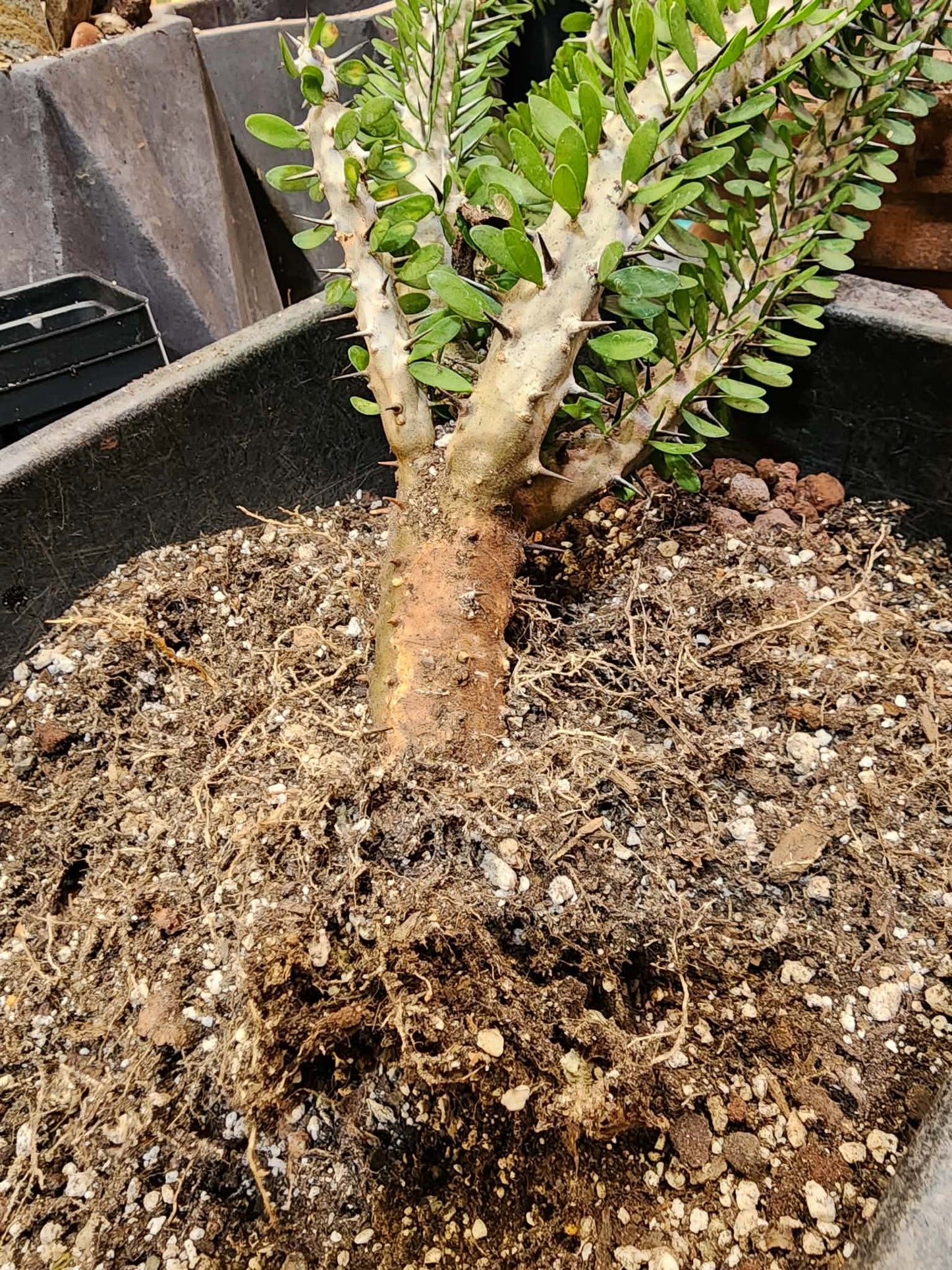
You will receive the exact HUGE specimen shown here.
Very large specimen measuring 3 feet tall above the soil line!
Features 5 arms + a new baby!
Showcased here in Tuscany Earthen Terra Cotta Pottery — Italian Blue Ruin Planter No. 219 (sold separately).
Roots as shown.
Will be shipped bare root.
🌵
Alluaudia procera, commonly known as Madagascar Ocotillo, is one of the great architectural plants of Madagascar's extraordinary spiny forests. Tall, slender stems rise vertically and are densely patterned with pairs of small green leaves and formidable thorns, creating a plant that seems at once primitive, elegant, and almost impossibly well adapted to its harsh environment. Although its resemblance to the American ocotillo is striking, the two are not close relatives—one of the classic examples of convergent evolution in succulent plants.
This is an exceptionally large, mature specimen standing approximately 3 feet tall above the soil line, with five established arms plus a new basal baby already emerging. Its long upright stems show years of development, while the dense covering of fresh green leaves gives the entire specimen remarkable texture. At this size, Alluaudia procera moves beyond simply being an unusual succulent and begins to display the vertical architecture that makes mature plants so spectacular in the Malagasy landscape.
Care Instructions
☀️ Light
Very bright light to full sun. Strong light encourages sturdy upright growth, compact internodes, and the characteristic dense arrangement of leaves along the stems. Acclimate gradually to intense direct sunlight after shipping.
💧 Water
Water thoroughly during active warm-season growth, then allow the soil to dry substantially before watering again. Reduce watering dramatically when the plant becomes dormant or loses its leaves. Leaf drop can be a normal response to cool temperatures or dry seasonal conditions and does not necessarily indicate a problem.
🪨 Soil
Requires an exceptionally fast-draining succulent mix with substantial mineral content. Pumice, lava, coarse grit, and similar inorganic materials are ideal for maintaining excellent aeration around the roots. Avoid dense or persistently wet soil.
🌡️ Temperature
Thrives in warmth and should be protected from frost and prolonged cold. This is a Madagascan dry-forest species accustomed to heat and strong seasonal rhythms. During cool weather or dormancy, keep substantially drier.
🌬️ Humidity
Prefers relatively dry conditions with good air circulation. It can tolerate periods of seasonal humidity when actively growing, provided temperatures are warm and drainage is excellent.
📈 Growth Habit
Develops into a tall, strongly vertical, many-branched succulent shrub or small tree. Young container specimens often consist of only one or several slender stems, but established plants progressively branch and can eventually become substantial woody structures. In habitat, mature plants can reach tree-like proportions, becoming an important structural component of Madagascar's spiny forest.
✍️ Special Note
Despite the common name Madagascar Ocotillo, Alluaudia procera is not an ocotillo and is not closely related to the North American Fouquieria splendens. Their remarkable resemblance evolved independently as both adapted to similarly dry environments.
This is an especially beautiful example of convergent evolution: unrelated plants arriving at strikingly similar solutions to the same environmental challenges.
The leaves of Alluaudia procera are also naturally deciduous under certain conditions. Plants may shed some or all of their foliage during dry or cool periods and leaf out again when warmth and moisture return.
Please review all photographs carefully, as you will receive the exact plant shown.
Why It Stands Out
- HUGE 3-foot-tall specimen
- 5 established arms + a new baby
- Spectacular mature vertical architecture
- Beautiful silver-gray stems
- Dense rows of small emerald-green leaves
- Dramatic paired thorns running the length of the stems
- Already developing the multi-stemmed structure of an older plant
- Fascinating example of convergent evolution
- Iconic species of Madagascar's spiny forest
- Increasingly tree-like with age
- Established root system
- Mature character that takes years to develop
- The exact specimen shown here
Collector Notes
Few plants embody the strange botanical world of Madagascar as completely as Alluaudia procera.
The species is native to the island's remarkable southern and southwestern spiny forests, an ecosystem dominated by plants that have evolved under intense heat, irregular rainfall, and prolonged seasonal drought. Here, Alluaudia can become one of the defining elements of the landscape, rising above the surrounding vegetation in forests of tall, narrow, thorn-covered stems.
And they can become enormous.
In habitat, mature Alluaudia procera may eventually reach roughly 30–50 feet in height, transforming the slender stems familiar to succulent collectors into genuine trees. Large specimens branch repeatedly overhead, producing bizarre vertical forests unlike almost anything found elsewhere on Earth.
The specific epithet procera means tall, high, or elongated—an exceptionally appropriate name for a species whose entire architecture is built around vertical ascent.
But perhaps the most fascinating story surrounding Alluaudia procera begins thousands of miles away.
Anyone familiar with the deserts of the American Southwest will immediately recognize something strangely familiar about it. The upright whip-like branches, small leaves distributed along thorny stems, and ability to shed foliage during drought make it look remarkably like the North American ocotillo, Fouquieria splendens.
For a long time, the resemblance seems almost too precise to be accidental.
Yet the two plants evolved on opposite sides of the world and belong to entirely different botanical families.
What they share is not ancestry, but environmental pressure.
Both evolved in dry landscapes where rainfall arrives unpredictably and conserving water is essential. Both developed tall photosynthetic stems armed against browsing animals. Both produce leaves when conditions permit and can shed them when water becomes scarce.
Evolution encountered similar problems twice—and arrived at remarkably similar answers.
There is another wonderful detail hidden in those stems.
The green leaves and sharp spines occur in organized pairs and repeating ranks along the plant, producing the almost stitched or laddered appearance visible on mature branches. As the stems age, the foliage may come and go with the seasons, but the thorny architecture remains, gradually becoming thicker, paler, and more woody.
This specimen has already begun that transformation.
At 3 feet tall, with five substantial arms, it has developed far beyond the simple single-stemmed appearance of a young nursery plant. The stems vary in age and thickness, older sections carrying the marks of previous growing seasons while their tips continue extending upward with fresh foliage.
And then, right at the base, there is the beginning of the next generation of architecture:
a new baby.
That small emerging shoot matters. It is the beginning of another vertical stem which, given time, can become another major component of the plant's increasingly complex framework.
Today this specimen is three feet tall.
In Madagascar, its relatives eventually become trees.
And looking at those five great stems reaching upward—with number six already beginning at their feet—you can see exactly how it happens.