Shangri-Ha Cactus Ranch
Agave decipiens - False Sisal - Florida Agave
Agave decipiens - False Sisal - Florida Agave
Regular price
$48.00 USD
Regular price
$48.00 USD
Sale price
$48.00 USD
Unit price
per
Shipping calculated at checkout.
Couldn't load pickup availability
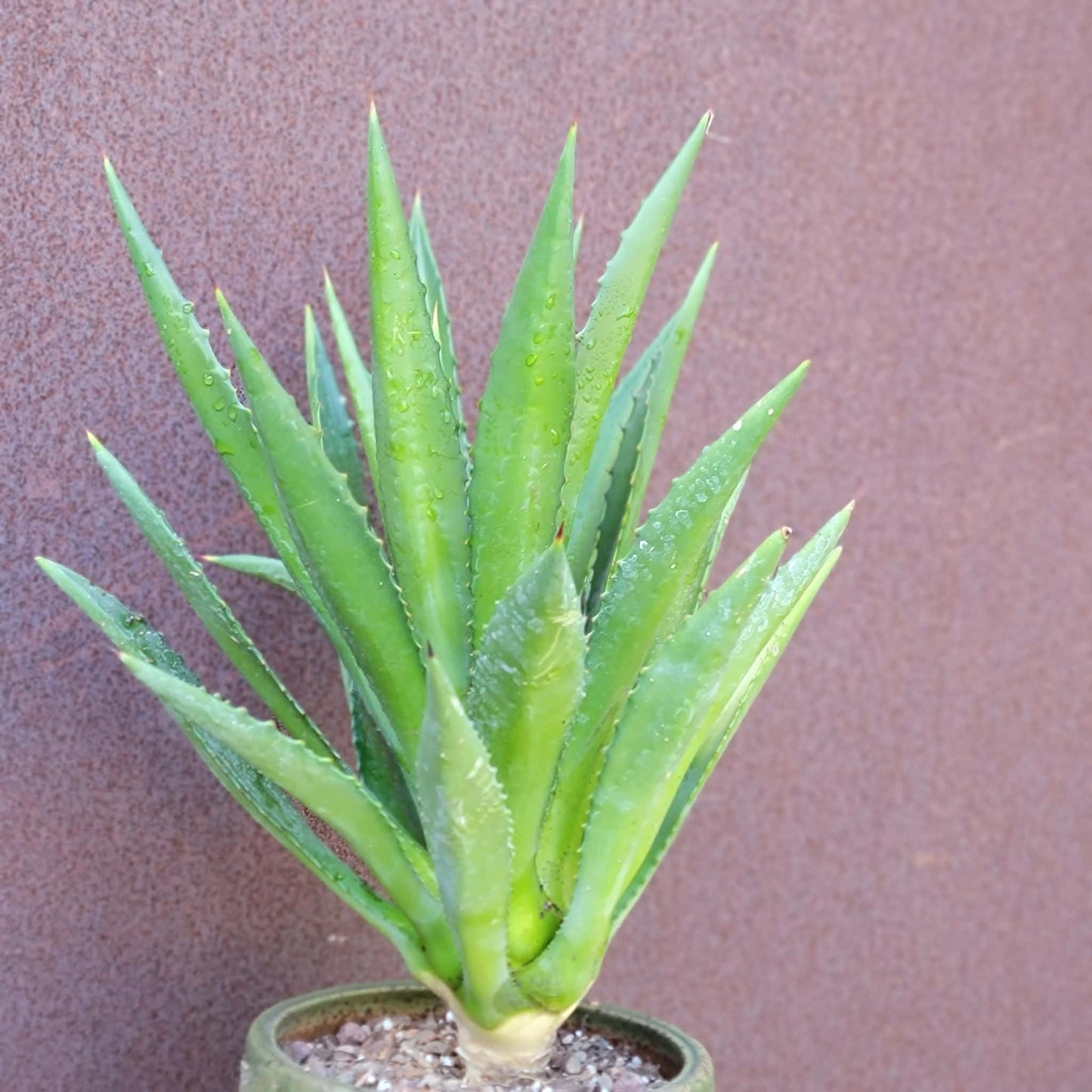
Agave decipiens - False Sisal
You will receive theexact, BIG specimen shown here.
Measures 17" tall x 15" wide.
Showcased here in one-of-a-kind handmade pottery (sold separately).
Well established roots (see photo).
Will be shipped bare root.
Agave decipiens, commonly known as False Sisal or Florida Agave, is a striking, arborescent (tree-like) succulent native to the coastal regions of southern Florida. It is admired for its architectural form, drought tolerance, and the fiber it produces, which is similar to true sisal.
DESCRIPTION and CHARACTERISTICS:
- Appearance: It forms a tight, symmetrical rosette of thick, fleshy, bright to blue-green leaves that can reach 3 to 6 feet in height and 5 to 10 feet in width. Unlike most agaves, it can develop a bare trunk up to 10 feet tall.
- Leaves: The long, spreading to recurved leaves have wavy margins with small, sharp, dark brown teeth and a conical dark brown spine at the tip.
- Flowering: Like other agaves, it is monocarpic, meaning it flowers only once in its lifetime, typically after several years (sometimes as many as 7 to 20 years). It produces a tall flower stalk (scape) up to 10 to 15 feet high with greenish-yellow flowers in late fall or early winter, after which the main rosette dies.
- Propagation: It spreads readily by producing numerous offsets ("pups") at the base and from bulbils on the flower stalk, ensuring the plant persists after the mother plant flowers and dies.
- Toxicity: The plant's juice, sap, and thorns can cause a skin rash or irritation, and it can be toxic to humans and pets if ingested.
CULTIVATION and CARE:
- Light: Thrives in full sun to light shade, with shade leading to larger, deeper green leaves.
- Watering: Extremely drought-tolerant once established and requires low to occasional water. The soil should be allowed to dry completely between waterings to prevent root and crown rot.
- Soil: Needs extremely well-drained, gritty, sandy, or rocky soil. It is highly salt-tolerant, making it suitable for coastal landscapes.
- Temperature and Humidity: Best suited for USDA hardiness zones 9a to 11. It handles hot, humid locations well but does not tolerate frost or standing water.
- Maintenance: It is a low-maintenance plant and generally resistant to pests and diseases.
USES:
- Ornamental: Its dramatic and architectural form makes it a popular choice for containers, raised planters, rock gardens, and xeriscaping.
- Fiber: The plant is valued for its fiber, which is similar to true sisal (Agave sisalana), a characteristic that likely contributed to its common name. The specific name decipiens means "deceiving," possibly alluding to its resemblance to true sisal.
- Wildlife: It is a larval host for the Yucca Giant Skipper and Cofaqui Giant Skipper butterflies.